Need help?
Do you have a question about the KPI-JCI FT3055 and is the answer not in the manual?
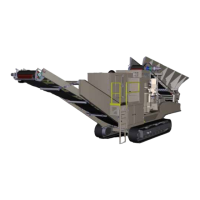
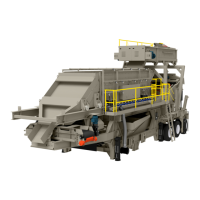
Details operation and maintenance for the FT3055 Jaw Crusher.
Explains the manual's objective to maximize equipment value and provide maintenance info.
Describes how the manual is structured into chapters and sections.
Explains signal words (DANGER, WARNING, CAUTION, IMPORTANT) used for hazards.
Identifies serial number plate locations on key components.
Locates the plant's serial number for service and parts ordering.
Identifies authorized dealers as the primary source for parts.
Emphasizes the necessity of serial numbers for correct part identification.
Lists essential tools for operation and maintenance.
Covers fastener types, condition, and replacement best practices.
Details the recommended grease for bearings and pivot points.
Specifies the recommended hydraulic oil and alternatives for temperature variations.
Outlines procedures to minimize corrosion and deterioration during storage.
Specific procedures for machines stored for six months or longer.
Lists overall dimensions, weights of components, and travel specifications.
Details jaw opening, width, depth, RPM, stroke, and weight of crusher parts.
Explains plant orientation and introduces key components like the jaw crusher.
Describes the base, pitman, tension rods, side liners, flywheels, and eccentric shaft.
Explains the hydraulic system's components, closed loop, and open loop functions.
Emphasizes personal safety, accident prevention, and hazard recognition.
Explains the meaning of DANGER, WARNING, CAUTION, and NOTICE signals.
Details the principles and steps involved in lockout/tagout procedures.
Explains the crusher's function, material reduction, and feed size limitations.
Details how to calculate CSS based on jaw dies and material strength.
Covers site clearing, ground compaction, leveling, and drainage considerations.
Explains the importance of presizing material and identifying uncrushable items.
Provides a step-by-step guide for starting the engine safely.
Outlines the steps for safely shutting down the engine and plant.
Discusses factors affecting cold weather operation and recommended lubricants.
Provides starting aid recommendations based on temperature categories and altitude.
Step-by-step instructions for safely unloading the plant from a trailer.
Details the procedure for adjusting the jaw crusher's open side setting.
Describes the location and function of various hydraulic control valves.
Explains operation via tethered control or radio remote receiver.
Explains how the system monitors engine data and maintains plant functions.
Displays engine functions, alerts, and maintenance indicators.
Shows engine load, crusher pressure, and feeder speed parameters.
Details the hydraulic system for track drives, including pumps and motors.
Explains the hydraulic circuit for the crusher drive, including accumulators.
Procedure for setting relief pressure for proper spring compression.
Steps to synchronize the auto adjust system for tension rod nuts.
Procedure for adjusting track tension to prevent frame damage.
Instructions for adjusting the timing gears on the vibrating feeder.
Lists tools and critical notes for removing the undercrusher conveyor.
Detailed instructions for detaching and removing the undercrusher conveyor.
Daily walk-around inspection checklist for potential problems.
Inspects jaw dies for wear and determines if reversal or replacement is needed.
Procedure for servicing the air cleaner unit.
Explains jaw die maintenance, reversal, and replacement procedures.
Steps for removing and replacing worn side liners.
Lubrication points and procedure for vibrating feeder bearings.
Procedure for lubricating head and tail pulley bearings.
Guidelines for changing oil in the Durst gear box.
Procedures for checking hydraulic oil level and identifying condensation.
Guidance on checking and replacing the hydraulic system filter.
Instructions for draining, flushing, and refilling the hydraulic oil tank.
Overview of emission standards adopted since 1996.
Provides specific emissions data for CAT C13 engines.
Tables showing capacities for series 2, 11, and 13 conveyors.
Diagrams illustrating hydraulic system configurations for conveyors.
Step-by-step procedure for starting up closed loop hydraulic circuits.
Instructions for adjusting hydraulic relief pressure for various functions.
Lists PLC parameters for the overload protection system (FT3055).
Provides a reference for CAT engine diagnostic codes (SPN/FMI).
Procedure for using a sonic belt tester to measure belt tension.
Method for measuring v-belt tension using a tension gauge.
Guidelines and procedures for welding lifting lugs to jaw manganese.
Checklist for ensuring the equipment is in operational condition before use.
Step-by-step guide for starting the machine.
Steps for safely shutting down the machine.
 General
| Brand | KPI-JCI |
|---|---|
| Model | FT3055 |
| Category | Industrial Equipment |
| Language | English |


 To Next Page