This document describes the Kramer Electric Defrost Evaporators, specifically models LPE, LVE, MSE, CSE, HSE, CED, and KED. These evaporators are designed for commercial refrigeration applications, particularly in walk-in freezers and cold rooms.
Function Description:
The primary function of these evaporators is to extract heat from refrigerated spaces and facilitate the defrosting of accumulated frost on the coil. They utilize electric defrosting, which involves heating elements to melt frost, ensuring efficient operation and maintaining desired room temperatures. The units are designed to work with various refrigerants, including R-22, R-404A, and R-507, as indicated by the recommended line size tables.
Important Technical Specifications:
- Temperature Ranges:
- LPE, CSE, MSE models: Recommended for room temperatures down to -20°F.
- CED, KED models: Recommended for room temperatures down to -30°F.
- HSE models: Recommended for room temperatures down to -10°F.
- LVE (Low Air Velocity) models: Recommended for 28°F to 34°F rooms, ideal for meat holding due to gentle air flow.
- Fan Types:
- CED and KED models: Available with D-type, direct drive fans as standard, or optional PP-type, high output cast aluminum pressure propeller fan blades.
- Other models may use shaded pole or PSC motors with varying wattages (9W, 16W) and fan blade pitches (20°, 31°).
- TD (Temperature Difference) Limitations:
- Medium temperature systems: Limited to 16° TD MAXIMUM.
- Low temperature systems: Limited to 11° TD MAXIMUM, with most operating efficiently at 8° to 10° TD. Higher TD leads to faster frost accumulation and more frequent defrosts.
- Electrical Specifications:
- Units operate on 208/230V or 460V, single-phase or three-phase power, depending on the model and motor.
- Heater voltages are typically 230V for LPE, MSE, CSE, HSE, and LVE models, and 115V or 230V for CED and KED models.
- Capacitors are specified for PSC motors (e.g., 2 MFD, 4 MFD, 7.5 MFD).
- Line Sizing: Detailed tables provide recommended copper tube sizes (O.D. Type L, ACR, or RS) for suction and liquid lines based on BTUH capacity, suction temperature, and equivalent line length (30', 60', 100'). These tables are designed for a maximum 2°F equivalent pressure loss.
- Defrost Termination: Standard defrost termination controls (e.g., 103079010) and fan delay controls (e.g., 103079009) are specified. Adjustable DTFD (Defrost Termination Fan Delay) is standard on CED-KED models.
Usage Features:
- Installation: Requires certified and experienced commercial refrigeration technicians. Proper piping, wiring, and mounting are critical.
- Piping: All piping must be clean, dry, and capped. Dry nitrogen flow is recommended during brazing. Suction lines should slope a minimum of 1/4 inch per foot, with "P" traps at risers and 15-foot intervals. Liquid-suction line heat exchangers are highly recommended for electric defrost systems.
- Expansion Valves: Kramer supplies expansion valves with each evaporator. Proper sizing and secure bulb clamping (4 or 8 o'clock position) are essential to prevent hunting and floodback. Superheat adjustment is typically 6° to 12°F, with 6° to 8° for low-temperature evaporators.
- Drain Line: Must run directly from the evaporator, pitched a minimum of 4 inches per foot, and be as large as or larger than the drain pan connection. Traps are required where ambient temperature is above 33°F and must be heated and insulated to prevent freezing.
- Evaporator Location: Units should be positioned to ensure good air circulation throughout the room and product. Obstructions to airflow, such as walls, ceilings, or stacked product, should be avoided. Minimum clearances from walls, other units, and the floor are provided in detailed diagrams and tables.
- Start-up: A thorough leak test and evacuation are mandatory. The control circuit should be energized 12-24 hours before charging to open the liquid line solenoid and activate the crankcase heater. Manual defrosts may be necessary during initial pull-down in new rooms with high moisture levels.
- Defrost Timer Adjustment: Typically, 2 to 4 defrosts per day are sufficient, but up to 6 may be needed for heavy frost loads. The timer fail-safe setting for electric defrost evaporators is usually 30 to 40 minutes, with 6 to 10 minutes beyond normal termination time.
Maintenance Features:
- Regular Cleaning: Evaporators, fan blades, and guards should be checked and cleaned periodically to remove dirt or grease. The drain pan and connection must be kept clean and clear. Coils should be power washed if dirty.
- Safety: Always disconnect all power sources before servicing. Exercise caution when uncrating due to sharp edges and staples.
- Troubleshooting: The "System Operation Check List" (page 10) is provided to help diagnose problems and document service records.
- Replacement Parts: A comprehensive list of replacement parts is provided, including motor types, fan blades, fan guards, defrost termination controls, and heater elements, along with their part numbers, voltages, and wattages. When ordering, the evaporator model number, serial number, and a complete description of the part are required.

 Need help?
 General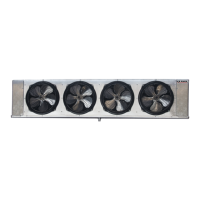

 To Next Page