The Kramp Universal Electronic Driver Type KRED is a microcontroller-designed device for controlling solenoid-operated proportional valves. It is available in two versions: KRED-S for single solenoid proportional valves and KRED-D for double solenoid proportional valves. This driver is designed for easy assembly directly onto the DIN rail of an electrical cabinet.
Function Description:
The KRED driver controls the output current to a proportional valve's solenoid based on an analog input signal. It offers independent adjustments for ramp-up and ramp-down times, allowing for precise control of valve opening and closing speeds. The device features a 4-digit LED display that shows actual values (current and voltage) and provides easy access to the menu setup for parameter configuration.
The driver's operation is highly configurable through two selectors, eliminating the need for special tools or programming devices. It can accept various input signals, including 0-5V, 0-10V, and 4-20mA. For KRED-D, an additional input range of -10V to 10V is available when the DIP switch is in the OFF/Down position.
Key parameters that can be adjusted include:
- Hi (High, Maximum Current Output): Sets the maximum output current, ranging from 0.20 A to 3.00 A.
- Lo (Low, Minimum Current Output): Sets the minimum output current, ranging from 0.00 A to 2.99 A.
- rUP (Ramp Up): Configures the time for the output to increase from minimum to maximum, with a range of 0.0 to 99.5 seconds.
- rdn (Ramp Down): Configures the time for the output to decrease from maximum to minimum, with a range of 0.0 to 99.5 seconds.
- Cdb (Command Deadband): Defines a deadband percentage (0-5%) where the output is disabled if the command signal is below this threshold.
- JC (Joystick Calibration / Input Offset Compensation): Adjusts the midpoint between 'a' and 'b' at 50% for joystick calibration, ranging from 40-50-60%.
- dFr (Dither Frequency): Sets the dither frequency, which can be adjusted from 40 Hz to 450 Hz.
- in (Input Signal Selection): Selects the type of input signal (5V, 10V, or 420mA). For KRED-D, -10V is also an option.
- di (Displayed Signal for Troubleshooting): Allows selection of the displayed signal (command signal [V] or [mA], or output signal [A]) for troubleshooting. A flashing decimal point indicates the present display mode (fast for di=0, slow for di=1, no flash for setting/adjust mode).
The driver is fully functional during the setup procedure, with adjustments taking effect immediately. New settings can be saved to memory by rotating "SELECT" until "SR" is displayed, then rotating "ADJUST" from 0 to 1, or by waiting 100 seconds. If settings are not saved, they will revert to previous values after 100 seconds or if power is disconnected. Factory settings can be restored by rotating "SELECT" to "rFP" and then "ADJUST" up past 10.
Important Technical Specifications:
- Operating Voltage: 9-36 V DC
- Maximum Output Current: 3.00 A
- Input Signal: 0-5 V, 0-10V, 4-20 mA (KRED-S); 0-5 V, 0-10V, 4-20 mA, -10V to 10V (KRED-D)
- Maximum Ramp Time: 99.5 s
- Linearity: 40-450 Hz
- Operating Temperature: -40 to 80 °C
- Mounting: DIN rail (open)
- Dimensions: Approximately 31mm (width) x 76mm (height) x 59mm (depth).
Usage Features:
- User-Friendly Interface: The 4-digit LED display and two selectors (ADJUST and SELECT) provide an intuitive way to monitor and configure parameters without external programming tools.
- Wide Ramp Time Range: Offers a broad range for ramp-up and ramp-down times (0.0 to 99.5 seconds), allowing for fine-tuned control of valve dynamics.
- Analog Input Control: Simple control through standard analog input signals (0-5V, 0-10V, 4-20mA, and -10V to 10V for KRED-D).
- Locally Supplied Reference Voltage: Provides a local reference voltage for input signals.
- Live Connection/Disconnection: The load can be connected and disconnected while the device is live.
- EMC Compliance: Designed and tested to meet specific standards outlined in EMC 2004/108/EC, Emission: EN 61000-6-4:2007, and Immunity: EN 61000-6-2: 2005, EN 61000-4-2, EN 61000-4-4, EN 61000 4-6.
Maintenance Features:
- Error Detection State (Err): The device includes error detection for short circuits and reverse polarity protection.
0: No errors.1: Overcurrent in the driver, likely due to a short circuit in the solenoid.2: Current exceeding 20 mA in 4-20 mA input mode.
- Clear Error (CLr): Allows clearing of the driver or error state.
- No Heat Sink Required: Simplifies installation and reduces potential maintenance related to thermal management.
- Electronic Limiting Circuit/Short Circuit Proof: Enhances durability and protects the device from electrical faults.
- Reverse Polarity Protection: Safeguards the device from damage due to incorrect power supply connection.
- Command Input Protection: Protects the command input from potential damage.
For command input drivers (0 to 5 VDC and 0 to 10 VDC), it is recommended to use independent negative conductors for the power supply and analog output channel (PLC/PC) to maintain command signal accuracy, especially over long cable runs, to mitigate voltage drop.

 Need help?
 General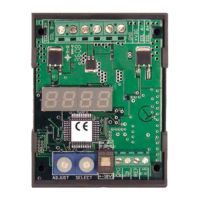

 To Next Page