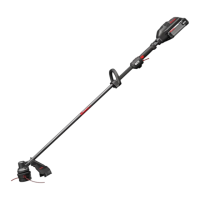
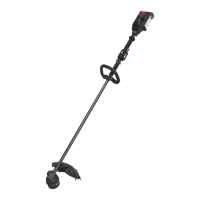
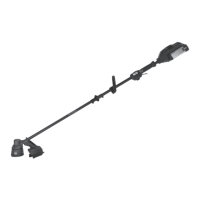
This document is a safety and operating manual for the Kress Cordless Grass Trimmer, models KG160E and KG160E.X. It provides essential information for safe operation, maintenance, and technical specifications of the device.
Function Description:
The Kress Cordless Grass Trimmer is designed for cutting grass and similar soft vegetation, as well as for trimming grass edges in private and hobby garden areas that are inaccessible with a lawnmower. It is not intended for use in public gardens, parks, sports centers, roadsides, agriculture, or forestry. The device is also explicitly not allowed for cutting or chopping hedges, shrubs, bushes, flowers, or for composting purposes, as doing so carries a risk of injury. The trimmer operates with a bump-line feed system, where new line feeds out by bumping the trimmer head while the machine is running. It also features an ECO speed mode for longer run time, which operates the machine at a lower speed.
Important Technical Specifications:
The models covered are KG160E and KG160E.X.
- Voltage: 60 V⎓ Max (Nominal voltage is 54 volts).
- No-load speed: 6000 /min.
- Cutting Diameter: 38 cm.
- Line Diameter: Recommended 2.4mm twist line.
- Line Length: Recommended 4m (Dual-Exit).
- Machine Weight (bare tool): 3.0 kg.
- Typical weighted vibration (aₕ): 5.326 m/s².
- Uncertainty (K): 1.5 m/s².
- A-weighted sound pressure (LpA): 74 dB(A).
- Uncertainty (KpA): 0.8 dB(A).
- A-weighted sound power (LwA): 94.8 dB(A).
- Uncertainty (KwA): 0.8 dB(A).
- Ambient temperature range for tool and battery use/storage: 0°C-45°C.
- Recommended ambient temperature range for charging system: 5°C-40°C.
Suggested Batteries and Chargers:
- 60V Battery: KA3000 (2.0 Ah) and KA3002 (4.0 Ah).
- 60V Charger: KA3714 (5.0 A).
It is recommended to purchase accessories from the same store where the tool was bought.
Usage Features:
- Assembly: The manual details the assembly of the auxiliary handle, safety guard, and shoulder strap. The auxiliary handle should be adjusted between the soft sleeve and the label to ensure the front arm is straight during use.
- Battery Installation/Removal: The battery pack slides into the compartment until a click is heard and is released by pressing the battery release button.
- Starting/Stopping: The trimmer is started by pressing the lock-off button first, then the switch trigger. It is crucial to wait until the cutting head completely stops rotating after switching off before laying down the tool.
- ECO Speed: An ECO button allows operation at a lower speed for extended run time.
- Cutting Tips: For effective trimming, the trimmer should be moved from left to right. Only the tip of the cutting line should be used, and the trimmer head should not be forced into uncut grass. Users are advised to avoid wire and picket fences, stone and brick walls, curbs, wood, trees, shrubs, and fence posts, as these can cause rapid line wear, breakage, or damage to the cutting line and surfaces.
- Backpack Harness: The manual describes how to use a backpack harness by inserting the battery pack into the harness, connecting the battery adapter to the trimmer, and then connecting the harness to the trimmer with the provided cord. More details are available in the backpack harness's manual.
- Trimmer Head Maintenance: Instructions are provided for assembling/removing the trimmer head using a hex key, winding new line onto the spool, and replacing the spool. For winding, replacement line should be inserted through the eyelet, ensuring both ends are even (recommended 2m each), and then the dial is turned clockwise to wind the line until about 19cm remains on each side.
Maintenance Features:
- General Maintenance: Always disconnect the machine from the power supply (remove the battery pack) before any maintenance or cleaning. Only manufacturer-recommended replacement parts and accessories should be used. The machine should be inspected and maintained regularly by an authorized repairer.
- Cleaning: Aggressive detergents or solvents should not be used. The machine should be cleaned with a moist cloth dipped in neutral detergent. The socket must be kept free of foreign matters and cleaned with a soft, dry brush or cloth. Water should not be sprayed onto the motor or electrical components, and pressure washers should not be used.
- Battery Pack Care:
- Do not dismantle, open, or shred cells or battery packs.
- Avoid short-circuiting battery packs; store them away from conductive materials.
- Do not expose battery packs to heat, fire, or direct sunlight.
- Do not subject battery packs to mechanical shock.
- In case of battery leakage, avoid contact with skin or eyes; wash affected areas with water and seek medical advice.
- Keep battery packs clean and dry.
- Wipe terminals with a clean, dry cloth if dirty.
- Charge battery packs before use, following the correct charging procedure.
- Do not maintain battery packs on charge when not in use.
- After extended storage, charge and discharge the battery pack several times for maximum performance.
- Recharge only with the specified Kress charger (KA3714).
- Do not use battery packs not designed for the equipment.
- Keep battery packs out of reach of children.
- Retain original product literature for future reference.
- Remove the battery from the equipment when not in use.
- Dispose of batteries properly; do not mix cells of different manufacture, capacity, size, or type.
- Keep batteries away from microwaves and high pressure.
- Non-rechargeable batteries should not be used.
- Storage: Remove the battery pack before storage. Store the trimmer in a dry, secure place inaccessible to children and unauthorized persons.
- Troubleshooting: A table is provided to help identify common problems (e.g., trimmer fails to operate, intermittent running, excessive vibrations/noise, short cutting time, machine not cutting) and their possible causes and corrective actions. These actions include recharging the battery, allowing it to cool/warm, contacting service agents, rewinding the line, cutting grass in stages, and replacing the battery or line.
- Vibration Exposure: Users are advised to minimize vibration exposure by using sharp chisels, drills, and blades, maintaining the tool, and investing in anti-vibration accessories if used regularly. Work schedules should be planned to spread high vibration tool use across multiple days.
- Safety Warnings: Emphasizes reading all safety warnings and instructions to prevent electric shock, fire, and serious injury. Always wear eye protection and stout shoes. Never operate the machine while people, children, or pets are nearby. Never operate with damaged or missing guards/shields. Disconnect power before clearing blockages, checking/cleaning the machine, after striking foreign objects, or if the machine vibrates abnormally. Do not overreach and maintain balance. Do not touch moving hazardous parts until they have completely stopped.

 To Next Page


 General