Need help?
Do you have a question about the Kuat Racks TRANSFER 3 and is the answer not in the manual?
List of all hardware components provided with the product.
Visual catalog of all included parts for assembly.
Identification of tools provided for assembly.
Attaching the front tire cradle to the main frame.
Attaching the rear tire cradle to the main frame.
Securing the pivot puck with pre-installed nuts.
Assembling the 'A' version of the tire hook arm.
Mounting the assembled Tire Hook Arm A onto the pivot puck.
Assembling the 'B' version of the tire hook arm.
Assembling the 'C' version of the tire hook arm.
Mounting the hitch shank with pivot bolt and nut.
Securing the rack assembly into the vehicle's hitch receiver.
Verify hardware tightness, rack security, and lever engagement.
Position rear cradle and tighten strap evenly for tire fit.
Position tire hook near fork and ratchet down tightly.
Flip locator tab for bike pitch adjustment or interference.
Understanding rack pivot for travel and trunk access.
Kit for use with wider tires and compatible racks.
Kit includes hitch lock and cable locks for security.
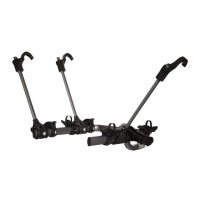
The Kuat Transfer 3 is a bicycle rack designed for vehicle attachment, capable of transporting up to three bicycles. Its primary function is to securely hold bicycles during transport, offering features that enhance ease of use and versatility.
The Transfer 3 rack is engineered to mount to a vehicle's hitch receiver, providing a stable platform for carrying bicycles. It utilizes a combination of tire cradles and adjustable hooks to secure each bike, ensuring minimal movement and protection during transit. The rack's design allows for the transport of various bicycle types and sizes, accommodating different wheelbases and tire widths. A key functional aspect is its ability to pivot, allowing users to access the vehicle's trunk or hatch without removing the bicycles or the entire rack. This pivot mechanism is designed for quick and easy operation, enhancing convenience for users. The rack also incorporates a hitch bolt and cotter pin system for a secure connection to the vehicle's hitch, minimizing wobble and ensuring a stable ride.
The Transfer 3 offers several features aimed at simplifying the loading, unloading, and transport of bicycles.
Tire Cradles: The rack includes front and rear tire cradles for each bicycle. These cradles are designed to support the bike's wheels, distributing weight and providing a foundational hold. The front tire cradles can be adjusted in position along the rack's arms to accommodate different bicycle lengths. A unique feature of the front tire cradle bolt is its locator tab, which can be flipped upside-down. This adjustment allows users to modify the pitch of the bike on the rack, which can be crucial for achieving a better fit, especially for bikes with unique frame geometries, or to eliminate interference when carrying multiple bikes. The rear tire cradles are also adjustable, allowing users to fine-tune their position to fit the specific tire size and wheelbase of each bike.
Tire Hook Arms: Each bike is secured by a tire hook arm that ratchets down onto the front wheel. These arms are designed to hold the bike firmly in place by applying pressure to the tire, preventing vertical and lateral movement. The arms are adjustable in height, allowing them to accommodate various wheel sizes and bike frame designs. The instruction manual distinguishes between different tire hook arms (A, B, C) for specific positions on the rack, emphasizing the use of arms without decals for assembly. This suggests a tailored design for optimal performance in each position.
Tire Straps: In addition to the tire hook arms, tire straps are provided to further secure the rear wheels within their cradles. These straps thread through ratchets, allowing users to tighten them evenly around the tire. This dual-point securing system (hook arm on the front wheel, strap on the rear wheel) ensures that the bicycle remains stable and secure throughout the journey.
Pivot Mechanism: A significant usage feature is the rack's ability to pivot. This mechanism allows the entire rack, with or without bikes loaded, to tilt away from the vehicle. This is particularly useful for accessing the vehicle's trunk or hatch without the need to unload the bikes or detach the rack from the hitch. The pivot lever is designed for full engagement, ensuring the rack is securely locked in either the upright travel position or the tilted access position.
Hitch Compatibility: The Transfer 3 is designed to be compatible with common hitch receiver sizes. For 1-1/4" hitches, a 2" hitch adapter can be removed, indicating its versatility across different vehicle setups. The hitch shank is installed with a pivot bolt and nut, and the hitch bolt is secured with washers and a cotter pin, ensuring a robust and stable connection to the vehicle.
Loading and Unloading: The design prioritizes ease of loading. Bicycles are placed into the tire cradles, the tire hook arm is brought down and ratcheted tightly onto the front tire, and the rear tire is secured with a strap. The process is designed to be straightforward, allowing users to quickly and efficiently load and unload their bikes.
Accessories: The manual highlights optional accessories that enhance the rack's functionality. A "Phat Bike Kit" is available for users with wider tires (2.75-4.25" width), indicating the rack's adaptability to specialized bicycles. This kit is compatible with both Transfer and NV racks. Additionally, a "Lock Kit" (available for Transfer2 and Transfer3 models) includes a hitch lock and cable locks, providing added security for both the rack and the bicycles during transport or when parked.
While the manual primarily focuses on assembly and usage, some aspects imply maintenance considerations:
Hardware Tightening: A crucial maintenance instruction is to ensure "ALL HARDWARE IS TIGHTENED" before attempting to load a bicycle. This emphasizes the importance of regular checks to maintain the rack's structural integrity and safety. Users are expected to periodically inspect and tighten all bolts and nuts to prevent loosening due to vibrations during travel.
Component Inspection: The assembly process involves numerous bolts, nuts, spacers, and pivot pucks. Regular inspection of these components for wear, damage, or corrosion would be an implicit maintenance task to ensure the rack's longevity and safe operation. For example, the pivot pucks, which contain pre-installed nuts, should be checked to ensure they are facing out correctly and are not damaged.
Tire Strap and Ratchet Care: The tire straps and ratchets are critical for securing the bikes. Users should inspect these components for fraying, cracks, or any signs of wear that could compromise their ability to hold the bike securely. Keeping the ratchets clean and free of debris would also contribute to their smooth operation and lifespan.
Cleaning: Although not explicitly stated, general cleaning of the rack, especially after exposure to dirt, mud, or road salt, would be beneficial for maintaining its appearance and preventing corrosion of metal components.
Lubrication: Moving parts, such as the pivot mechanism and ratchet components, might benefit from occasional lubrication to ensure smooth operation and prevent seizing, although specific instructions for this are not detailed in the provided pages.
In summary, the Kuat Transfer 3 is a user-friendly and versatile bicycle rack designed for secure and convenient transport of multiple bikes, with an emphasis on adjustable components and vehicle access. Its maintenance primarily revolves around ensuring all hardware remains tightened and inspecting components for wear.
 General
| Capacity | 3 bikes |
|---|---|
| Weight Capacity (per bike) | 40 lbs |
| Weight Capacity (total) | 120 lbs |
| Folding | Yes |
| Tilt Feature | Yes |
| Material | Steel |
| Ramp Included | No |
| Hitch Size | 2-inch |
| Bike Tire Compatibility | Up to 5 inches wide |
| Integrated Lock System | Yes |

 To Next Page