
 Need help?
Do you have a question about the KÜBLER SPORT OxyCycle 3 and is the answer not in the manual?
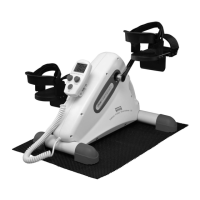
The device described in this manual is the Kübler Sport Oxycycle III Pedal Exerciser, a rehabilitation and exercise aid designed for both active and passive (motor-assisted) use. It is primarily intended to facilitate leg and arm exercises, promoting circulation, muscle strength, and flexibility. The compact design allows for use in various settings, such as on a table for arm exercises or on the floor for leg exercises.
The Oxycycle III Pedal Exerciser operates with an electric motor, providing assistance during exercise, which is particularly beneficial for users with limited mobility or those undergoing rehabilitation. It features two main modes of operation: active mode and passive mode.
In active mode, the user powers the pedals, and the device offers adjustable resistance. This mode is suitable for users who can actively pedal and wish to build strength and endurance. The resistance levels can be set from 0 to 5 using a dedicated resistance control knob. It is crucial to ensure the speed control knob is in the "off" position before adjusting the resistance. Once the resistance control knob is turned on, the device operates exclusively in active mode, and the speed control knob should not be engaged.
In passive mode (motor-assisted), the device's motor moves the pedals, allowing users to experience a gentle, continuous motion without expending significant effort. This mode is ideal for passive rehabilitation, improving joint mobility, and stimulating circulation. Users can set the desired speed using the speed control knob. Similar to active mode, the resistance control knob must be set to the "off" (0 level) position before engaging the speed control knob for passive exercise. The device incorporates an overload protection mechanism. If excessive force is applied or pedaling occurs at speeds significantly higher than the motor's set speed, the motor will temporarily stop to prevent damage. This protective shutdown lasts for 2-3 seconds before the motor automatically restarts. If the motor overload situation persists and the motor stops and restarts 10 times, it will cease operation completely to prevent equipment damage. In such an event, a "STOP" sign will flash on the controller screen, accompanied by an 8-second alarm, prompting the user to turn the speed control knob to the "off" position and then restart the device.
The device is equipped with a wired controller that allows users to manage its functions, including adjusting resistance or speed, and monitoring exercise parameters. The controller is connected to the main unit via a coiled cable, providing flexibility in placement during use.
The Oxycycle III Pedal Exerciser is designed for ease of use, with clear instructions for setting up and operating the device.
The manual provides detailed, step-by-step instructions for various maintenance and repair procedures, indicating that certain components are designed to be replaceable. This approach supports the device's longevity and allows for troubleshooting common issues. Key maintenance features include:
These detailed maintenance instructions suggest that the Oxycycle III Pedal Exerciser is designed for maintainability, allowing users or technicians to perform component replacements and extend the life of the device.
 General
| Resistance Levels | 16 |
|---|---|
| Display | LCD |
| Pulse Measurement | Hand pulse sensors |
| Transport Wheels | Yes |
| Type | Ergometer |
| Display Functions | Time, Speed, Distance, Calories, Pulse, RPM |
| Seat Adjustment | Vertical |

 To Next Page