EasyManua.ls Logo

Kubota M8540 Narrow - User Manual

Kubota M8540 Narrow
110 pages
Print Icon
To Next Page IconTo Next Page
Loading...
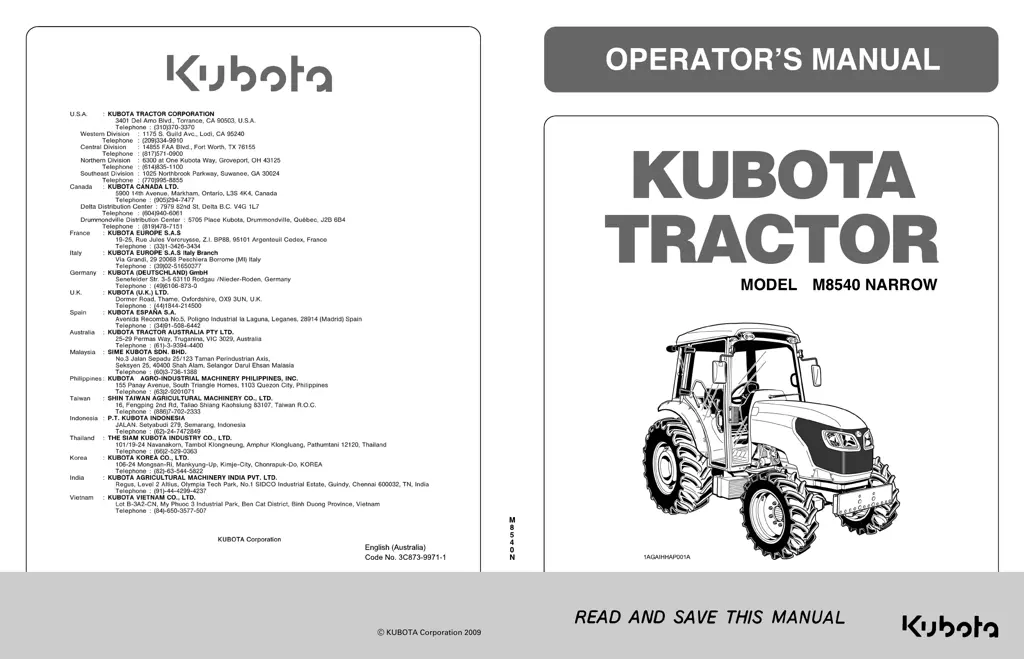
PRINTED IN JAPAN
English (Australia)
Code No. 3C873-9971-1
M
8
5
4
0
N
TRACTOR
OPERATORÕS MANUAL
MODEL M8540 NARROW
©
KUBOTA Corporation 2009

Table of Contents

Questions and Answers

  • D
    David MeyersAug 4, 2025
    What to do if my Kubota M8540 Narrow engine overheats?
    • V
      Victor VelezAug 4, 2025
      If your Kubota Tractor engine overheats, several factors could be responsible. First, the engine might be overloaded, so shift to a lower gear or reduce the load. A low coolant level could also be the culprit, so fill the cooling system to the correct level and inspect the radiator and hoses for leaks. A loose or defective fan belt can cause overheating, so adjust or replace the fan belt. A dirty radiator core or grille screens can restrict airflow, so remove any debris. Finally, corrosion in the coolant flow route can lead to overheating, so flush the cooling system.
  • R
    Regina MercadoAug 8, 2025
    Why are the exhaust fumes colored in my Kubota M8540 Narrow?
    • J
      Jessica MartinezAug 8, 2025
      Colored exhaust fumes from your Kubota Tractor can indicate different issues. Black fumes suggest you should change the fuel and fuel filter, check the oil level, and clean or replace the air cleaner element. Blue-white fumes suggest checking if the intake air heater functions in cold weather, heating the muffler by applying a load to the engine, inspecting the injection nozzle, and changing the fuel and fuel filter.
  • M
    Misty ReyesAug 13, 2025
    What to do if Kubota M8540 Narrow engine overheats?
    • B
      Benjamin FarmerAug 13, 2025
      If your Kubota Tractor engine overheats, several factors could be responsible. First, the engine may be overloaded, so shift to a lower gear or reduce the load. Second, the coolant level might be low, so fill the cooling system to the correct level and inspect the radiator and hoses for leaks. A loose or defective fan belt could also be the cause, requiring adjustment or replacement. Additionally, a dirty radiator core or grille screens can restrict airflow; remove any trash. Finally, the coolant flow route may be corroded, necessitating a flush of the cooling system.
  • E
    elizabethashleyAug 17, 2025
    How to fix insufficient engine power in my Kubota Tractor?
    • Z
      zholtAug 17, 2025
      If your Kubota Tractor has insufficient engine power, it could be due to insufficient or dirty fuel, or a clogged air cleaner. Check the fuel system and clean or replace the air cleaner element.
  • C
    Carolyn MaciasAug 21, 2025
    Why are exhaust fumes colored on my Kubota M8540 Narrow?
    • L
      Lindsey CoxAug 21, 2025
      Colored exhaust fumes from your Kubota Tractor can indicate different issues. Black fumes suggest poor fuel quality, too much oil, or a clogged air cleaner. In this case, change the fuel and fuel filter, check the oil level, and clean or replace the air cleaner element. Blue-white fumes may indicate fuel in the exhaust muffler, injection nozzle trouble, or poor fuel quality. Check the intake air heater function in cold weather, heat the muffler by applying load to the engine, inspect the injection nozzle, and change the fuel and fuel filter.
  • J
    John McbrideAug 26, 2025
    What to do if my Kubota Tractor engine stops suddenly?
    • D
      Daniel HerringAug 26, 2025
      If your Kubota Tractor engine stops suddenly, it may be due to insufficient fuel. Refuel and bleed the fuel system if necessary.
  • J
    James ShortOct 30, 2025
    Why is my Kubota Tractor engine difficult to start?
    • D
      driveraOct 30, 2025
      There are several reasons why your Kubota Tractor engine might be hard to start. It could be due to no fuel flow, so check the fuel tank and fuel filter, replacing the filter if needed. Air or water in the fuel system could also be the cause; ensure the fuel line coupler bolt and nut are tight and bleed the fuel system. In cold weather, the oil viscosity may increase, slowing the engine revolution; consider using oils of different viscosities or an engine block heater. A weak battery can also prevent the engine from turning over quickly enough; clean the battery cables and terminals, charge the battery, and in cold weather, remove the battery, charge it, and store it indoors until use. Finally, there could be an issue with the intake air heater system; check the slow blow fuse and ensure t...

Summary

Universal Symbols

Foreword

Safety First

Instrument Panel and Controls

Instrument Panel, Switches and Hand Controls

Identification and location of controls and instruments on the dashboard.

Fuel Gauge

How to read the fuel gauge and avoid running out of fuel.

Coolant Temperature Gauge

Monitoring the engine coolant temperature indicator.

Tachometer

How to read the tachometer for engine speed indication.

PTO RPM; Travel Speed Monitor

Display modes for PTO speed and travel speed monitoring.

Foot and Hand Controls

Identification of essential foot and hand operated controls.

Safe Operation

Before Operating the Tractor

Essential checks and awareness before starting tractor operation.

CAB, ROPS

Recommendations for using CAB, ROPS, and seat belts for operator safety.

Operating on Slopes

Safety precautions and techniques for operating on inclines and uneven terrain.

Driving the Tractor on the Road

Guidelines for safe operation of the tractor on public roads.

Operating the Tractor

Operators Seat

Instructions for adjusting the operator's seat for comfort and safety.

Seat Belt

Importance and usage of the seat belt for operator safety.

Muffler

Safety precautions regarding the hot muffler and surrounding area.

Tilt Steering Adjustment

How to adjust the steering wheel tilt for optimal operator position.

Light Switch Positions

Operation of head and auxiliary lights.

Turn Signal; Hazard Light Switch

Operation of turn signals and hazard lights.

Brake Pedals (Right and Left)

Safe use of brake pedals, including interlocking and adjustment.

Clutch Pedal

Proper use and care of the clutch pedal.

Selecting the Travel Speed

How to select forward and reverse speeds using gear levers.

Creep Speed

Usage and limitations of the creep speed function.

4 WD; Bi-speed Turn Switch

Operation of the 4WD engagement and Bi-speed turn functions.

Accelerate the Engine

Use of hand throttle and foot throttle for engine speed control.

Unlock the Parking Brake and Slowly Release the Clutch

Procedure for releasing the parking brake and starting to move.

Stopping

Steps for safely stopping the tractor.

Check During Driving

Monitoring indicators and warning lights during operation.

Servicing of Tractor

Specifications

Specification Table

Detailed technical specifications of the tractor model.

Traveling Speeds

Table of tractor speeds based on gear selections.

Implement Limitations

Pre-Operation Check

Daily Check

Daily inspection items to ensure safe and proper tractor operation.

Operating the Engine

Starting the Engine

Step-by-step instructions for starting the tractor engine safely.

Cold Weather Starting

Special procedures for starting the tractor in cold conditions.

Jump Starting

Safety precautions and procedure for jump-starting a dead battery.

Stopping the Engine

Correct procedure for shutting down the tractor engine.

Warming Up

Importance and procedure for warming up the engine and transmission.

Three-Point Hitch & Drawbar

3-Point Hitch

Information on attaching and using the 3-point hitch system.

Drawbar

Use and removal of the drawbar.

Lifting Rod (Left)

Adjustment and use of the left lifting rod.

Lifting Rod (Right)

Adjustment and use of the right lifting rod.

Top Link

Adjusting the top link for implement angle.

Telescopic Stabilizers

Adjusting telescopic stabilizers for implement control.

Hydraulic Unit

3-Point Hitch Control System

Controls for position, draft, mixed, and float hitch operations.

Float Control

Using the float control for free movement of lower links.

3-point Hitch Lowering Speed

Adjusting the speed at which the 3-point hitch lowers.

Remote Hydraulic Control System

Information on remote hydraulic control valves and couplers.

Remote Control Valve

Description of the double-acting remote control valve.

Remote Control Valve Lever

Operation of the remote control valve levers.

Remote Control Valve Coupler Connecting and Disconnecting

Procedures for connecting and disconnecting hydraulic couplers.

Tires, Wheels and Ballast

Tires

Information on tire pressure, types, and tread adjustment.

Ballast

Guidance on adding front and rear ballast for stability.

Cab Operation

Door and Window

Instructions for locking, unlocking, and opening doors and windows.

Side Window

Operation of the side window.

Dome Light

Operation of the interior dome light.

Work Light

Operation of front and rear work lights.

Wiper

Operation of front and rear wipers and washers.

Air Conditioner

Controls and operation of the cab's air conditioning system.

Rear; Side Defogger with Timer (if equipped)

Operation of the rear and side window defogger system.

Electrical Outlet

Location and use of accessory electrical outlets.

Beacon Light

Installation and operation of the beacon light.

Maintenance

Service Intervals

Schedule of maintenance tasks based on operating hours.

Lubricants, Fuel and Coolant

Types and capacities of lubricants, fuel, and coolant.

Periodic Service

Detailed maintenance procedures for regular service.

Daily Check

Daily inspection items to ensure safe and proper tractor operation.

Checking Engine Oil Level

How to check and maintain the engine oil level.

Checking Coolant Level

How to check and maintain the engine coolant level.

Checking Brake Pedal

Checking brake pedal free travel and operation.

Checking Engine Start System

Testing the safety interlocks for engine starting.

Cleaning Air Cleaner Primary Element

Procedure for cleaning the primary air cleaner element.

Adjusting Brake Pedal

Adjusting brake pedal free travel and stroke.

Replacing Fuel Filter

Procedure for replacing the fuel filter.

Changing Transmission Fluid

Procedure for changing the transmission fluid.

Flushing Cooling System and Changing Coolant

Procedures for flushing the cooling system and changing coolant.

Bleeding Fuel System

Procedure for bleeding air from the fuel system.

Checking Battery Condition

Procedures for checking battery condition and charging.

Troubleshooting

Engine Troubleshooting

Common engine problems, causes, and corrective actions.

Options

Kubota M8540 Narrow Specifications

General IconGeneral
Engine TypeDiesel
Horsepower85 HP
Hydraulic SystemOpen center
3-Point HitchCategory II
Overall Width1520 mm

Related product manuals