EasyManua.ls Logo

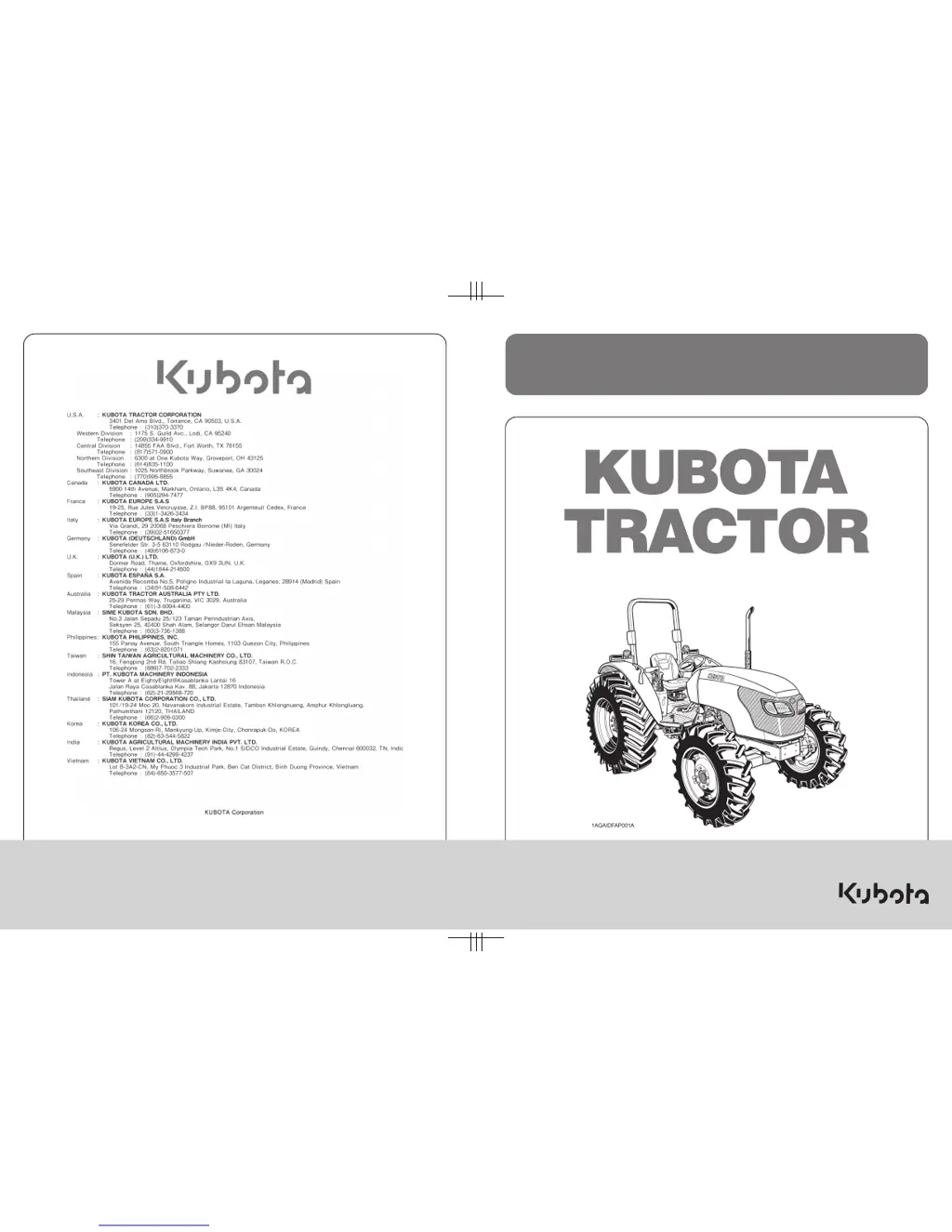
Kubota M8540 - User Manual

Kubota M8540
111 pages
Print Icon
To Next Page IconTo Next Page
Loading...
English (AC)
Code No. 3C081-9971-4
M9540
M8540MODELS
OPERATOR'S MANUAL
M
8
5
4
0
·
M
9
5
4
0
©
KUBOTA Corporation 2005
PRINTED IN JAPAN
READ AND SAVE THIS MANUAL

Table of Contents

Other manuals for Kubota M8540

Questions and Answers

  • J
    Jacqueline JacksonSep 7, 2025
    Why is my Kubota M8540 emitting white or blue exhaust gas?
    • J
      James WilliamsSep 7, 2025
      The emission of white or blue exhaust gas from your Kubota Tractor can be attributed to a few potential issues. One possibility is excessive engine oil (reduce to specified level). Another cause could be piston ring and cylinder wear or sticking (repair or replace). Incorrect injection timing (adjust) might also be the reason.
  • M
    Mr. Mark BernardNov 25, 2025
    Why is my Kubota Tractor engine difficult to start?
    • R
      Robert JohnstonNov 25, 2025
      There are several reasons why your Kubota Tractor engine might be hard to start. It could be due to no fuel flow, so check the fuel tank and fuel filter, replacing the filter if needed. Air or water in the fuel system could also be the culprit; ensure the fuel line coupler bolt and nut are tight and bleed the fuel system. In cold weather, the oil viscosity increases, slowing the engine revolution, so use oils of different viscosities or consider using an engine block heater. A weak battery can also prevent the engine from turning over quickly enough; clean the battery cables and terminals, charge the battery, and in cold weather, remove the battery, charge it, and store it indoors until use. Finally, there might be an issue with the intake air heater system; check the slow blow fuse and en...
  • C
    claudiawalkerNov 19, 2025
    How to start a Kubota M8540 when the engine won't start?
    • P
      patrick27Nov 20, 2025
      If your Kubota Tractor's engine won't start, several factors could be the cause. First, ensure you have sufficient fuel by replenishing it. If fuel is present, there might be air in the fuel system, which requires venting. Other potential issues include water in the fuel system (change the fuel and repair or replace the fuel system), a clogged fuel hose (clean or replace it), or a clogged fuel filter (replace it). Also, check for excessively high viscosity of fuel or engine oil at low temperatures (use specified fuel or engine oil), fuel with a low cetane number (use specified fuel), or a fuel leak due to a loose injection pipe retaining nut (tighten the retaining nut). More complex issues could involve incorrect injection timing (adjust), a clogged injection nozzle (repair or replace), co...
  • M
    Michael OwensSep 18, 2025
    How does water get mixed into the lubricant oil of my Kubota M8540 Tractor?
    • A
      Anthony PerkinsSep 18, 2025
      If water is mixing into the lubricant oil of your Kubota Tractor, it could be due to a defective head gasket (replace) or a flawed cylinder block or cylinder head (replace).
  • T
    Timothy GaySep 16, 2025
    Why is oil leaking into the exhaust or suction pipe of my Kubota M8540?
    • B
      Barry EdwardsSep 16, 2025
      If oil is leaking into the exhaust or suction pipe of your Kubota Tractor, it could be due to a clogged or deformed waste oil pipe (repair or replace) or a faulty turbocharger’s piston ring seal (replace the turbocharger assembly).
  • M
    Mariah StanleySep 14, 2025
    What causes high oil pressure in a Kubota Tractor?
    • J
      Jonathan FranklinSep 14, 2025
      High oil pressure in your Kubota Tractor can be caused by using a different type of oil (use specified type of oil) or a defective relief valve (replace).
  • C
    Christopher VargasSep 12, 2025
    What would cause fuel to mix into the lubricant oil of my Kubota M8540?
    • E
      Erika RomeroSep 12, 2025
      If fuel is mixing into the lubricant oil of your Kubota Tractor, it could be due to a worn injection pump plunger (repair or replace) or a broken injection pump (replace).
  • G
    Gregory GonzalezSep 12, 2025
    Why is the oil pressure low in my Kubota M8540?
    • B
      brownangelaSep 12, 2025
      Low oil pressure in your Kubota Tractor can stem from several causes. Insufficient engine oil (replenish), a clogged oil strainer (clean), or a relief valve stuck with dirt (clean) are common culprits. Additionally, using a different type of oil (use specified type of oil) or a defective oil pump (replace) can lead to low oil pressure.
  • J
    Jacqueline HallSep 9, 2025
    What causes excessive lubricant oil consumption in a Kubota M8540 Tractor?
    • T
      Taylor YoungSep 9, 2025
      Excessive lubricant oil consumption in your Kubota Tractor can be caused by several factors: the piston ring’s gap facing the same direction (shift ring gap direction), a worn or stuck oil ring (replace), a worn piston ring groove (replace piston), worn valve stem and valve guide (replace), or worn crankshaft bearing and crank pin bearing (replace).
  • C
    Carla KimAug 22, 2025
    What to do if my Kubota Tractor engine is overheating?
    • M
      Mary PerezAug 22, 2025
      If your Kubota Tractor engine is overheating, several issues could be the cause. Begin by checking the engine oil and coolant levels and replenish if insufficient. Inspect the fan belt for breakage or elongation; replace or adjust as necessary. Look for corrosion inside the radiator and clean or replace it if needed. A defective radiator cap should also be replaced. Other potential causes include incorrect injection timing (adjust), or using an unsuitable fuel (use specified fuel).

Summary

SAFE OPERATION

BEFORE OPERATING THE TRACTOR

General guidelines and checks before starting tractor operation.

OPERATING THE TRACTOR

General guidelines for safe tractor operation.

OPERATING ON SLOPES

Safety precautions and procedures for operating on slopes.

DRIVING THE TRACTOR ON THE ROAD

Safety guidelines for operating the tractor on public roads.

PARKING THE TRACTOR

Procedures for safely parking the tractor.

OPERATING THE PTO

Guidelines for operating the Power Take-Off (PTO).

USING 3-POINT HITCH

Instructions for using the 3-point hitch with implements.

SERVICING THE TRACTOR

General procedures for servicing the tractor.

DANGER, WARNING AND CAUTION LABELS

Explanation of safety labels found on the tractor.

CARE OF DANGER, WARNING AND CAUTION LABELS

How to maintain and replace safety labels.

SPECIFICATIONS

SPECIFICATION TABLE

Detailed technical specifications for M8540 and M9540 models.

TRAVELING SPEEDS

Table of traveling speeds for different gear and model configurations.

INSTRUMENT PANEL AND CONTROLS

Instrument Panel, Switches and Hand Controls

Overview of the tractor's instrument panel and controls.

Foot and Hand Controls

Details on various foot and hand operated controls of the tractor.

PRE-OPERATION CHECK

DAILY CHECK

Daily inspection checklist to ensure safe operation.

OPERATING THE ENGINE

STARTING THE ENGINE

Step-by-step procedure for starting the tractor engine.

COLD WEATHER STARTING

Procedures for starting the engine in cold weather conditions.

STOPPING THE ENGINE

Procedures for safely stopping the tractor engine.

WARMING UP

Recommended engine warm-up procedures.

JUMP STARTING

Instructions for jump starting a tractor with a dead battery.

OPERATING THE TRACTOR

OPERATING NEW TRACTOR

Guidelines for operating a new tractor to ensure proper break-in.

OPERATING FOLDABLE ROPS

Instructions for operating and folding the Roll-Over Protective Structure (ROPS).

STARTING

Procedures related to starting and preparing to operate the tractor.

Operators Seat

How to adjust the operator's seat for comfort and safety.

Glove Box

Location and use of the tractor's glove box.

Seat Belt

Importance and use of the seat belt for safety.

Tilt Steering Adjustment

How to adjust the steering wheel tilt for optimal position.

Light Switch

Operation of the tractor's lighting system.

Turn Signal; Hazard Light Switch

How to use the turn signal and hazard light switches.

Front Work Light Switch

Operation of the front work light switch.

Brake Pedals (Right and Left)

Instructions for using and interlocking the tractor's brake pedals.

Clutch Pedal

Proper use and care of the tractor's clutch pedal.

Selecting the Travel Speed.

How to select forward and reverse speeds using gear levers.

Creep Speed (if equipped)

Usage and limitations of the creep speed function.

Front Wheel Drive Lever

Operation and benefits of the front wheel drive lever.

4 WD Indicator

Explanation of the 4WD indicator light on the instrument panel.

Accelerate the Engine.

How to use the hand throttle and foot throttle levers.

Unlock the Parking Brake and Slowly Release the Clutch.

Procedure for releasing the parking brake and engaging the clutch.

STOPPING

Steps for safely stopping the tractor.

CHECK DURING DRIVING

Checks to perform while driving the tractor.

Fuel Gauge

How to read and use the fuel gauge.

Coolant Temperature Gauge

How to read the coolant temperature gauge.

Tachometer

How to read the tachometer for engine speed.

PTO RPM; TRAVEL SPEED MONITOR

Changing Display Mode

How to switch between different display modes on the LCD monitor.

PTO Speed Display Mode Switching

Procedure to switch PTO speed display modes for accurate readings.

Entering the Travel Speed Coefficient

How to enter tire circumference for accurate speed display.

PARKING

Parking

Procedures for safely parking the tractor.

OPERATING TECHNIQUES

Differential Lock

How and when to use the differential lock for traction.

Operating the Tractor on a Road

Safety guidelines for operating the tractor on roads.

Operating on Slopes and Rough Terrain

Safety precautions for operating on slopes and rough terrain.

Directions for Use of Power Steering

How to properly use the tractor's power steering system.

Trailer Electrical Outlet

Information about the trailer electrical outlet and its terminals.

Electrical Outlet

Information about the accessory electrical outlet.

PTO

PTO OPERATION

General procedures for operating the Power Take-Off (PTO).

1000 rpm PTO Shaft

Information on installing and using the 1000 rpm PTO shaft.

LCD Monitor Message

How to read PTO information on the LCD monitor.

PTO Shaft Cover and Shaft Cap

Proper use and maintenance of PTO shaft covers and caps.

THREE-POINT HITCH & DRAWBAR

3-POINT HITCH

Procedures for attaching implements using the 3-point hitch.

Drawbar

How to attach and use the drawbar.

Lifting Rod (Left)

How to adjust the length of the left lifting rod.

Lifting Rod (Right)

How to adjust the length of the right lifting rod.

Top Link

How to adjust the top link for implement angle.

Telescopic Stabilizers

How to adjust telescopic stabilizers for implement sway control.

Telescopic Lower Links

How to attach implements using telescopic lower links.

Swing Drawbar

How to use the swing drawbar in different configurations.

HYDRAULIC UNIT

3-Point Hitch Control System

Overview of the 3-point hitch control system functions.

Position Control

How to use position control for the 3-point hitch.

Draft Control

How to use draft control for the 3-point hitch.

Mixed Control

How to use mixed control for the 3-point hitch.

Float Control

How to use float control for the 3-point hitch.

3-point Hitch Lowering Speed

How to adjust the lowering speed of the 3-point hitch.

REMOTE HYDRAULIC CONTROL SYSTEM

Information on the remote hydraulic control system.

Remote Control Valve

Types and operation of remote control valves.

Remote Control Valve Lever

How to operate the remote control valve levers.

Remote Control Valve Coupler Connecting and Disconnecting

Procedures for connecting and disconnecting remote control valve couplers.

Flow Control Valve (option)

Information and operation of the optional flow control valve.

Adjusting the flow rate

How to adjust the flow rate of the remote control valve.

Positions and advantages of the flow control valve

Different positions and benefits of the flow control valve.

Hydraulic Control Unit Use Reference Chart

Chart for using hydraulic control units with different implements and soil.

TIRES, WHEELS AND BALLAST

TIRES

Information and precautions regarding tires.

WHEEL ADJUSTMENT

Guidelines for adjusting tractor wheel tread and alignment.

Front Wheels (with two wheel drive)

How to adjust front wheel tread width for 2WD models.

Front Wheels (with four wheel drive)

How to adjust front wheel tread width for 4WD models.

Rear Wheels

How to adjust rear wheel tread width.

BALLAST

Adding ballast for stability and traction.

Front Ballast

Adding front ballast for stability and traction.

Rear Ballast

Adding rear ballast for traction and stability.

Liquid Ballast in Rear Tires

How to use liquid ballast in rear tires for weight.

MAINTENANCE

SERVICE INTERVALS

Schedule for regular maintenance tasks based on operating hours.

LUBRICANTS

Recommended lubricants, capacities, and locations for the tractor.

PERIODIC SERVICE

Hood

How to open and close the tractor hood.

DAILY CHECK

Daily inspection items to ensure proper tractor function.

Checking Water Separator

How to check and clean the fuel water separator.

Checking Engine Oil Level

How to check the engine oil level.

Checking Transmission Fluid Level

How to check the transmission fluid level.

Checking Coolant Level

How to check the coolant level in the recovery tank.

Cleaning Evacuator Valve

How to clean the air cleaner evacuator valve.

Cleaning Grill, Radiator Screen, Oil Cooler and Battery Mount

How to clean the tractor's cooling system components and battery mount.

Checking Dust Indicator

How to check the air cleaner dust indicator.

Checking Brake Pedal

How to check the brake pedal operation and free travel.

Checking Brake Pedals and Clutch Pedal

How to check brake and clutch pedals in Synchro shuttle models.

Checking Gauges, Meter and Easy Checker(TM)

How to inspect dashboard gauges and indicators.

Checking Head Light, Hazard Light etc.

How to inspect and check tractor lights.

Checking Seat Belt and ROPS

How to check seat belt and ROPS for proper condition.

EVERY 50 HOURS

Maintenance tasks to be performed every 50 operating hours.

Checking Engine Start System

How to test the engine start safety systems.

EVERY 100 HOURS

Maintenance tasks to be performed every 100 operating hours.

Checking Wheel Bolt Torque

How to check and tighten wheel bolt torque.

Checking Battery Condition

How to check the battery's condition and charge level.

EVERY 200 HOURS

Maintenance tasks to be performed every 200 operating hours.

Checking Radiator Hose and Clamp

How to check radiator hoses and clamps for leaks or damage.

EVERY 300 HOURS

Maintenance tasks to be performed every 300 operating hours.

Replacing Hydraulic Oil Filter

How to replace the hydraulic oil filter.

EVERY 400 HOURS

Maintenance tasks to be performed every 400 operating hours.

Changing Engine Oil

How to change the engine oil and oil filter.

Replacing Fuel Filter

How to replace the fuel filter.

EVERY 600 HOURS

Maintenance tasks to be performed every 600 operating hours.

Replacing Engine Oil Filter

How to replace the engine oil filter.

Changing Transmission Fluid

How to change the transmission fluid and filters.

EVERY 800 HOURS

Maintenance tasks to be performed every 800 operating hours.

Adjusting Engine Valve Clearance

How to adjust engine valve clearance.

EVERY 1500 HOURS

Maintenance tasks to be performed every 1500 operating hours.

Checking Fuel Injection Nozzle (Injection Pressure)

How to check fuel injection nozzle pressure.

EVERY 3000 HOURS

Maintenance tasks to be performed every 3000 operating hours.

Checking Turbocharger

How to check the turbocharger.

Checking Injection Pump

How to check the injection pump.

Checking Intake Air Heater

How to check the intake air heater.

EVERY 1 YEAR

Maintenance tasks to be performed annually.

Replacing Air Cleaner Primary Element and Secondary Element

How to replace air cleaner primary and secondary elements.

EVERY 2 YEARS

Maintenance tasks to be performed every two years.

Flushing Cooling System and Changing Coolant

How to flush the cooling system and change the coolant.

Anti-Freeze

Proper use and handling of antifreeze for the cooling system.

SERVICE AS REQUIRED

Maintenance tasks performed as needed.

Bleeding Fuel System

How to bleed air from the fuel system.

Bleeding Brake System

How to bleed air from the brake system.

Draining Clutch Housing Water

How to drain water from the clutch housing.

Replacing Fuse

How to replace blown fuses in the electrical system.

STORAGE

TRACTOR STORAGE

Procedures for storing the tractor for extended periods.

REMOVING THE TRACTOR FROM STORAGE

Procedures for preparing the tractor after storage.

TROUBLESHOOTING

ENGINE TROUBLESHOOTING

Common engine problems, their causes, and solutions.

Kubota M8540 Specifications

General IconGeneral
Engine TypeDiesel
Engine ModelKubota V3800-DI-T
Engine Power85 hp
PTO Power72 HP
Drive4WD
Hydraulic SystemOpen Center
3-Point HitchCategory II
Displacement230 cu in (3.8 L)

Related product manuals