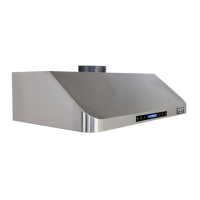
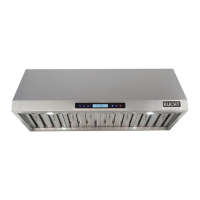
This document is an installation guide and user manual for the KUCHT Professional 48" Wall Mounted Hood, model KRH4815A - Color Series. It provides comprehensive instructions for installation, operation, and maintenance of the range hood.
Function Description:
The KUCHT Professional 48" Wall Mounted Hood is designed for general ventilating use in kitchens to exhaust cooking fumes, odors, and vapors. It aims to provide high air volume, lower noise, and an elegant appearance, transforming a simple kitchen into a professional one. The hood is intended to be mounted above a cooking range, with a recommended height of 25"-36" above the top of the cooking surface. It is suitable for use with fuel-burning equipment, provided adequate ventilation is maintained to prevent back drafting. The unit is designed for ducted exhaust, meaning it requires connection to external ductwork to vent air outside.
Important Technical Specifications:
- Model: KRH4815A - Color Series
- Type: 48" Wall Mounted Hood
- Dimensions:
- Width: 47.5"
- Height: 13"
- Depth: 22"
- Duct Size: 2x 6" (indicating two 6-inch duct connections)
- Available Colors: White, Red, Black
- Electrical Specifications:
- Rated Voltage: 110-120 V
- Rated Frequency: 60 Hz
- Performance:
- Motor Input Power: 2x 148W
- Lamp Power: 2x 21W
- Air Volume (CFM): 700-1200
- Air Pressure (Pa): >160
- Noise Level (dB(A)): <70
- Air Output Diameter: 2x 6"
Usage Features:
The range hood is equipped with controls for its fan and lights. Users are instructed to test these controls upon receiving the unit to ensure proper functionality. The manual emphasizes the importance of proper ductwork installation, including the use of appropriate-sized ductwork and an exterior roof or wall cap, depending on the venting location. A multi-blower transition adapter (not included) may be used to connect the hood's blowers to the ductwork. The hood can be powered by connecting its three-pronged plug to a nearby electrical outlet or by hardwiring it to a power source (professional electrician consultation recommended for hardwiring). The unit includes baffle hood filters, which are to be installed after removing their protective coating. A QR code is provided for a video tutorial on clock configuration, suggesting the hood may include a clock display feature.
Maintenance Features:
Regular maintenance is crucial for the range hood's safety and performance.
- General Cleaning: The inside and outside of the hood should be cleaned with warm water and a neutral detergent, then dried with a soft cloth. Abrasive materials like cleansing balls should be avoided to prevent surface damage. Gloves are recommended for cleaning the interior. This cleaning should be done every half a month to a month.
- Wind Wheel Care: Care must be taken not to crush the wind wheel during cleaning, as deformation can increase noise and reduce oil-smoke absorption efficiency.
- Filter Cleaning: The filter requires frequent cleaning, ideally once a week. To clean, press the spring on the filter's edge to dismantle it, then soak it in strong detergent and brush its surface with a soft brush. Agitate the filter in the detergent, rinse with clean water, air dry, and reinstall. Combustible detergents like banana oil or gasoline should not be used.
- Grease Management: All fans, baffles, spaces, filters, grease tunnels, oil containers, and grease-laden surfaces must be kept clean to prevent grease accumulation.
- Stainless Steel Surfaces: Stainless steel is easy to clean. Hot water with soap or detergent is usually sufficient. For persistent discolorations, a non-scratching household cleanser or stainless steel polishing cream can be used. Stubborn cases may require a plastic scouring pad or soft bristle brush, rubbing lightly in the direction of the grain. Deposits should not be left for long periods. Ordinary steel wool or brushes, salt solutions, disinfectants, bleaches, or cleaning compounds should be avoided as they can cause rust or harm the surface. Always rinse with water and wipe dry after exposure to such substances.
- Painted Surfaces: These should be cleaned with warm water and mild detergent only.
Safety Cautions:
The manual outlines several critical safety precautions:
- Installation should only be performed by qualified installers, service technicians, or persons with similar qualified backgrounds due to the risk of injury and the appliance's size and weight (two-person installation recommended).
- Always switch off power at the service panel and lock it before servicing or cleaning the unit, or changing a light bulb.
- Avoid detergent flow into the electric appliance box or switches during cleaning to prevent electrical leakage.
- Do not flambé under the range hood.
- Failure to clean the unit according to instructions poses a fire risk.
- Ensure adequate room ventilation when the range hood is used simultaneously with other fuel-burning appliances.
- Air must not be discharged into a flue used for exhausting fumes from other appliances.
- Maintain a minimum distance of 25" between the cooking vessel's supporting surface on the hob and the lowest part of the range hood (or greater if specified by the gas hob's installation instructions).
- Regulations concerning air discharge must be followed.
- A damaged supply cord must be replaced by the manufacturer, service agent, or a similarly qualified person to avoid hazards.
- The appliance is not intended for use by young children or infirm persons unless adequately supervised. Young children should be supervised to prevent them from playing with the unit.
- The hood is for general ventilating use only and should not be used to exhaust hazardous or explosive materials and vapors.
- To reduce fire risk, duct air outside and avoid venting into walls, ceilings, attics, crawl spaces, or garages.
- In case of a stovetop grease fire, smother flames with a close-fitting lid, cookie sheet, or metal tray, then turn off the burner. Never pick up a flaming pan. Evacuate and call the fire department if flames do not extinguish immediately. Do not use water on a grease fire, as it can cause a violent steam explosion.

 Need help?
 General

 To Next Page