
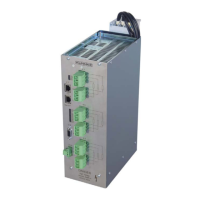
Why is my Kuhnke 610.441.31 in Device Failure mode?
- MMelissa DunnJul 31, 2025
The Kuhnke Controller is in Device Failure mode because a module error has been detected. The Module Error Word displays the active module error for diagnosis.
Why is my Kuhnke 610.441.31 in Device Failure mode?
The Kuhnke Controller is in Device Failure mode because a module error has been detected. The Module Error Word displays the active module error for diagnosis.
Describes the general functionality, benefits, and diverse applications of the thermo-controller in various industries.
Specifies the intended operational environment, target audience, and required expertise for the thermo-controller manual.
Details product reliability measures and explains the importance of safety symbols for warnings and orientation.
Provides critical safety precautions for planning, installing, maintaining, and servicing the thermo-controller.
Defines EMC, interference emission, and general installation notes for control systems to ensure compliance.
Covers electrical safeguards, cable routing, wiring, and installation location considerations for optimal performance.
Identifies particular sources of interference, such as inductive actuators, and discusses mitigation strategies.
Describes the 9-channel thermo-controller's functionality and its EtherCAT fieldbus interface capabilities.
Details the hardware design, block diagram, and comprehensive technical properties of the thermo-controller.
Explains the location of ports on the front panel and the device's status indication via LEDs.
Details the connection and requirements for the 24 VDC auxiliary power supply unit (X10).
Describes the EtherCAT fieldbus port (X7, X8) connections and device status indicators.
Details the pin configuration and wiring for the output channel terminals (X1-X6).
Explains the proper connection of operative/protective earth for safety and interference dissipation.
Stresses skilled handling, compliance with regulations, and provides warnings for safe installation.
Outlines preparatory steps, lists relevant safety regulations, and provides mounting instructions for installation.
Details the process of attaching the thermo-controller to bus bar systems using the mounting rail adapter.
Provides instructions on how to safely remove the thermo-controller unit from its mounting rail adapter.
Specifies power supply criteria, short circuit rating (SSCR), and fuse requirements for safe operation.
Explains protective earth conductor attachment and cross-section requirements for indirect contact protection.
Details branch circuit protection per UL 508A, lead fuse requirements, and output line specifications.
Explains the function of the mounting lid and the importance of keeping it closed for safety and proper operation.
Describes startup/shutdown procedures and explains the function of status indicators and error codes.
Details module and channel state signaling via EtherCAT, indicating operational status and errors.
Covers the process of replacing power output fuses, including fuse types and allocation to channels.
Explains operational modes like soft start, error suppression, and channel error detection at pilot stage.
Describes half sine wave control, mains voltage correction, and their impact on heat output.
Explains the operation of speed-controlled axial fans, their monitoring, and error handling.
Lists potential malfunctions, faults, and power mains disturbances that can affect the thermo-controller.
Provides a troubleshooting guide for common problems like device failure and incorrect voltage/frequency readings.
Outlines preventive maintenance tasks, including fan cleaning and proper disposal of the device.
Details the "ModuleState" word, defining bits for module status, errors, and operational states.
Explains the "ChannelState" word, detailing signal bits for channel status, errors, and fault detection priority.
Describes actual control values, phase voltage readings, and mains frequency parameters.
Covers output stage temperature, version information, and module control via the ControlWord.
Lists and describes various configurable parameters for fine-tuning the thermo-controller's operation.
Provides safety precautions for servicing, potential damage risks, and checks required before restarting the unit.
Explains CoDeSys instance creation, pointers to EtherCAT variables, and provides programming examples.
Lists and describes the output and input variables used for controlling and monitoring the thermo-controller.
Provides technical data for basic units (Power Heat Controller) and accessories like fuse adapters.
Shows dimensional drawings and key specifications for the Power Heat Controller with bus bar adapter.
Provides contact details for sales and service, including headquarters address and email for support.
| Input Voltage | 24 VDC |
|---|---|
| Operating Voltage | 24 VDC |
| Protection Class | IP20 |
| Current Consumption | 100mA |
| Input Type | Digital |