EasyManua.ls Logo

KUL KU-SAC120W - User Manual

KUL KU-SAC120W
58 pages
Print Icon
To Next Page IconTo Next Page
Loading...
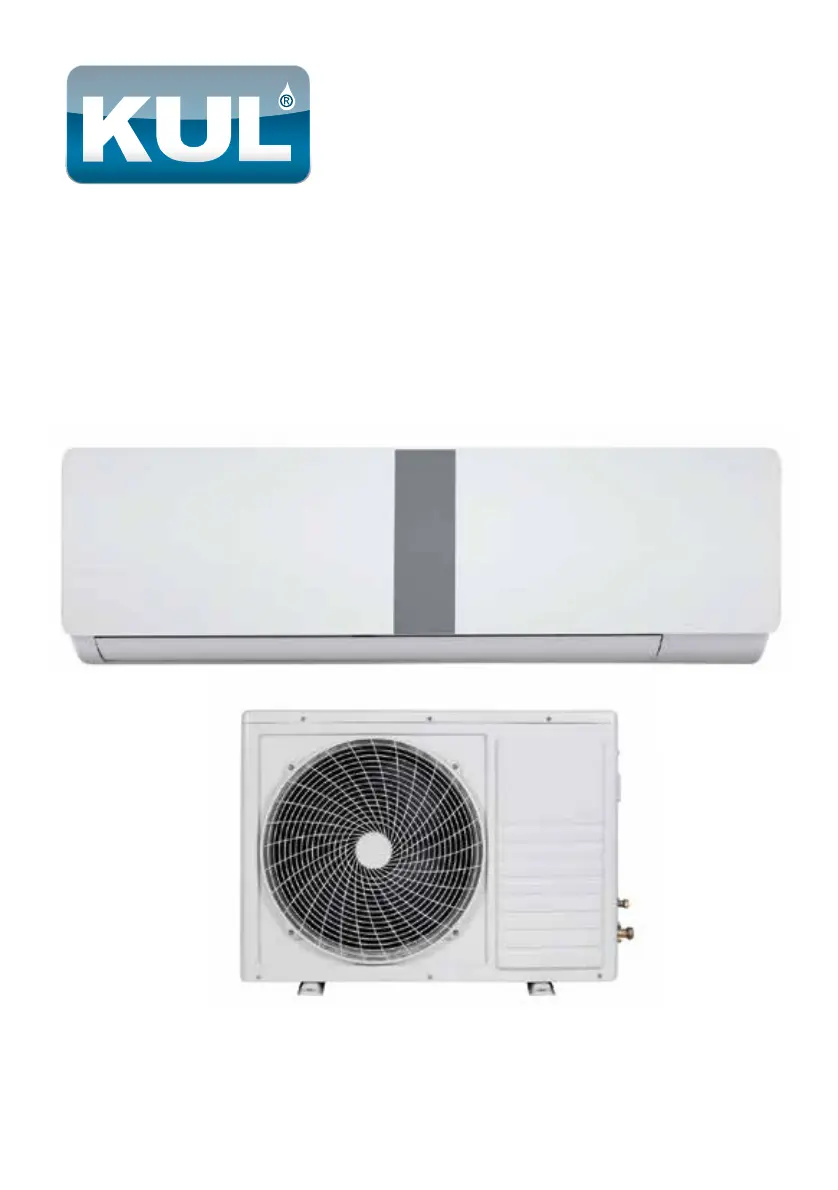
Split AC
User Manual
Models: KU-SAC120W
KU-SAC180W
KU-SAC220W

Questions and Answers

  • M
    Michael SilvaAug 4, 2025
    Why my KUL Air Conditioner does not operate?
    • T
      Tracy HarrisAug 4, 2025
      If your KUL Air Conditioner isn't operating, start by checking the power supply and plug to ensure they are working correctly. Also, make sure all connections are secure and that the plug hasn't been pulled out. If the unit stops occasionally to protect itself, allow it time to reset. Check the voltage supply to ensure it's within the correct range. Deactivate the TIMER-ON function if it's active. Finally, other potential issues could be a damaged indoor/outdoor unit fan motor, a faulty compressor thermomagnetic circuit breaker, faulty protective devices or fuses, or a damaged electronic control board, all of which may need inspection or replacement.
  • D
    Denise HayesAug 8, 2025
    What to do if my KUL KU-SAC120W does not respond to commands?
    • T
      Tim ValenciaAug 8, 2025
      If your KUL Air Conditioner isn't responding to commands, there might be a few reasons. First, check the refrigerant levels. If they are low, that could be the problem. Second, make sure the remote control is close enough to the indoor unit. Finally, the batteries in the remote might be dead, so try replacing them.
  • D
    Devin BradyAug 14, 2025
    How to improve airflow in my KUL Air Conditioner?
    • W
      William EllisSep 12, 2025
      If your KUL Air Conditioner is not providing enough airflow, whether hot or cold, there are several things you can check. First, make sure the temperature setting is appropriate for your needs. Next, ensure that neither the air inlet nor the outlet of the indoor or outdoor unit is blocked by any obstructions. Also, check the air filter to see if it's blocked and needs cleaning or replacing. Verify that the fan speed isn't set to the minimum; if it is, increase it. Finally, consider whether there are other sources of heat in the room that could be affecting the air conditioner's performance and eliminate them.
  • B
    Brent GarciaAug 18, 2025
    Why the display is off on my KUL KU-SAC120W?
    • J
      Joshua PowellAug 18, 2025
      If your KUL Air Conditioner display is off, first ensure there are no obstacles between the remote control and the signal receiver on the indoor unit. If obstacles are present, remove them. Additionally, check if the LED function is active and, if so, deactivate it.
  • A
    Amber SmithAug 25, 2025
    Why does my KUL KU-SAC120W Air Conditioner have a strange odor?
    • N
      nicholasharperAug 25, 2025
      If your KUL Air Conditioner has a strange odor, the air filter may be dirty. Try cleaning or replacing the air filter.
  • E
    Eric AndrewsAug 29, 2025
    Why my KUL KU-SAC120W Air Conditioner makes noise of running water?
    • A
      andrea82Aug 29, 2025
      If you notice the noise of running water or a fine mist coming from the air outlet of your KUL Air Conditioner, check the refrigerant circulation. This could be due to back flow of liquid in the refrigerant circulation.

Summary

SAFETY RULES AND RECOMMENDATIONS FOR THE INSTALLER

SAFETY RULES AND RECOMMENDATIONS FOR THE USER

SAFETY RULES AND PROHIBITIONS

NAMES OF PARTS

INDOOR UNIT

Lists and identifies components of the indoor air conditioning unit.

OUTDOOR UNIT

Lists and identifies components of the outdoor air conditioning unit.

INDOOR UNIT DISPLAY

EMERGENCY FUNCTION & AUTO-RESTART FUNCTION

AUTO-RESTART FUNCTION

Explains how the unit automatically restarts after a power failure and how to deactivate it.

EMERGENCY FUNCTION

Details how to operate the unit manually using the emergency button for cooling or heating.

REMOTE CONTROLLER

Replacement of Batteries

Instructions for replacing batteries in the remote control unit.

Remote Controller Holder Recommendations

Guidance on placing and using the remote controller holder.

OPERATING INSTRUCTIONS

SWING Control of Air Flow

Explains how to control the air direction using the SWING function.

COOLING MODE

Describes the operation and settings for the cooling function of the air conditioner.

HEATING MODE

Describes the operation and settings for the heating function of the air conditioner.

TIMER MODE: TIMER ON

Instructions for setting the automatic switching-on time for the air conditioner.

TIMER MODE: TIMER OFF

Instructions for setting the automatic switching-off time for the air conditioner.

FAN MODE

Explains the operation of the air conditioner in fan-only ventilation mode.

DRY MODE

Describes the dehumidifying operation to reduce room humidity.

FEEL MODE

Explains the automatic mode that adjusts settings based on room temperature.

SLEEP MODE

Describes the mode that adjusts temperature for comfortable night-time operation.

PROTECTION

T1 Climate Condition Models

Lists protection conditions based on ambient temperature for T1 models.

Tropical (T3) Climate Condition Models

Lists protection conditions based on ambient temperature for T3 models.

INSTALLATION MANUAL

Selecting Installation Place for Indoor Unit

Guidelines for choosing the optimal location for the indoor unit.

Selecting Installation Place for Outdoor Unit

Guidelines for choosing the optimal location for the outdoor unit.

Indoor Unit Installation Steps

Covers mounting plate installation, hole drilling, and electrical connections for the indoor unit.

Refrigerant Piping Connection

Instructions for connecting the refrigerant pipes to the indoor unit.

Indoor Unit Condensed Water Drainage

Steps for correctly installing the drain hose for condensate removal.

Completing Indoor Unit Installation

Final steps for installing the indoor unit, including lagging and securing.

Outdoor Unit Installation

General guidelines and procedures for installing the outdoor unit.

Outdoor Unit Electrical Connections

Instructions for making electrical connections to the outdoor unit.

Connecting the Pipes and Bleeding

Procedures for connecting refrigerant pipes and bleeding the system.

System Bleeding Procedure

Detailed steps for removing air and humidity from the refrigerant circuit.

Operation Test

Procedures to verify the correct operation of the installed unit.

Model Capacity and Pipe Specifications

Details model capacities, pipe diameters, and refrigerant types for installation.

Tightening Torque Specifications

Recommended torque values for pipe connections and protection caps during installation.

Wiring Diagrams

Information on the location and reference to wiring diagrams for indoor and outdoor units.

Cable Wires Specification

Table showing recommended cable sizes for power and connection supply.

MAINTENANCE

Indoor Unit Antidust Filters

Instructions for cleaning and replacing the air filters in the indoor unit.

Cleaning the Heat Exchanger

Steps for cleaning the heat exchanger of both indoor and outdoor units.

End of Season Maintenance

Recommended tasks to perform at the end of the air conditioner's operating season.

Replacing the Batteries

Guide on how and when to replace the batteries in the remote controller.

TROUBLESHOOTING

Common Malfunctions and Causes

Lists common problems and their potential causes for the appliance.

Error Signals on the Display

Explains error codes displayed on the indoor unit and their meanings.

KUL KU-SAC120W Specifications

General IconGeneral
BrandKUL
ModelKU-SAC120W
CategoryAir Conditioner
LanguageEnglish