This document provides instructions for the Kunft KMW4459 microwave oven, a compact 20-liter appliance designed for household use.
Function Description
The Kunft KMW4459 is a microwave oven primarily intended for heating, cooking, and defrosting food and beverages. It operates by generating radio-frequency energy in the 2450 MHz frequency range, belonging to Class B Group 2 classification, making it suitable for residential environments. The appliance features a control panel with two main operators: a power/action selector knob and a timer knob.
The power/action selector allows users to choose from six power levels for microwave cooking:
- HIGH: 100% power output (700 W)
- M.HIGH: 88% power output
- MED: 73% power output
- M.LOW: 52% power output
- DEFROST: 42% power output
- LOW: 20% power output
The timer knob provides visual timing settings, allowing users to select a desired cooking time up to 30 minutes per session. The microwave oven begins cooking as soon as the timer is turned. For cooking times under 2 minutes, the user is instructed to turn the timer past the 2-minute mark and then return to the correct time. To stop the microwave during cooking, users can press the door release button or open the door by the handle. It is crucial to always return the timer to the ZERO position if food is removed before the set time is complete or when the oven is not in use.
The appliance is equipped with a door safety lock system, an oven window, a shaft, a roller ring, a control panel, a wave guide (covered by a mica plate that should not be removed), and a glass tray.
Important Technical Specifications
- Power Consumption: 230V/50 Hz, 1100 W (Microwave)
- Rated Microwave Power Output: 700 W
- Operation Frequency: 2450 MHz
- Outside Dimensions: 243 mm (H) x 446 mm (W) x 360 mm (D)
- Oven Cavity Dimensions: 202 mm (H) × 301 mm (W) × 311 mm (D)
- Oven Capacity: Compact 20 Litres
- Net Weight: Approx. 9.4 kg
Usage Features
Safety Instructions:
The manual emphasizes several critical safety precautions. The appliance can be used by children aged 8 and above, and by individuals with reduced physical, sensory, or mental capabilities, or lack of experience and knowledge, provided they receive supervision and instructions for safe use and understand the associated hazards. Children must not play with the appliance, and cleaning and maintenance should not be performed by children without supervision.
Users are warned against operating the microwave oven if it has fallen, shows signs of damage, or if any anomaly occurs during operation. It should not be used for purposes other than those intended for household use. Any damage from incorrect use or manual modifications voids the warranty.
Power Supply and Cables:
Ensure the main voltage is compatible with the appliance. The power cord should not be tangled or pulled to disconnect the appliance and must be kept away from warm surfaces. Never use the appliance if the cable or socket is damaged; it must be replaced by the manufacturer or Customer Support Service.
Humidity and Water:
The microwave oven should not be used in humid places or exposed to water to avoid fire hazards or electric shock. It is not designed for industrial or laboratory use.
General Precautions:
- Read all instructions before use.
- Maintenance and service operations should only be carried out by authorized professionals.
- Do not operate the microwave oven when empty.
- Do not install the microwave oven over a range cooktop or other heat-producing appliance, as this could cause damage and void the warranty.
- The microwave oven should not be placed in a cabinet.
- Accessible parts, including the door and outer surface, may become hot during operation, so young children should be kept away.
- If the door or door seals are damaged, the oven must not be operated until repaired by the Customer Support Service.
- The microwave oven is not intended to be operated by an external timer or separate remote-control system.
- Never remove the distance holder at the back or sides, as it ensures minimum wall distance for air circulation.
- Secure the turntable before moving the oven to prevent damage.
- Use gloves when removing heated food.
- Steam will escape when opening lids or foil.
- If smoke is emitted, switch off or unplug the oven and keep the door closed to stifle flames.
Food Preparation and Cooking:
- To reduce the risk of fire in the oven cavity:
- Check the oven frequently when heating food in plastic or paper containers to ensure no ignition occurs.
- Remove wire twist-ties from paper or plastic bags before placing them in the oven.
- If smoke is observed, switch off or unplug the oven and keep the door closed to stifle flames.
- Do not use the cavity for storage; do not leave paper products, cooking utensils, or food inside when not in use.
- Liquids or other food must not be heated in sealed containers, as they are liable to explode.
- Microwave heating of beverages can result in delayed eruptive boiling; handle containers with care.
- Do not fry food in the microwave oven, as hot oil can damage parts and utensils and cause skin burns.
- Eggs in their shell and whole hard-boiled eggs should not be heated in microwave ovens, as they may explode even after heating.
- Pierce foods with heavy skins (e.g., potatoes, whole squashes, apples, chestnuts) before cooking.
- Stir or shake the contents of feeding bottles and baby jars and check their temperature before serving to avoid burns.
- Cooking containers may become hot due to heat transfer; potholders may be needed.
- Containers should be checked for microwave suitability.
- Arrange food carefully, placing thicker areas towards the outside of the dish.
- Monitor cooking time, starting with the shortest recommended duration and adding more as needed. Overcooked food can smoke or ignite.
- Cover foods while cooking to prevent spattering and ensure even cooking.
- Turn foods over once during cooking to speed up the process for items like chicken and hamburgers. Large items like roasts should be turned at least once.
- Rearrange foods (e.g., meatballs) halfway through cooking, from top to bottom and from the center to the outside.
Utensils Guide:
Microwaves cannot penetrate metal. Only microwave-safe utensils should be used. Metallic containers for food and beverages are not allowed unless specified by the manufacturer. Metal utensils or dishes with metallic trim should not be used. Recycled paper products are not recommended due to potential metal fragments causing sparks or fires. Round or oval dishes are preferred over square/oblong ones to prevent overcooking in corners. Narrow strips of aluminum foil can be used to prevent overcooking exposed areas, but sparingly and kept at least 2.54 cm from the cavity.
The manual provides a table for utensil suitability:
- Heat-Resistant Glass: Yes
- Non Heat-Resistant Glass: No
- Heat-Resistant Ceramics: Yes
- Microwave-Safe Plastic Dish: Yes
- Kitchen Paper: Yes
- Metal Tray: No
- Metal Rack: No
- Aluminium Foil & Foil Containers: No
Grounding Instructions:
The appliance must be grounded. It is equipped with a grounding wire and plug and must be plugged into a properly installed and grounded wall receptacle. A separate circuit for the microwave oven is recommended. Improper use of the grounding plug can result in electric shock.
Radio Interference:
Microwave oven operation can cause interference with radio, TV, or similar equipment. Measures to reduce interference include cleaning the door and sealing surface, reorienting antennas, relocating the oven, and plugging the oven into a different branch circuit.
Maintenance Features
Cleaning:
- Before cleaning, switch off the microwave oven and unplug it from the wall socket. Allow the unit to cool down.
- Keep the inside of the oven clean. Wipe food splatters or spilled liquids from oven walls with a damp cloth. Mild detergent can be used for heavy soiling. Avoid spray and harsh cleaners, as they may stain, streak, or dull the door surface.
- Clean outside surfaces with a damp cloth. Prevent water from seeping into ventilation openings to avoid damage to internal operating parts.
- Wipe the door, window, door seals, and adjacent parts frequently with a damp cloth to remove spills or spatters. Do not use abrasive cleaners.
- A steam cleaner must not be used.
- Do not allow the control panel to get wet. Clean with a soft, damp cloth, keeping the door open to prevent accidental activation.
- If steam accumulates inside or around the door, wipe with a soft cloth. This is normal under high humidity conditions.
- The glass tray should be removed occasionally for cleaning. Wash it in warm soapy water or a dishwasher.
- The roller ring and oven floor should be cleaned regularly to prevent excessive noise. Wipe the bottom surface with mild detergent. The roller ring can be washed in mild soapy water or a dishwasher. Ensure the roller ring is replaced in the correct position after cleaning.
- To remove odors, combine a cup of water with the juice and skin of one lemon in a deep microwaveable bowl, microwave for 5 minutes, then wipe thoroughly and dry with a soft cloth.
- If the microwave oven light needs replacement, consult the Customer Support Service.
- Regular cleaning and removal of food deposits are essential. Failure to maintain cleanliness can lead to surface deterioration, affecting the appliance's lifespan and potentially creating hazardous situations.
Troubleshooting (Before Calling for Service):
If the microwave oven fails to operate, check the following:
- Ensure the oven is securely plugged in. If not, unplug, wait 10 seconds, and plug it back in.
- Check for a blown circuit fuse or a tripped main circuit breaker. If they appear to be operating correctly, test the outlet with another appliance.
- Ensure the control panel is programmed correctly and the timer is set.
- Ensure the door is securely closed, engaging the safety lock system. Otherwise, microwave energy will not flow into the oven.
If these steps do not resolve the issue, contact a qualified technician. Do not attempt to adjust or repair the microwave oven yourself.
Environmental Protection:
The manual states that the product is designed to minimize packaging volume, using three easily sorted materials: cardboard, paper, and plastic. The appliance is manufactured using recyclable materials and should be disassembled by a specialized company. Users are instructed to comply with local regulations for material recycling and not to dispose of the microwave oven in domestic rubbish bins, but at a specialized disposal center provided by the municipality.
The Kunft KMW4459 microwave oven is designed for ease of use and safety, with clear instructions for installation, operation, and maintenance to ensure optimal performance and longevity.

 Need help?
 General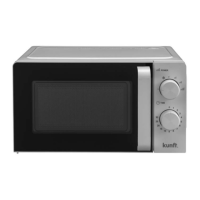

 To Next Page