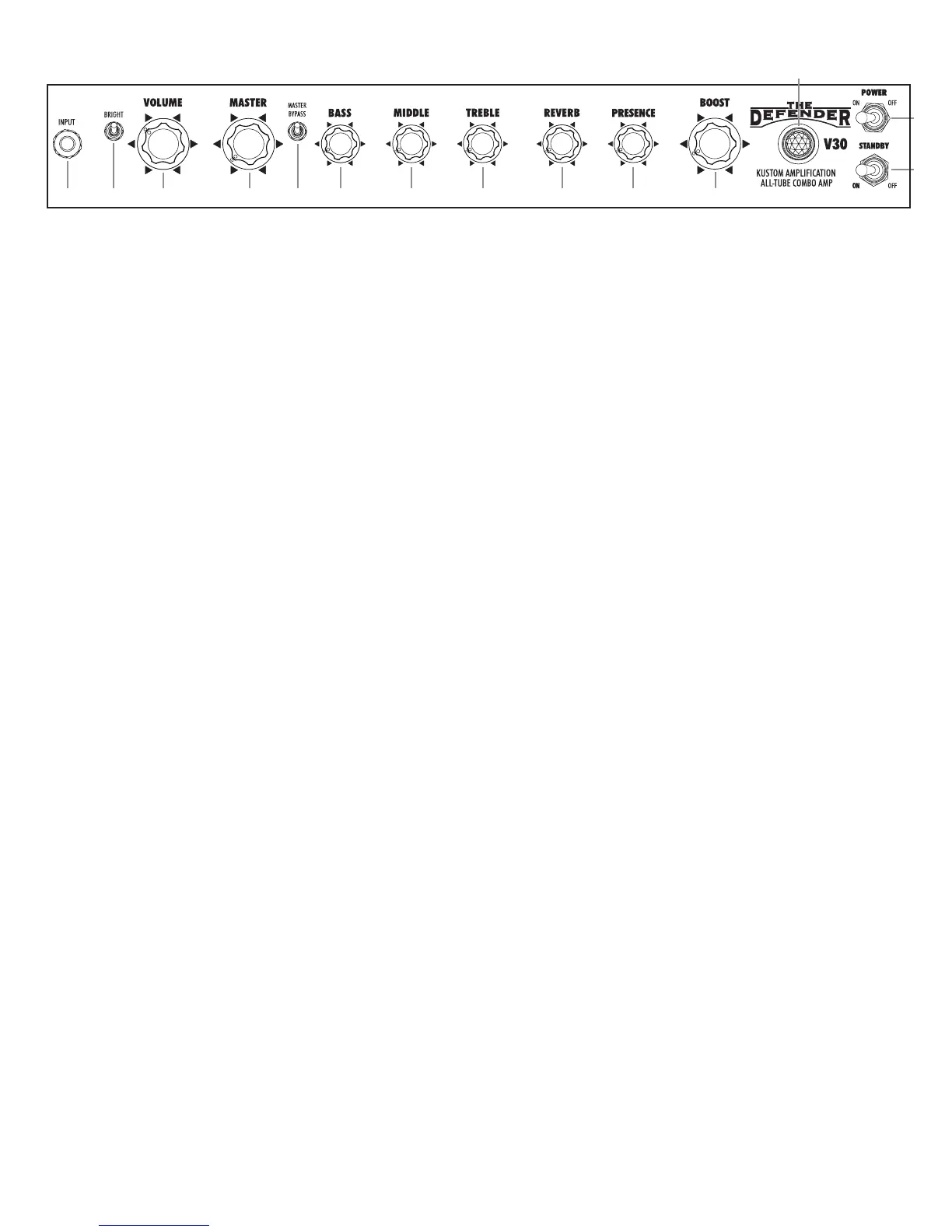
5. MASTER BYPASS: This control disables the Master Volume control from the circuit, allowing the V30 to function like a vintage tube
amp. Crank up the Volume Control with Master Bypass engaged for authentic vintage overdrive.
1 2 3 4 5 6 7 8 9 10 11
12
14
13
6. BASS: This passive EQ adjusts the low frequency equalization of the amplier. It interacts with the Middle and Treble as described
in the Treble section (8). For a tighter low end, use the Bass EQ set to lower settings. This is particularly helpful when using the amp at
very loud settings.
1. INPUT JACK: This ¼” input is for plugging in your instrument. It is intended for guitar but will accept other instruments as well.
3. VOLUME: This control adjusts the gain at the input stage of the preamp. It is used in conjunction with the Master to dial in the
desired amount of distortion and volume. For cleaner sounds, this control should be set to lower settings and the Master set higher for
slight breakup, the controls should be set in their middle ranges for heavier distortion, set the Volume higher and the Master lower.
2. BRIGHT: The Bright Switch increases the high frequencies while reducing low frequencies for a tighter, chunkier attack. This feature
is useful for ne-tuning the amp’s tone and feel for different guitars.
4. MASTER: The Master control sets the overall volume of the amplier and simultaneously tailors the tone controls based on the
Master knob position. When the Master is set higher, the tone is adjusted for a cleaner, “chimey” tone. When set lower, for more
distortion, the tone controls adjust the low end for a tighter, thicker sound.
7. MIDDLE: This passive EQ adjusts the midrange equalization of the amplier. It interacts with the Bass and Treble EQ as described
in the Treble section (8). For a heavier, more distorted sound, set the Middle lower. For more of a vintage-style, cleaner sound, set the
Middle higher. This EQ works for both Rhythm and Lead channels
8. TREBLE: This passive EQ adjusts the high frequency equalization of the amplier, but also interacts with the Bass and Middle
controls as follows: As the Treble is increased, the Bass automatically decreases and the Middle slides down in frequency. Conversely,
if the Treble is decreased, the Bass automatically increases and the Middle slides up in frequency. This interaction is typical of vintage-
style passive EQ, and is responsible for the increased effectivity of such a simple system.
9. REVERB: Reverb controls the amount of reverberation effect in the amplier. This effect is created by an authentic spring reverb pan
and essentially sounds like playing the amp in a large room. The Reverb can be defeated by turning the knob fully counter-clockwise.
10. PRESENCE: The Presence control operates in the power amp section of the amp and adds high frequencies to the tone. Higher
settings will provide more bite and help you cut through the mix.
11. BOOST: This controls the amount of footswitchable boost in the power amp, and is particularly useful for solos. It will provide up to
10dB of “Master Volume” boost. The tone is optimized to increase the volume without sacricing too much headroom in the power amp.
(Note: Boost is active if the footswitch is unplugged.)
12. JEWELED PILOT LIGHT: Indicates that the power switch is in the “ON” position.
13. STANDBY: This allows the amplier to be on, but with the tubes in a non-operational mode. Switching into the “OFF” will cause no
sound to come out of the amplier. This can be used instead of the power switch between performance sets, and when powering up the
amp.
14. POWER: Provides AC power to the amplier when in the “ON” position.
V30 Control Panel


 To Next Page
 Loading...