Need help?
Do you have a question about the KYMCO Super 8 ForU and is the answer not in the manual?
Explains symbols for hazards and information.
Defines indoor/outdoor use and user suitability.
Emphasizes reading manual, user access, and safety rules.
Covers safe driving practices, speed, inclines, and obstacles.
Highlights hazards during transport, assembly, and maintenance.
Details fire hazards, risks, and burn hazards related to batteries.
Discusses electromagnetic interference with scooter electronics.
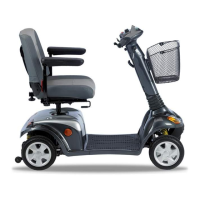
Identifies main parts of the scooter with labels.
Labels and explains dashboard components and controls.
Step-by-step guide on how to start driving.
Instructions for dismantling the scooter for transport.
Step-by-step guide to adjust seat height.
Instructions for adjusting seat distance and armrest width.
How to adjust the angle of the tiller for optimal reach.
Guidance on safely navigating inclines and slopes.
Instructions for safely clearing obstacles like kerbstones.
Detailed steps for climbing kerbs safely.
Explains overload protection and how the motor stops.
Details the battery charge display and its interpretation.
Factors affecting driving range and how to maximize it.
How the scooter protects batteries from over-discharge.
Step-by-step guide for safely mounting and dismounting.
Instructions for rotating the seat to different positions.
How to turn the scooter on and off.
Explains the operation indicator and fault codes.
How to adjust the maximum driving speed using the controller.
Pre-drive checks for safety and functionality.
Basic driving instructions and tiller handling.
How the motor brake functions for stopping.
How to operate the scooter's horn.
Procedures for safely switching off and parking.
General information and requirements for charging batteries.
Step-by-step guide to connect the charger.
Explains LED indicators on the charger.
Steps to disconnect the charger after use.
Explains how the battery charger works.
Information about the scooter's batteries.
Defines batteries designed for repeated charging cycles.
Explains battery break-in period for optimal performance.
Tips for maximizing battery lifespan.
Role and importance of anti-tipping wheels.
Details about the scooter's wheels and tyres.
Identifies components of the drive unit.
Explains the mechanical operation of the drive system.
Describes the programmable electronic control unit.
Explains the automatic power-off feature.
Details how the scooter's braking system works.
Information on whether a license is required.
Recommendations regarding scooter insurance.
Regulations regarding road use and classification.
General advice on dismantling for transport.
Safety rules for transporting the assembled scooter.
Safety notes on disassembling for transport.
A summary of disassembly steps.
Steps to remove seat and rear panelling.
Instructions for safely removing batteries.
How to fold the tiller for transport.
Steps to detach the drive unit.
Refers to reassembly.
Daily checks before operating the scooter.
Schedule and items for annual professional inspection.
Pre-troubleshooting checks for simple issues.
Table of common faults, causes, and remedies.
Explains blink codes for error messages.
Detailed list of error codes and their meanings.
Safety precautions for repair work.
Lists necessary tools for repairs.
Instructions for removing and replacing wheels.
Overview of replacing a damaged wheel.
Location and replacement of fuses.
Battery types and replacement considerations.
Proper disposal and handling of batteries.
Steps for refitting battery cables safely.
Tightening torques for various screws and bolts.
Environmental guidelines for scooter disposal.
 General
| Brakes (Front) | Disc |
|---|---|
| Brakes (Rear) | Drum |
| Seat Height | 780 mm |
| Front Tire | 120/70-12 |
| Rear Tire | 130/70-12 |
| Transmission | CVT |
| Cooling | Air Cooled |

 To Next Page