use shall be considered improper and hence hazardous. The manufacturer
cannot be held responsible for any damage resulting from improper or
incorrect use.
• Thisdevicedoesnotreplaceanyproductsuppliedtoyoubyyour
practitioner or by other professionals.
WARNING
1) If there is reduced blood circulation in the arm due to acute or chronic
vascular diseases (including the restriction of the diameter of the blood
vessels), the precision of the measurement could be affected.
2) In the case of cardiocirculatory illnesses, the measurements could be
falsified; the same could happen with very low blood pressure, problems
with blood supply, arrhythmia or other pre-pathological conditions.
3)Donotuseneartostrongmagneticfields.Itmustbekeptwellawayfrom
radio equipment or mobile phones.
4) Pressure varies from person to person, and increases or decreases every
day,dependingonthestresstheheartissubjectedto.Normallypressure
islowduringthenight,duringsleeporduringrelaxation,anditishigher
duringtheday,whenwesmoke,duringphysicalexercise,undereffort,
whenweareanxiousortense.
Blood pressure tends to increase with age and depends greatly on the
individualwayoflife.Itiswellknownthatstress,obesity,excessiveintake
of salt and alcohol all contribute to increase arterial pressure.
The blood pressure value measured at home tends to be lower
than that measured at the hospital, in the clinic, or by your
doctor.Thisoccursbecauseoneisusuallyanxiousatthehospitaland
relaxedatone’shome.
5) Keep the batteries out of the reach of children.
CLASSIFICATION OF BLOOD PRESSURE VALUES
The following table has been developed by the World Health Organization
(WHO), a special agency of the United Nation for health issues.
RANGE SYSTOLIC DIASTOLIC MEASURES
Optimal 105 - 120 60 - 80 self-measurement
Normal 120 - 129 80 - 84 self-measurement
Limit range 130 - 139 85 - 89 refer to a physician
High blood pressure (1st level) 140 - 159 90 - 99 refer to a physician
High blood pressure (2nd level) 160 - 179 100 - 109
refer to a physician
High blood pressure (3rd level) beyond 180 beyond 110 refer to a physician
At the end of each measurement, the measured pressure data are compared
with the above mentioned table.
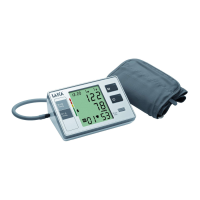
The segments appearing on the left of the display indicate the classification of
the blood pressure values:
Optimal green color
Normal green color
Limit range green color
High blood pressure (1st level) yellow color
High blood pressure (2nd level) orange color
High blood pressure (3rd level) red color
Measured values lower than 105 mmHg (systolic) and than 60 mmHg (diastolic)
Instructions and guarantee
23
GB
English


 To Next Page
 Loading...