EasyManua.ls Logo

Lambrecht meteo 15189 - User Manual

Lambrecht meteo 15189
10 pages
Print Icon
To Next Page IconTo Next Page
Loading...
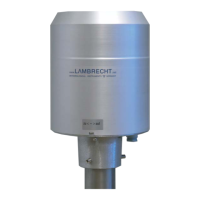
(15189 analog) Precipitation Sensor Operating Instructions
Operating Instructions
Precipitation Sensor (15189 analog)
Features
Precipitation sensor for automatic weather stations
Linearised pulse output, e. g. for connection to external data loggers
Selectable analog output signals, e g. for easy connection to PLC
Selectable measuring ranges as well as absolute or gliding sum for the analogue output signals
Exchangeable, weighing tipping bucket system according to Joss-Tognini, over ow proof
2 cm³ tipping bucket (2 g water) for precise precipitation measuring in regions with normal rain falls
4 cm³ tipping bucket (4 g water) for precise precipitation measuring in regions with heavy rain falls / tropical rain
Winter- t model (15189 H analog) with electronically controlled 2-circuit heating
Weatherproof materials (anodized aluminium, stainless steel) guarantee a long durability
Funnel according to the WMO Standard No. 8
1
Question and Answer IconNeed help?

Do you have a question about the Lambrecht meteo 15189 and is the answer not in the manual?

Summary

Precipitation Sensor Features

Primary Application

Identifies the sensor's use in automatic weather stations.

Linearised Pulse Output

Details the linearised pulse output for data logger connectivity.

Selectable Analog Outputs

Explains selectable analog signals for easy PLC integration.

Adjustable Measuring Ranges

Covers selectable ranges and output modes for analog signals.

Exchangeable Tipping Bucket System

Features the exchangeable, overflow-proof Joss-Tognini tipping bucket system.

2 cm³ Tipping Bucket

Specifies the 2 cm³ tipping bucket for normal rainfall measurements.

4 cm³ Tipping Bucket

Specifies the 4 cm³ tipping bucket for heavy rainfall measurements.

Heated Model for Winter

Highlights the heated model for year-round operation with controlled heating.

Durable Weatherproof Materials

Discusses weatherproof materials ensuring long-term durability.

WMO Standard Compliant Funnel

Notes the funnel design meets WMO Standard No. 8 requirements.

Sensor Functionality

Weighing Tipping Bucket Operation

Explains the weighing principle and error compensation of the tipping bucket.

Pulse and Analog Signal Outputs

Describes bounce-free pulse and analog outputs for system integration.

Low Power Mode

Details deactivating the analog output for low power consumption mode.

Heated Version for Snowfall Regions

Covers the heated variety for year-round measurements and snow prevention.

Installation Guide

Sensor Mounting Procedure

Instructions for mounting the sensor securely on a tube or pole.

Protective Covering Installation

Guidance on installing the protective covering without hindering the mechanism.

Tipping Bucket Handling

Tipping Bucket Assembly and Transport

Instructions for assembling and transporting the tipping bucket with care.

Tipping Bucket Bearings Explained

Explains the precision delrin bearings that reduce friction during operation.

Securing the Tipping Bucket

Details how to insert and secure the tipping bucket using locking plates.

Dismounting the Protective Cover

Steps for removing the protective covering using an Allen key.

Electrical Connections and Power

Sensor Connection Cable Specifications

Specifies cable type, diameter, and maximum length for sensor connection.

Underground Cable Protection

Recommends protecting cables buried underground with a plastic tube.

Heated Version Wiring

Details the 2-core cable connection required for the heating system.

Heating System Test Procedure

Describes a test for heating elements using a magnet and checking LEDs.

Operation and Maintenance

Initial System Operation Check

States the sensor is ready after complete mounting and electrical assembly.

Periodic Maintenance and Cleaning

Advises periodic checks and cleaning to ensure proper operation.

Operational Check with Artificial Rain

Outlines using artificial precipitation for an operational check.

Tipping Bucket Cleaning Disassembly

Instructions for disassembling the tipping bucket for thorough cleaning.

Warranty and Non-Liability

Notes loss of warranty due to unauthorized manipulation or improper use.

Basic Sensor Settings

Default Output Settings

Lists default settings for active pulse and analog outputs.

Power Requirements

Specifies current consumption and required supply voltage range.

Wiring Diagram with Heating

Provides the wiring diagram for the sensor with heating functionality.

Wiring Diagram without Heating

Provides the wiring diagram for the sensor without heating functionality.

Advanced Configuration Options

Modifying Basic Settings

Guidelines for changing basic settings, recommending power-off mode.

Selectable Operating Modes Overview

Overview of selectable modes like analog outputs and time-frames.

Jumper Functions for Configuration

Explains the role of jumpers J3, J4, J5, J6, and J12 in sensor configuration.

Jumper J10 Installation Requirement

Notes that jumper J10 must always be plugged in the middle position.

Analog Output Configuration Examples

4-20 mA Analog Output Setup

Example wiring diagram for configuring the 4-20 mA analog output.

0-5 V Analog Output Setup

Example wiring diagram for configuring the 0-5 V analog output.

0-10 V Analog Output Setup

Example wiring diagram for configuring the 0-10 V analog output.

Low Power Mode Configuration

2-Wire Circuit Low Power Mode

Example configuration for low power mode using a 2-wire circuit.

PLC Interface Low Power Mode

Example configuration for low power mode with a PLC interface.

Operating Mode Explanations

Pulse Output Explained

Details pulse output characteristics, frequency, and connection precautions.

Absolute Sum of Precipitation

Explains how accumulated precipitation is output as an analog signal up to a range limit.

Gliding Sum of Precipitation

Describes the gliding sum mode for updated precipitation over a time frame.

Resetting the Analog Output

How to reset the analog output signal to its starting value using an external switch.

Jumper Setting Diagram

Blank Board for Jumper Settings

Diagram of the circuit board for registering specific jumper settings for service.

Technical Data Specifications

Unheated 2 cm³ Version Technical Data

Technical specifications for the unheated 2 cm³ bucket sensor.

Unheated 4 cm³ Version Technical Data

Technical specifications for the unheated 4 cm³ bucket sensor.

Heated 2 cm³ Version Technical Data

Technical specifications for the heated 2 cm³ bucket sensor.

Heated 4 cm³ Version Technical Data

Technical specifications for the heated 4 cm³ bucket sensor.

Accessories and Services

General and Heated Version Accessories

Lists general accessories and those specific to heated sensor versions.

User-Specific Configuration Service

Information on factory configuration services for customizing the precipitation sensor.

Critical Safety Instructions

Pre-Operation Safety Guidelines

Emphasizes reading manuals and following guidelines before operating the system.

System Usage and Compliance

Stresses using the system strictly according to manual regulations and technical conditions.

Warranty and Unauthorized Modifications

Warns about loss of warranty due to unauthorized system modifications.

Overview

The LAMBRECHT meteo Precipitation Sensor (15189 analog) is a device designed for precise measurement of precipitation in automatic weather stations. It utilizes a weighing tipping bucket system, developed by Joss-Tognini, with bearings arranged for low friction to ensure accuracy. The unique form of the tipping bucket automatically compensates for errors typically caused by incomplete draining due to surface tension.

Function Description:

The sensor measures rain quantity by counting tips of a bucket. Each tip closes a reed contact, generating a signal that can be transmitted as a pulse or an analog output. The tipping bucket can hold either 2 cm³ (2 g) or 4 cm³ (4 g) of water. Given a collecting surface of 200 cm² (WMO standard), one bucket charge corresponds to a precipitation rate of 0.1 mm or 0.2 mm per square meter, respectively.

The device offers a bounce-free, linearised pulse output, which is continuously available in parallel with an analog current or voltage output, facilitating easy integration into a PLC. The analog output can be deactivated for low power operation, allowing the sensor to be supplied separately from the signal circuit or directly via the signal voltage.

For year-round measurements in snowfall regions, a heated version (15189 H analog) is available. This model incorporates two separate, electronically controlled heating circuits with minimal hysteresis. This design ensures optimal temperature regulation to prevent snow accumulation on the sensor and minimize evaporation from heated surfaces.

The sensor is constructed from weatherproof materials, including anodized aluminum and stainless steel, ensuring long-term durability. The funnel is designed according to WMO Standard No. 8.

Important Technical Specifications:

General:

  • Current consumption: ≤ 40 mA
  • Supply voltage: 18...30 VDC, max. load 600 Ω
  • Dimensions: See dimensional drawing (height 292 mm, diameter 190 mm, mounting diameter 60 mm)
  • Weight: Approx. 4 kg
  • Standards: WMO-No. 8, VDI 3786 Bl. 7, EN 50081/82, VDE 0100

Unheated Versions (15189 analog):

  • Measuring principle: Weighing tipping bucket designed according to Joss-Tognini
  • Range of application: 0...+70 °C (measuring)
  • Analog outputs: 0...20 mA (basic setting), 4...20 mA, 0...5 V, 0...10 V (selectable)
  • Pulse output: Linearised, bounce-free signal
    • Current consumption (deactivated analog output): Max. 100 µA, typical 50 µA

    • Supply voltage (deactivated analog output): 5...30 VDC

    • Switch load: Max. 30 VDC / max. 0.5 A (at pure ohm load)

    • 2 cm³ bucket (00.15189.002 050):

      • Measuring range: 2 cm³ (2 g water) - volume of bucket
      • Precipitation rate: 0...8 mm/min
      • Resolution: 0.1 mm
      • Accuracy: ± 2%
    • 4 cm³ bucket (00.15189.004 050):

      • Measuring range: 4 cm³ (4 g water) - volume of bucket (for very high precipitation intensity)
      • Precipitation rate: 0...16 mm/min
      • Resolution: 0.2 mm

Heated Versions (15189 H analog):

  • Heating data: Electronic controlled, dual-circuit

  • Accuracy: 4 °C ± 2 °C, controlled temperature within a range of -20...+4 °C

  • Heating power: 80 W (funnel), 70 W (outlet/tipping bucket)

  • Supply voltage (heating): 24 VDC / 150 W

  • Range of application: -20...+70 °C (no icing, no snowdrift)

    • 2 cm³ bucket (00.15189.402 050): Data similar to 00.15189.002 050, with controlled 2-circuit heating.
    • 4 cm³ bucket (00.15189.404 050): Data similar to 00.15189.004 050, with controlled 2-circuit heating.

Usage Features:

  • Mounting: The sensor mounts on a tube or pole with an outer diameter of 60 mm. A metallic extension tube (minimum 100 mm) is recommended if a wooden pole is used. A spirit-level should be used on the upper measuring edge for horizontal adjustment. The mounting pedestal screws should be tightened evenly to ensure the tipping bucket is vertically positioned.
  • Protective Covering: When mounting the protective covering, ensure the "close <--> open" sign is positioned above the fixing screw to prevent the heating cable from blocking the tipping bucket, especially in heated versions.
  • Tipping Bucket Assembly: The tipping bucket is separately packed for transport and should be inserted on-site after mounting the gauge. The protective covering must be removed first. Caution is advised to avoid damaging the sharp edges of the tipping bucket or bending the middle wall. The bucket rests on precision bearings made of abrasion-resistant delrin. A relocatable locking plate secures the tipping bucket. Ensure the magnet attached to the middle wall of the bucket rests under the capsule with the embedded reed contact.
  • Electrical Connections: The sensor connects via a cable led through a conduit gland. A (2)(4) x AWG 20 CU L sw cable (approx. 5.1 mm diameter) is recommended, not longer than 11 m. For underground cable transfer, a protective plastic tube is advised.
  • Heating Connections (for heated versions): A 2-core cable is required for the heating, connected to a power supply unit as per wiring diagrams. The function of the heating elements can be tested by holding a magnet close to the blue housing of the switching circuit; current switches off at approximately 50 °C. Green and red LEDs on the thermostatic module indicate supply voltage and heating status, respectively.
  • Operating Modes:
    • Pulse Output: Permanently activated, linearised pulses with a duration of 125 ms, up to 100 output signals per minute. An additional current-limited resistor (2...10 kOhm) is necessary if the pulse output is connected to the power supply via jumper J12. The "2 wire" operating mode is not compatible with analog output signals.
    • Absolute Sum of Precipitation: Accumulated precipitation is emitted as an analog signal up to a selected final value. Upon exceeding this value, the analog signal resets to a low level (sawtooth diagram), and a new summation begins.
    • Gliding Sum of Precipitation: Accumulated precipitation, updated each minute, is emitted within a selected time-frame. If the final value of the selected range is exceeded, the analog signal remains at the highest level. The gliding sum over the adjusted time-frame will then decrease below the final value, meaning the signal is limited and does not reset.
    • Analog Output Reset: An external switch at the "RESET ANALOG OUTPUT" pins allows resetting the analog output to its starting value (e.g., 4 mA for a 4...20 mA range), restarting summation from zero.
  • Jumper Settings: Jumpers (J3, J4, J5, J6, J12) allow selection of operating modes, analog output activation, voltage output switching, and power supply/pulse output separation for 2-wire circuits. J10 must always be plugged in the middle position. Changes to basic settings should be made in power-off mode by a skilled technician, as they are accepted only after reconnecting the power supply.

Maintenance Features:

  • Maintenance-Free Design: The precipitation sensor is largely maintenance-free.
  • Periodic Cleaning: Regular checks and cleaning are necessary to ensure proper operation, as dirt accumulation can cause measurement errors. The cleaning interval depends on local conditions.
  • Operational Check: An operational check can be performed using artificial precipitation. A 200 cm³ or 400 cm³ (for 4 cm³ buckets) test container of water should be introduced into the collecting funnel via a nozzle (approx. 0.6 mm diameter) over 10 to 20 minutes. After this, 100 ± 2 bucket tippings should be counted.
  • Sensor Cleaning: Rinse the sensor thoroughly. Clinging dirt particles in the collecting funnel or outlet pipe can be removed with a piece of wood.
  • Tipping Bucket Cleaning: If measurement results are unsatisfactory after general cleaning, the tipping bucket should be disassembled. It can be cleaned by placing it in warm water with scouring material and carefully scraping off dirt with a small piece of wood. Caution is advised to avoid damaging the tipping bucket during cleaning.

Lambrecht meteo 15189 Specifications

General IconGeneral
BrandLambrecht
Modelmeteo 15189
CategoryAccessories
LanguageEnglish