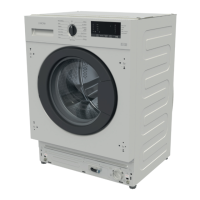
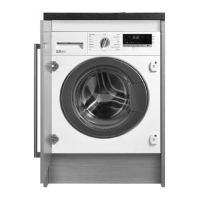
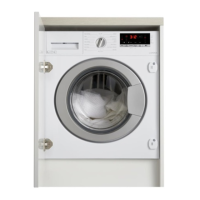
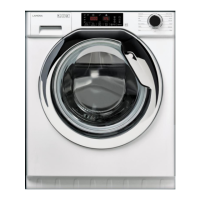
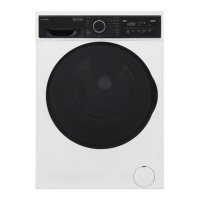
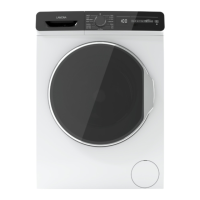
This document is an installation and operating instruction manual for an Integrated Washing Machine, model HJA 8514, manufactured by Lamona.
Function Description
The Lamona HJA 8514 is an integrated washing machine designed for domestic use. It is capable of washing various types of fabrics, from cotton and synthetics to delicate items like wool and silk, with specific programs tailored for different needs. The machine offers a range of wash temperatures and spin speeds to optimize cleaning and fabric care. It features a detergent drawer with separate compartments for prewash, main wash, and special additives. The appliance is designed to be integrated into kitchen cabinetry, with options for decor fitting to match existing furniture.
Important Technical Specifications
- Max. load of dry laundry for washing: 6 kg
- Water pressure: 0.05 – 0.8 MPa
- Cold fill only
- Spin speed: 1200 r.p.m.
- Measurements:
- Width: 60 cm
- Depth: 54 cm
- Height: 82 cm
- Electrical Connection: Requires a 13 Amp BS 1362 ASTA approved fused plug. The appliance must be earthed.
- Water Connection: Uses cold water only. The inlet hose is 3/4" B.S.P threaded. The discharge hose must be at a minimum of 50 cm and a maximum of 85 cm from the ground.
- Compliance: Appliance complies with European Directives 73/23/EEC and 89/336/EEC, replaced by 2006/95/EC and 2004/108/EC, and subsequent amendments.
Usage Features
Controls:
The washing machine features a control panel with a program selector knob, various buttons, and indicator lights.
- Door Open Button (A): Releases the door at the end of the wash cycle or after a 2-minute delay if pressed during a cycle.
- Door Security Indicator Light (B): Illuminates when the door is fully closed and the machine is ON. Flashes during the wash cycle and goes out when the door can be opened.
- Start/Pause Button (C): Initiates or pauses the selected program. A "STOP" indicator light flashes while waiting for the "Start/Pause" button to be pressed.
- Start Delay Button (D): Allows setting a delayed start for the program (3, 6, or 9 hours).
- Prewash Button (E): Activates a prewash cycle, useful for heavily soiled loads.
- Extra Rinse Button (F): Adds an extra rinse cycle, beneficial for sensitive skin or when using extra detergent.
- Crease Guard Button (G): Minimizes creases by using more water and a delicate spin.
- Spin Speed Control Knob (H): Adjusts the spin speed or selects "No Spin" for delicate fabrics.
- Wash Temperature Control Knob (I): Sets the wash temperature according to fabric type.
- "Time to End" Indicator Light (L): Displays the remaining time for the wash cycle (above 60 minutes, 60 minutes, 30 minutes, 15 minutes, or STOP).
- Buttons Indicator Light (M): Illuminates when specific options are selected.
- Timer Knob for Wash Programmes with OFF Position (N): The main program selector knob, which also serves as the "OFF" position.
Programmes:
The machine offers a variety of programs tailored for different fabric types and soil levels:
- Resistant fabrics (Cotton, Linen): Programs at 90°C, 60°C, and 40°C.
- Resistant fabrics (40°C AA): Special program for cotton with maximum load.
- Mixed fabrics and synthetics: Programs at 50°C and 40°C.
- Very delicate fabrics: Program at 40°C.
- Rinse: Separate rinse cycle.
- Spin: Separate spin cycle.
- Drain only: Drains water without spinning.
- Woolmark: Program at 40°C for wool.
- Silk – Hand Wash: Program at 30°C for silk.
- Sport: Program at 30°C for mixed fabrics.
- Resistant fabrics (A 59'): Special program for resistant fabrics with a 59-minute duration.
- Resistant or mixed fabrics (R 44'): Special program for resistant or mixed fabrics with a 44-minute duration.
- Resistant or mixed fabrics (R 29'): Special program for resistant or mixed fabrics with a 29-minute duration.
Detergent Drawer:
The detergent drawer is split into three compartments:
- Compartment "I": For prewash detergent.
- Compartment "II": For main wash detergent.
- Compartment "III": For special additives (fabric softeners, fragrances, starch, brighteners, etc.).
Liquid detergents should only be poured into compartment "II" during the final rinse stage for all wash cycles.
Loading the Laundry:
- Sort laundry by fabric type, color, and soil level.
- Check pockets for foreign objects.
- Close zippers, buttons, and hooks.
- Place small items in a net bag.
- Do not overload the machine; refer to maximum load capacities for each program.
Energy Saving Tips:
- Do a full load in your washing machine whenever possible.
- When prewashing is really needed? Only with particularly dirty loads.
- Which wash temperature should you choose? Use lower temperatures (e.g., 60°C) for energy savings.
Maintenance Features
Cleaning and Routine Maintenance:
- Cleaning the appliance: Use alcohol-based scourers or mild detergents. Avoid abrasive cleaners.
- Cleaning the detergent compartments: Remove the drawer and clean all compartments under running water.
- Cleaning the door glass: Regularly clean the door glass with a damp cloth to remove soap and water residues.
- Transporting the appliance: If the appliance is being transported or is out of use for long periods, ensure all remaining water is completely removed. Unplug the hose and point it downwards into a basin until all water has emptied out.
Investigating Malfunctions:
The manual provides a troubleshooting guide for common issues:
- Appliance not working: Check if plugged in, switch is ON, door is closed, fuse is blown.
- Does not fill with water: Check tap, program selector position, and hoses.
- Water does not drain away: Check for kink in discharge hose or blocked drain.
- Water on floor around machine: Check for leaking gasket, inlet hose, or blocked soap drawer.
- Does not spin: Check if water has not yet drained, or if "No spin" is selected.
- Machine vibrates a lot during spin: Check for transit brackets, level adjustment, and even laundry distribution.
- Door will not open: Wait two minutes after the program finishes.
Important Notes:
- Disposal: The appliance is marked according to European Directive 2002/96/EC on Waste Electrical and Electronic Equipment (WEEE). It should be disposed of correctly to prevent negative consequences for the environment and human health.
- Installation: Ensure the appliance is correctly installed and that the transit brackets are removed as shown in the installation instructions (page 27). Failure to remove transit brackets can cause significant damage and noise.
- Water hardness: Adjust detergent dosage based on water hardness to prevent scale buildup and optimize cleaning.
- Foam production: Excessive foam can indicate too much detergent or the presence of zeolites in hard water.
Warranty:
The product comes with a 12-month guarantee. For service, customers are advised to provide their full name, address, telephone number, sales receipt number, and the model number (HJA 8514).

 Need help?

 To Next Page
 General