
 Need help?
Do you have a question about the Landoll Drexel SLT30 AC and is the answer not in the manual?
Covers essential training requirements and general safety practices for forklift operators.
Importance of supervision in safe operation and proper training of forklift operators.
Explains how terms and illustrations are used within the manual for clarity.
Defines the meaning of safety alert symbols like DANGER, WARNING, and CAUTION.
Details the location and types of product decals found on the SLT30 AC forklift.
Lists and defines the meaning of various decals affixed to the forklift.
Essential safety practices for forklift operators to prevent injury.
Guidelines for proper use and importance of the seat belt for operator safety.
Explains the function of the operator seat switch for truck operation and safety.
Information regarding the automatic parking brake system and its operation.
Identifies conditions and causes of forklift tip-overs to ensure operator awareness.
Safe practices for driving the forklift and managing loads effectively.
Guidelines for selecting appropriate travel speed based on operating conditions.
Safety measures and precautions to take when visibility is restricted.
Precautions and safety guidelines related to battery handling and charging.
Safety guidelines for performing maintenance or repairs on the forklift.
Lists items included with the forklift from the factory.
Lists essential items needed for the truck's operation upon receipt.
Describes tools and equipment needed for general maintenance.
Steps to prepare the forklift for operation after receiving it.
Detailed procedure for performing a thorough inspection of the forklift.
Guidelines for proper storage, towing, and shipping of the forklift.
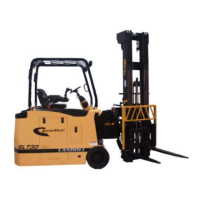
Overview of the forklift's design, features, and capabilities.
Details how to identify various components of the forklift using illustrations.
Explains the information found on the truck's identification plate.
Provides guidance on how to decode the serial number for the SLT30 AC truck.
Explains how to determine the forklift's safe lifting capacity based on various factors.
Introduces the basic components and systems of the SLT30 AC forklift.
Description of the truck's frame construction and materials.
Details the hydraulic brake system used on the truck.
Explains safety interlocks that prevent unauthorized movement of the truck.
Overview of the truck's electrical control system components.
Describes the main control unit for the truck's electrical system.
Details the AC drive motor and traction system of the forklift.
Explains the AC lift motor and its control system for mast functions.
Information regarding the 48-volt lead-acid battery and its maintenance.
Describes the feature for easy battery removal from the truck.
Location and function of the emergency power interrupt button.
Details the steer-by-wire steering system and its operation.
Information about the optional wire guidance system for automated steering.
Overview of the hydraulic system powering mast functions like tilt and side shift.
How mast positioning is achieved using the joystick and hydraulic system.
Details the hydraulic circuit for lifting and lowering the mast assembly.
Describes the hydraulic circuit for controlling mast tilting.
Explains the hydraulic circuit for side shifting the mast assembly.
Describes the hydraulic circuit for pivoting the mast assembly.
Information on triplex and quad mast configurations and their capacities.
Overview of all controls provided for operating the forklift.
Explanation of the accelerator and brake pedals and their functions.
Adjusting the steering column for operator comfort and safe operation.
Details seat adjustments for operator comfort, weight, and safety.
Location and function of the truck's main key switch for power control.
Explanation of the information and indicators shown on the dash display.
Details the function and operation of the joystick for mast control.
Fundamental principles for operating forklifts safely and efficiently.
Core concepts of forklift stability, balance, and the stability triangle.
Explains the three-point suspension and how the center of gravity affects stability.
Explanation of horizontal and vertical load centers and their impact on stability.
Role of counterweights in maintaining forklift stability with heavy loads.
How fork lift height affects the load capacity and stability of the forklift.
Safe practices for tilting the mast when handling loads at various heights.
Methods for accurately determining the weight of a load before lifting.
Awareness of changing workplace environments and potential hazards.
Safety precautions for operating in explosive or flammable atmospheric conditions.
Safe procedures for mounting and dismounting the forklift using three-point contact.
Explains the function and location of forklift controls and indicators.
Details seat adjustments for operator comfort, weight, and safety.
Detailed explanation of the joystick's function for controlling mast movements.
How to use the joystick for controlling mast lift and tilt functions.
How to use the joystick for controlling mast pivot and side shift functions.
Operation of the button to activate the optional wire guidance system.
Use of the button for operating optional hydraulic attachments via joystick.
Operation of the switch for selecting forward, neutral, and reverse movement.
Location and use of the horn button on the joystick.
Adjusting the steering column for operator comfort and safe operation.
Function and operation of the truck's main key switch for power.
Explanation of the information and indicators shown on the dash display.
Operation of the pedal controlling truck speed and acceleration.
Operation of the pedal to activate the service brakes for stopping.
How the automatic parking brake system functions and its engagement.
General procedures and safety precautions for operating the forklift.
Proper seating posture and seat belt usage for safe driving.
Steps for starting the truck and beginning to travel safely.
Safe practices for turning the forklift and navigating intersections.
Procedures for safely stopping the forklift under various conditions.
Steps for properly parking the forklift when it is not in use.
Techniques for safely handling loads, especially in narrow aisles.
How to adjust fork spacing for safe load engagement and stability.
Step-by-step guide for picking up a load from a rack.
Conditions that can cause a forklift to tip over and how to react.
Guidelines for safely moving loads across the workplace.
Safe turning procedures to prevent tip-overs, especially with loads.
Safety precautions for operating the forklift on ramps and inclines.
Step-by-step guide for safely placing a load into a rack.
Safe use of dockboards when loading or unloading vehicles.
Checks for optional warning devices like beacons and backup alarms.
Inspection and maintenance procedures for the fire extinguisher.
Details on operating optional systems like wire guidance and fork positioners.
Overview of the vehicle-controlled steering system.
Explanation of different operational modes for the wire guidance system.
Operation of the fork positioner attachment via the joystick.
Importance of daily and scheduled inspections for truck longevity and problem prevention.
Reference to detailed maintenance schedules and procedures for the forklift.
Procedures for performing the daily pre-shift inspection of the forklift.
Inspection of tires for wear, damage, chunking, and proper lug nut torque.
Checks for the condition and presence of static discharge straps.
Proper maintenance practices for battery longevity and strong voltage potential.
Steps for safely removing the battery from the forklift.
How to use a hydrometer to check battery electrolyte specific gravity.
Procedures for safely charging the forklift's wet cell battery.
Ensuring the battery restraint system is properly in place for safety.
Procedure to test the functionality and engagement of the parking brake.
Checks for proper operation and smooth stopping of the service brakes.
Checking the accelerator pedal for smooth operation and controlled stopping.
Visual inspection of lift chains for cracks, stress, or broken pins.
Inspection of forks for cracks, wear, and proper seating; use of replacement parts.
Checking electrical connections for looseness, fraying, or broken wires.
Inspection for hydraulic fluid leaks, hose wear, and tight fittings.
Checking and maintaining the hydraulic oil level for proper system function.
Checks related to the proper functioning of various operator controls.
Testing the lift/lower function of the joystick and associated motor.
Checking the mast tilt for racking, proper adjustment, and smooth operation.
Checking side-shift for binding, proper lubrication, and smooth movement.
Testing the directional control switch and the static return-to-off safety feature.
Checking the operation of the optional wire guidance system.
Checking the operation of optional hydraulic attachments via joystick.
Testing the horn operation by pressing the button on the joystick.
Checking the proper operation of all lights and audible alarms.
Checking the steering system for correct operation and speed sensitivity.
Adjusting the steering column for operator comfort and secure locking.
Inspecting the dash display for errors and ensuring normal readings.
Checking seat condition, belt integrity, slide locks, and operator presence switch.
Inspecting the truck frame, panels for rust, corrosion, or cracks.
Checking for damaged, missing, or illegible safety decals.
Verifying capacity ratings, lift heights, and serial numbers on the plate.
Identifying and reporting any new or unusual noises from the forklift.
Table detailing recommended lubricants for various forklift components.
Provides standard specifications for SLT30AC and SLT35AC forklift models.
 General
| Brand | Landoll |
|---|---|
| Model | Drexel SLT30 AC |
| Category | Compact Loader |
| Language | English |

 To Next Page
