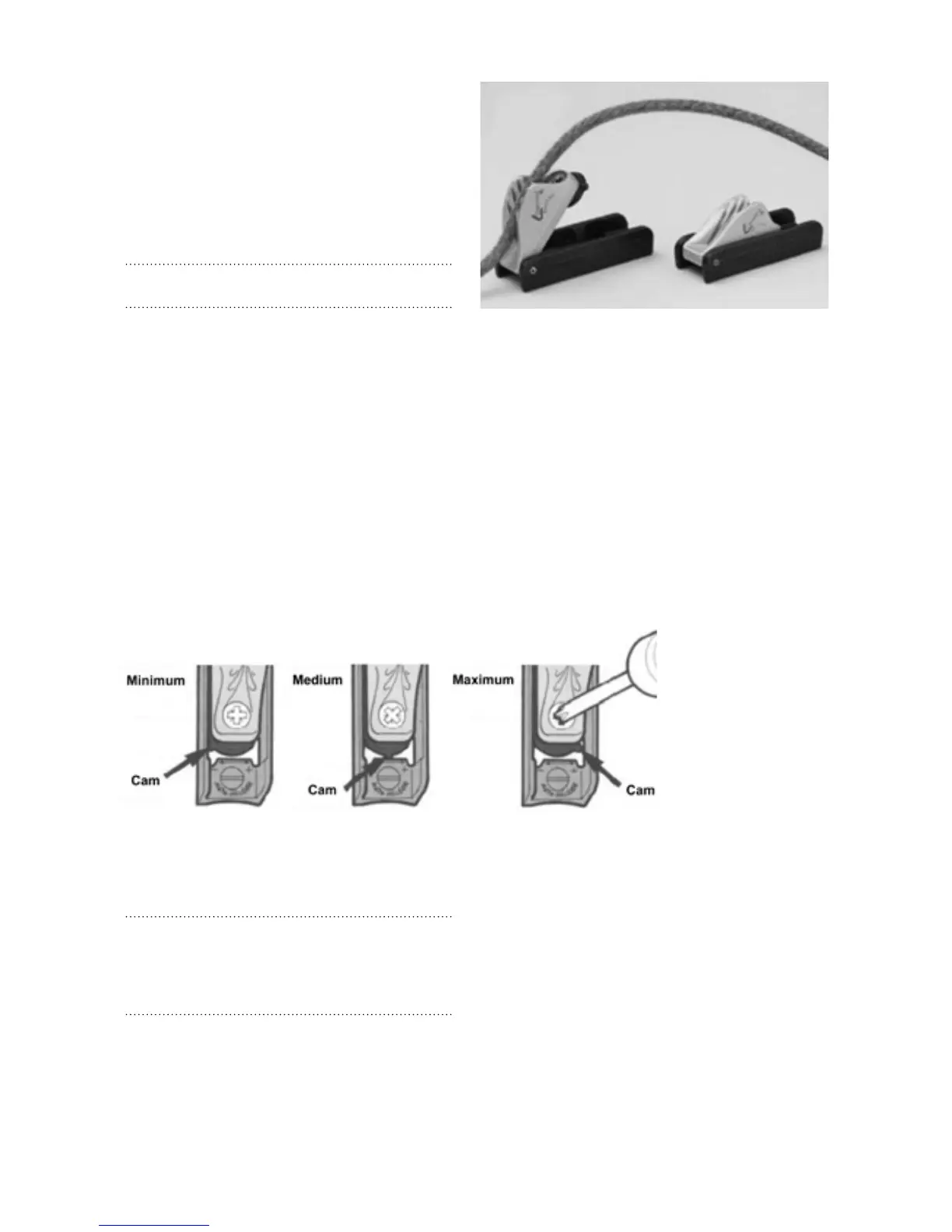
When adjusting the kick-up cleat mechanism on
your Pico rudder, we strongly recommend that
you set the cam at the minimum setting and
progressively increase it to suit your experience and
style of sailing.
If racing and sailing in strong winds you will want
to set the kick –up load higher. If recreational
sailing o the beach you will want to set the kick
up much lower.
Warning: Running aground with the kick-up set incorrectly
could damage your rudder and the hull.
e auto-release cleat provides the neatest and
best solution to the problem of how to lock-down
a rudder blade yet allow it to flip up if it hits
the bottom or a solid obstacle in the water. e
cleat holds ropes securely, yet will release them
immediately when the cleat is overloaded. Once
tripped, it can be easily reset in seconds by just
pushing the cleat back down into its base.
e cleat is also fitted with an adjustable cam so
that the release tension can be set to suit the boat
and local conditions. e cam is adjusted until the
rudder blade is held down reliably under maximum
sailing conditions. e cleat will then be set so that
the least strain is put on the rudder if it hits an
obstacle.
Setting the Release Load
1. Test release load with “cam” at minimum
setting.
2. To increase load use a screwdriver to rotate
“cam” towards maximum.
Warning: To avoid damaging equipment, make small adjust
-
ments and test each increase. Tests show that release loads of
240kg (530lbs) are possible with the cam at “maximum” setting.
Smaller or worn ropes release at higher loads than larger new
ropes.



 To Next Page