Need help?
Do you have a question about the LaTrax Teton 76054-1 and is the answer not in the manual?
Essential pre-operation instructions and warnings for safe and proper use of the model.
Procedure for correctly installing AA batteries into the transmitter for operation.
Instructions for safely charging the model's NiMH battery pack using the provided charger.
Guide to correctly inserting the model's battery pack into the chassis before operation.
Steps for checking and adjusting the radio system's initial setup and operation before driving.
Steps to electronically link the transmitter and receiver for proper operation.
Built-in function that returns throttle to neutral on signal loss, preventing runaway models.
Methods for selecting different ESC modes like Sport, Race, and Training for varied driving experiences.
Factory default mode (Profile 1) offering 100% forward, brakes, and reverse.
Mode (Profile 2) with 100% forward and brakes, but no reverse.
Important warnings about operating the model in wet conditions and the need for extra maintenance.
Detailed post-operation cleaning and maintenance steps for models used in wet conditions.
Check for cracked parts, binding, leaks, loose connections, and other signs of damage.
Regular upkeep for motor, chassis, shocks, suspension, and driveline components.
This document is the owner's manual for the LaTrax Teton, a 1/18-scale 4X4 adventure vehicle designed for off-road performance. It features a 4-wheel independent suspension, oil-filled shocks, and an efficient 4WD drivetrain, all engineered to be waterproof for use in various wet conditions. The manual provides comprehensive instructions for operating and maintaining the model, aiming to ensure a long and enjoyable user experience. It emphasizes the importance of reading and following all instructions, even for experienced R/C enthusiasts, to unlock the full performance and potential of the model.
The manual begins with an introduction and table of contents, outlining sections on safety precautions, supplied equipment, model overview, getting started, the 2.4GHz radio system, adjusting the electronic speed control, driving the model, and maintaining the model. It also includes information on customer support and product registration.
Safety is a primary concern, with a dedicated section detailing important warnings and precautions. Users are advised to operate the model sensibly and with care to prevent property damage or serious injury. The model is not intended for use by children under 14 without adult supervision. Key points include avoiding public roads or congested areas, never operating in crowds, being aware of radio interference, and exercising common sense. Specific warnings are given regarding the motor and battery, which can become hot during use. The manual also highlights the importance of disconnecting the battery when not in use, turning on the transmitter first, and using factory-installed connectors to prevent damage. It explicitly states that external Schottky diodes are not compatible with reversing speed controls and will void the warranty. Information on recycling NiMH batteries is also provided.
A critical section is dedicated to LiPo battery warnings, cautions, and dangers, emphasizing the severe fire risk if not handled properly. LiPo batteries are recommended only for advanced users who understand the associated risks. The manual details the importance of Low-Voltage Detection, which alerts the driver when LiPo batteries reach their minimum voltage threshold, requiring immediate cessation of use. It stresses the use of LiPo balance chargers with balance adapter ports and warns against using NiMH or NiCad-type chargers for LiPo batteries, as this can cause fire or injury. Users are advised never to charge LiPo battery packs in series or parallel. Pre-charging inspections for damage, proper storage in cool, dry places, and avoiding disassembly are also covered. General charging and handling precautions for all battery types include confirming charger settings, not attempting to charge non-rechargeable batteries, not exceeding recommended charge rates, and always charging/discharging in a fire-retardant container on a non-flammable surface. Additional warnings cover charging batteries inside automobiles, on flammable materials, in cluttered spaces, or unattended.
The supplied equipment includes a 5-6 cell 2-amp DC NiMH battery charger, a 5-cell 2/3A NiMH battery, and 4 AA alkaline batteries for the transmitter. Recommended, but not required, equipment for an R/C toolbox includes safety glasses, Traxxas Ultra Premium Tire Glue, a hobby knife, side cutters, needle nose pliers, a Phillips screwdriver, a complete hex key set, and a soldering iron.
A detailed model overview diagram labels key components such as the front body mount, front bumper, front suspension arm, shock, front differential, front camber link, toe link, steering servo, receiver box plug, chassis, battery compartment, receiver box, battery hold-down, motor, electronic speed control, pinion gear, spur gear, rear differential, rear suspension arm, rear body mount, and rear camber link.
The "Getting Started" section provides step-by-step instructions for installing transmitter batteries, charging the battery pack, and installing the battery pack in the model. It includes visual aids for battery installation and charging status indicators. Users are advised to check the transmitter's status LED for a solid green light and to replace weak batteries promptly. The charging process for the NiMH battery pack is detailed, including plugging the charger into an automotive auxiliary power socket and monitoring the LED status (red for charging, blinking green for charging, solid green for charged).
The 2.4GHz radio system is explained, covering terminology like Spread Spectrum, BEC, Current, ESC, Frequency band, mAh, Neutral position, NiMH, Receiver, Resistance, Servo, Transmitter, Trim, Thermal Shutdown Protection, and Voltage. Rules for radio system operation include holding the transmitter upright for maximum range, always turning the transmitter on first and off last, using new or freshly charged batteries, and ensuring the receiver is turned on within 20 seconds of the transmitter to bind. The manual warns against cutting the receiver's antenna wire, as this will reduce range.
Radio system controls are illustrated, showing the set button, red/green status LED, steering trim, power switch, steering wheel, and throttle trigger. Instructions for using the radio system include turning on the transmitter, elevating the model, connecting the battery, turning on the ESC, checking steering servo operation, adjusting steering trim, and verifying forward/reverse throttle operation. Range-testing the radio system before each running session is recommended to ensure proper operation, with a warning to leave adequate space between the user, model, and others.
The manual also covers radio system basic adjustments, including steering trim, channel reversing, and throttle reversing. It explains the failsafe function, which centers the throttle servo if low voltage is detected in the receiver, allowing enough power to maintain control. Transmitter and receiver LED codes are provided in tables, detailing different LED colors/patterns, their meanings (e.g., normal driving mode, binding, low battery alarm, link failure/error, failsafe/low-voltage detect), and corresponding notes or actions.
Adjusting the electronic speed control (ESC) is a key section, detailing profile selection (Sport Mode, Race Mode, Training Mode) and ESC operation. The ESC is factory-set to Sport Mode (100% forward, brakes, and reverse). Programming procedures involve pressing and holding the EZ-Set button and releasing it when the LED blinks a specific number of times to select a profile. Training Mode reduces forward and reverse throttle by 50% for beginning drivers. Instructions for verifying and disabling Low-Voltage Detection (NiMH setting) are provided, as this feature is not compatible with the supplied NiMH battery and is disabled by default. ESC setup programming (calibrating the ESC and transmitter) involves a series of steps to ensure correct operation, including setting neutral, full throttle, and full reverse positions. LED codes and protection modes for the ESC are explained, such as solid red for power-on, fast blinking red for thermal shutdown, slow blinking red for low-voltage protection, fast blinking green for no signal, and flashing red and green for over-voltage protection.
The "Driving Your Model" section offers practical advice for optimal performance and longevity. It emphasizes allowing the model to cool between runs, stopping immediately at the first sign of weak batteries, and avoiding public roads or crowds. Users are warned against continuing to run the motor if the model is stuck, driving in tall grass or deep sand, or operating in conditions that severely limit performance, as these can strain the power system and cause motor failure. The manual reiterates the importance of allowing a safety margin due to potential radio interference. It encourages sensible driving to prevent poor performance and broken parts. Regular checks of wheel bolts and other screws are recommended due to vibrations. Tips for increasing run time include using batteries with high mAh ratings, using the included or a high-quality peak-detecting charger, following battery/charger maintenance instructions, keeping the speed control cool, and maintaining the model's drivetrain. The effect of mAh ratings on power output and top speed is also discussed. Shock mounting positions are explained, allowing users to tune the suspension for different driving styles and surfaces.
Running the model in wet conditions is addressed, highlighting the model's water-resistant features for electronics but clarifying that it is not submersible or 100% waterproof. Precautions include understanding that additional maintenance is required after wet running, confirming battery compatibility with wet environments, avoiding rain or lightning, and staying away from salt or contaminated water. Special care for the motor in wet conditions is advised, such as using very light throttle if the motor gets wet. After running in wet conditions, maintenance steps include removing the battery, rinsing dirt with low-pressure water, blowing off with compressed air (wearing safety glasses), removing wheels, spraying bearings/bushings/fasteners with WD-40 or similar oil, lubricating the drivetrain, allowing the model to dry, and checking the receiver box for trapped water. Increased frequency of disassembly, inspection, and lubrication is recommended after extended wet use or long storage periods to prevent corrosion.
Finally, the "Maintaining Your Model" section provides a checklist for inspecting the vehicle for damage or wear, including cracked/bent parts, binding wheels/steering, shock leaks, frayed wires, loose connections, and chassis screws. Periodic maintenance tasks include cleaning and re-oiling stub axle housing bearings, disassembling/cleaning/regreasing front and rear differentials, cleaning spur and pinion gears, cleaning and re-oiling the motor bushings, keeping the chassis clean, maintaining shock oil levels, inspecting suspension components, and checking the driveline for wear. The manual concludes with a reminder to wear eye protection when using compressed air or spray cleaners and lubricants, and instructions for proper storage of the model and batteries.
 General
| Scale | 1:18 |
|---|---|
| Drive type | 4-wheel drive (4WD) |
| Engine type | Electric engine |
| Product type | Monster truck |
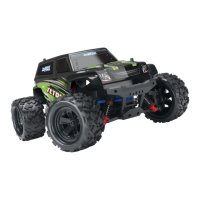
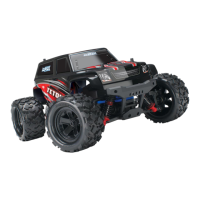
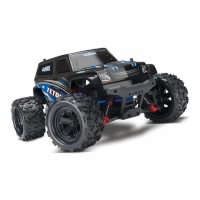
| Housing color | Black, Blue |
| Built-in servo | Yes |
| Frequency band | 2.4 GHz |
| Housing material | - |
| Channels quantity | 3 channels |
| Construction type | Ready-to-Run (RTR) |
| Protection features | Dust resistant, Snow resistant, Water resistant |
| Moving control functions | Backward, Forward, Stop |
| Electronic speed control (ESC) type | Brushed |
| Battery voltage | 7.2 V |
| Battery technology | Nickel-Metal Hydride (NiMH) |
| Number of battery cells | 6 |
| Compatible battery sizes | AA |
| Number of batteries (transmitter) | 4 |
| Package type | Window box |
 Weight and Dimensions
| Width | 185 mm |
|---|---|
| Height | 118 mm |
| Length | 258 mm |
| Weight | 550 g |
| Clearance | 30 mm |
| Wheelbase | 163.5 mm |
| Tire width (rear) | 107.5 mm |
| Tire width (front) | 106 mm |
| Front wheels diameter | 41.5 mm |

 To Next Page