
 Need help?
Do you have a question about the le-idea IDEA10 and is the answer not in the manual?
Download the free APP for aircraft communication, enabling advanced features like Photos, Videos, and Selfie/Follow mode.
Connect your device to the aircraft's WiFi band (e.g., WiFi-1080P-GPS-xxx) after powering on the aircraft.
Use the physical controller for safety and range; use the APP for advanced functions like selfie mode, photos, and video recording.
Insert a fully charged battery into the aircraft compartment. A full charge takes about 120 minutes.
Place aircraft on a flat surface and press the power button until all 4 LEDs (2 Red, 2 White) flash.
Turn on the remote, listen for a beep, check 4 blue LEDs, then flip the left joystick up and down to pair.
Perform Gyro calibration by spinning aircraft counter-clockwise, then flipping nose down and spinning again until LEDs stop blinking.
Complete Gyro (accelerometer) calibration by pulling both joysticks inwards for 3-5 seconds before each flight.
Press and hold the STOP button for 3 seconds to immediately turn off engines in an emergency.
After GPS connection and calibration, pull left and right joysticks in opposite directions to start rotor spinning.
Press the launch button after engines are active to self-launch the aircraft to waist height.
Control the aircraft to a landing spot and press the land button for a simple, soft landing and engine shutdown.
Use the 'Home' button to return the drone to its launch point, then manually land it.
This document serves as a Quick Start Guide for the IDEA10 aircraft, a drone manufactured by Guangzhou le Idea Technology Limited Company. It provides essential instructions for setting up, calibrating, and operating the drone, along with information on its associated mobile application and remote control.
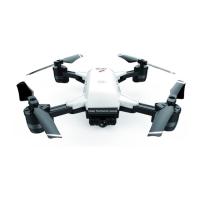
The IDEA10 aircraft is a drone designed for aerial photography, videography, and general flight. It features GPS capabilities, allowing for advanced functions like selfie/follow mode and precise positioning. The drone can be controlled via a physical remote control, which offers a safer and more robust control experience, or through a dedicated mobile application for advanced features and FPV (First Person View) and VR (Virtual Reality) modes. The aircraft is equipped with a camera for capturing photos and recording videos. Its design includes foldable arms for portability and a battery compartment for easy insertion of a rechargeable battery.

 To Next Page
 General