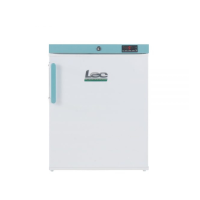
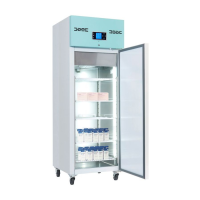
This document serves as a user manual for the Lec Medical Laboratory Refrigerator Range, specifically covering models LSR151 and LSR288. It provides comprehensive instructions for the safe and efficient operation, maintenance, and troubleshooting of these laboratory refrigerators.
Function Description
The Lec Medical Laboratory Refrigerator is designed for professional use in environments such as pharmacies, laboratories, and medical facilities. Its primary function is to store contents within a temperature range of +2°C to +10°C, ensuring the integrity of sensitive materials like vaccines. The refrigerator utilizes energy-efficient R600a refrigerant, an environmentally friendly, non-ozone-depleting gas.
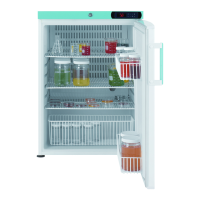
Key components include a lock for securing contents, an electronic controller for precise temperature management, and an antimicrobial handle for enhanced hygiene. The interior features wire shelves and wire baskets for organized storage. Adjustable feet at the front of the appliance, along with two roller castors at the rear, facilitate easy positioning and movement.
The electronic controller is central to the refrigerator's operation, allowing users to view and reset minimum and maximum air and "load" temperatures. The "load" temperature is a simulated temperature designed to indicate the temperature of the refrigerator's contents, which changes more slowly than air temperature in the event of a fault or open door. Users can also adjust the factory set point, change the temperature scale between Celsius and Fahrenheit, and configure remote alarm contacts.
The refrigerator is equipped with both audible and visual warning alarms to alert users to critical situations. These alarms are triggered if the door is left open for a set period, or if the internal air or "load" temperature deviates from the set parameters (either too high or too low). The audible alarm can be muted via a dedicated button on the controller.
Remote alarm contacts are a crucial safety feature, allowing the refrigerator to be connected to an external remote control station. These volt-free contacts can be configured as Normally Open (NO) or Normally Closed (NC) and will switch to create an electrical circuit in the event of a door open alarm, high or low temperature alarm, or power failure. This enables integration with building management systems or external monitoring devices, providing an additional layer of security for stored materials.
Usage Features
Before initial use, several steps are recommended to ensure proper setup and operation. These include checking for transportation damage, removing all packaging, cleaning the interior with a mild detergent, and allowing the refrigerator to stand upright for 24 hours before switching it on.
Proper positioning is vital for optimal performance and energy efficiency. The appliance should be placed in a dry, well-ventilated area, away from heat sources, and on a level surface. Adequate clearance around the unit (10cm on each side, 6cm at the rear, and 2.5cm at the top) is necessary for sufficient ventilation.
The manual emphasizes the importance of safe electrical connection, requiring the appliance to be earthed and connected to an alternating current supply via a switched wall socket. It also provides detailed instructions for connecting remote alarm contacts, stressing that this should only be performed by a competent electrician after disconnecting the power supply.
The electronic controller offers intuitive navigation for various settings. To view maximum or minimum air/load temperatures, specific buttons must be pressed and held for a few seconds. Resetting these values follows a similar sequence. Adjusting the factory set point involves entering a menu, confirming the selection, and then using up/down arrows to modify the temperature in 0.1°C increments within a 1°C range. The temperature scale can also be toggled between Celsius and Fahrenheit. Configuring remote alarm contacts involves navigating the menu to select between Normally Open (NO) and Normally Closed (NC) states.
In the event of an alarm, the controller provides visual and audible alerts. The audible alarm can be silenced by pressing the mute button. For power failures, a "Hi" caption will appear on the display, accompanied by a sound signal, which repeats every 15 minutes until the required temperature is reached.
The door can be reversed to suit different installation requirements. This process involves tilting the refrigerator, removing hinges and feet, and then reinstalling them on the opposite side. This procedure requires two people for safety.
For periods of non-use, the refrigerator should be switched off, unplugged, emptied, defrosted, and cleaned. The door should be left slightly ajar to prevent odors.
Maintenance Features
The Lec Medical Laboratory Refrigerator features automatic defrosting under normal operating conditions. However, if frost builds up due to heavy use or frequent door openings, manual defrosting may be necessary. This involves disconnecting the power and carefully removing frost with a wooden or plastic scraper, avoiding sharp metallic objects. The manual also describes a procedure for carrying out a non-scheduled defrost via the controller.
Regular cleaning is essential for hygiene and performance. Before cleaning, the refrigerator must be switched off and disconnected from the power supply. The entire unit, excluding the door gasket, can be cleaned with a mild cleaning detergent. The door gasket should be cleaned with water only and wiped dry. The antimicrobial handle should be regularly cleaned with soap and water. Shelves, baskets, and door furniture should be removed and wiped with a soft cloth, not placed in a dishwasher. Abrasive or acidic detergents are not suitable. After cleaning, all accessories should be replaced, and the plug reconnected with dry hands.
The manual includes a troubleshooting section to address common issues such as the appliance not working, insufficient cooling, water collection, or excessive noise. It provides potential reasons for these problems and corresponding solutions, such as checking electrical connections, repositioning products, unclogging the drain, or leveling the appliance. For damaged power cords or complex repairs, the manual advises contacting a qualified service engineer to ensure personal safety and maintain warranty validity.


 To Next Page
 General