This document is a user instruction manual for the Leegol Electric 1 HP Router Table, Model#: RT 150B. It provides comprehensive information on the assembly, operation, maintenance, and safety of the device.
Function Description:
The Leegol Electric 1 HP Router Table is designed for woodworking tasks, specifically for routing operations. It provides a stable platform for a router (not included) to perform various cuts, shaping, and decorative work on workpieces. The table setup allows for precise control over the routing process, enhancing accuracy and safety compared to handheld routing. Key components like the fence, miter gauge, and feather boards facilitate guiding the workpiece and ensuring consistent results. The integrated power switch box with an emergency cover ensures quick and safe operation.
Important Technical Specifications:
- Model: RT 150B
- Horsepower: 1 HP
- Electrical Requirements: 120VAC / 60Hz / 4.3A
- Cutter Speed: 8,400 - 27,000 RPM (adjustable)
- Table Dimensions: 18-4/5 X 13 inches
- Table Height: 11 inches
- Extension Table: 2 pieces, 8 X 13 inches each
- Cutting Depth: 1-3/8 inches
- Collet Capacity: 1/2 inch & 1/4 inch
- Accessories Included: 1/2 inch & 1/4 inch Collet, Miter Gauge, Guide Fence, Feather Board, Wrenches, Screw-driver.
Usage Features:
- Assembly: The manual details a step-by-step assembly process, starting with the extension table and supporting stands, followed by the power switch box, and then the fence and safety guard. It emphasizes proper alignment and tightening of screws and nuts.
- Router Bit Installation: Instructions are provided for installing and removing collets and router bits. The router includes 1/4" and 1/2" collets, allowing for versatility with different bit sizes. A spindle lock and wrench are used for secure tightening.
- Depth of Cut Adjustment: The router table features a height adjustment lock and an adjustment ring with corresponding lines for precise depth setting. Users can turn the ring clockwise for deeper cuts and counterclockwise for shallower cuts. A ruler is recommended for measuring the exact depth.
- Workpiece Feeding: Workpieces should be fed at a constant rate from right to left, against the rotation of the cutter. This prevents motor slowdown and workpiece burns. For hard wood or large cuts, multiple passes may be necessary.
- Speed Adjustment: The router table has a speed adjustment wheel numbered 1 to 5, corresponding to speeds from approximately 8,400 RPM (slowest) to 27,800 RPM (fastest). Users are warned not to adjust speed while the router is on and to determine the optimum speed on scrap wood.
- Safety Features:
- Grounding: The tool is equipped with a three-prong grounding plug to reduce the risk of electric shock. Proper grounding in accordance with local codes and ordinances is crucial.
- Guards: The manual stresses the importance of keeping guards in place and in working order.
- Push Stick: Detailed guidelines are provided for constructing and using an appropriate push stick to keep hands away from the revolving cutter.
- Power Switch Box: Features an "ON" button, "OFF" button, and an emergency cover. A removable key prevents unauthorized use.
- Eye and Breathing Protection: Users are advised to wear safety glasses and, if cutting operations are dusty, a face or dust mask.
- Work Area: Emphasizes maintaining a clean, well-lit work area free from distractions and obstructions.
- Extension Cords: Provides a table for recommended minimum wire gauge for extension cords to prevent power loss and overheating.
- Router Bit RPM: Only router bits rated to at least 27,800 RPM should be used.
Maintenance Features:
- Regular Inspection: Before each use, users should inspect the tool for loose hardware, misalignment or binding of moving parts, cracked or broken parts, damaged electrical wiring, or any other condition that may affect safe operation.
- Cleaning: Daily cleaning involves removing sawdust and debris from the table top and dust port assembly with a soft brush, cloth, or vacuum. After use, external surfaces should be wiped with a clean cloth.
- Lubrication: Premium quality, lightweight machine oil should be used to lubricate all moving parts daily.
- Motor Vent Cleaning: Periodically, users should wear ANSI-approved safety goggles and NIOSH-approved breathing protection and blow dust out of the motor vents using dry compressed air.
- Cord Replacement: If the supply cord is damaged, it must be replaced only by a qualified service technician.
- Troubleshooting Guide: A comprehensive troubleshooting table helps identify common problems, possible causes, and likely solutions, covering issues like the tool not starting, operating slowly, decreased performance, excessive noise, and overheating. It advises disconnecting the power supply before any service.

 Need help?
 General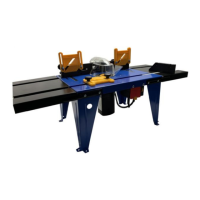

 To Next Page