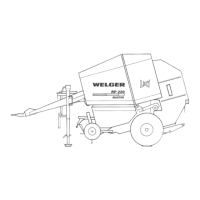
This document is an operating manual for the Lely Welger RP 405 / 435 / 505 / 535 series of round balers, designed for agricultural use. These machines are innovators in agriculture, focusing on efficient and reliable baling operations.
Function Description
The Lely Welger RP series balers are designed to collect cut crops (such as hay, silage, or straw) from the field and compress them into compact, cylindrical bales. These bales are then typically wrapped with twine or net to maintain their shape and protect the contents. The balers feature a pick-up mechanism to gather the crop, a compression chamber to form the bale, and a tying or netting system to secure it. The RP 405, 435, 505, and 535 models likely represent variations in bale size, capacity, or specific features, offering flexibility for different farming needs.
Important Technical Specifications
While specific numerical values for technical specifications are not fully detailed in the provided excerpts, the manual outlines several key areas that imply important technical aspects:
- Bale Diameter and Density: The manual mentions "Adjusting the bale diameter" and "Setting the bale density," indicating that these parameters are adjustable. This is crucial for optimizing bale size and weight according to crop type and storage requirements.
- Pick-up System: The presence of "Pick-up guide wheels" and "Windguard / Pick-up shield" suggests a robust pick-up mechanism designed for efficient crop gathering, potentially with features to prevent crop loss and ensure smooth feeding into the baler.
- PTO Speed: "PTO speed" is listed, which is a critical specification for ensuring the baler is operated at the correct power input from the tractor for optimal performance and safety.
- Drive System: The manual refers to "Drive shaft" and "Hydraulic System," indicating a mechanical drive system powered by the tractor's PTO, complemented by a hydraulic system for various functions like tailgate operation, bale ejection, and potentially pick-up lift.
- Electrical System: An "Electrical system" is present, likely controlling sensors, indicators, and automated functions within the baler.
- Compressed-air braking system: The mention of a "Compressed-air braking system" suggests that some models, particularly larger ones, may incorporate air brakes for enhanced safety during transport, especially when coupled with heavy loads.
- Hydraulic braking system: Similarly, a "Hydraulic braking system" indicates another type of braking mechanism, likely for different models or specific operational requirements.
- Tire Air Pressure: "Tire air pressure RP 405 / RP 435" and "Tire air pressure RP 505 / RP 535" are specified, highlighting the importance of correct tire inflation for stability, load bearing, and efficient field operation. Different models may have different tire requirements.
- Lubrication: The inclusion of "Lubrication chart" and "Lubrication points" emphasizes the need for regular lubrication, indicating various moving parts that require attention for smooth operation and longevity.
- Safety Clutch: A "Safety clutch" is mentioned, which is a vital safety feature designed to protect the baler's drivetrain from overload by disengaging power when excessive resistance is encountered.
Usage Features
The manual details several features that enhance the usability and operational efficiency of the Lely Welger RP series balers:
- BALERCONTROL E control box: This suggests an electronic control system, likely allowing the operator to monitor and adjust various baler functions from the tractor cab, improving convenience and precision.
- ELINK control box: Another control box option, possibly offering different levels of functionality or compatibility.
- Bale counter: This feature helps operators track the number of bales produced, useful for record-keeping and planning.
- Emergency operation: The provision for "Emergency operation" indicates built-in mechanisms or procedures to allow the baler to be operated safely in case of certain malfunctions.
- Adjustable Tailgate: The "Locking the tail gate" and "Adjusting the tail bale diameter" imply an adjustable tailgate, allowing for control over bale size and ejection.
- Twine and Net Tying Systems: The manual covers "Threading the twine," "Adjusting the twine brake," "Adjusting the net clearances," "Adjusting the wrapping distance," and "Edge wrapping adjustment," indicating sophisticated systems for securing bales with either twine or net, with options for fine-tuning the wrapping process.
- Cutting Device: The presence of "Inserting the net," "Tightening the net knife," "Adjusting the net length," "Equipment," "Knife groups," "Moving in and out the cutting device," "Lock bottom door," "Kettle knife material," "Assembly and disassembly of the cutting device knives," and "Regrinding the cutting device knives" points to models equipped with a cutting device (chopper) to pre-cut the crop before baling, which can improve bale density and forage quality. This system is designed for ease of maintenance and adjustment.
- Main Drive Reversing: This feature could be useful for clearing blockages or for specific operational maneuvers.
- Hydraulic Bottom Door: The "Hydraulic bottom door" may refer to a mechanism for clearing blockages or for maintenance access.
- Road Transport: The section "To heed in the road traffic" indicates guidelines for safe transport of the baler on public roads, including considerations for width, lighting, and braking.
Maintenance Features
The manual places a strong emphasis on maintenance, crucial for the longevity and reliable operation of the baler:
- Maintenance Platform and Ladder: The manual explicitly describes the "Maintenance platform and Ladder," highlighting its importance for safe access during maintenance tasks. It details how to fold down and secure the ladder and platform, emphasizing safety warnings regarding moving parts.
- Grease Knife Lever: This suggests a specific lever for greasing the knives, indicating a design that facilitates routine lubrication of the cutting device.
- Tensioners: The mention of "Tensioners" implies components that need regular checking and adjustment to ensure proper operation of belts or chains.
- Maintenance of the net tying unit: This indicates specific maintenance procedures for the net wrapping system, ensuring its smooth and reliable function.
- Tensioning the roller chains: This is a common maintenance task for agricultural machinery, ensuring proper power transmission and preventing wear.
- Hydraulic layout: Understanding the hydraulic layout is essential for troubleshooting and maintaining the hydraulic system.
- Chain lubrication (oil lubrication): This points to a dedicated system or procedure for lubricating the drive chains, vital for reducing friction and wear.
- Lubrication chart and points: These are critical for guiding operators on where and how often to lubricate various components of the baler.
- Regrinding the cutting device knives: This indicates that the knives of the cutting device are designed to be sharpened, extending their lifespan and maintaining cutting efficiency.
- General notes: The inclusion of "General notes" for maintenance suggests overarching principles and best practices for upkeep.
- Cleaning: While not explicitly detailed in the provided excerpts, the nature of agricultural machinery implies regular cleaning is a crucial maintenance task to prevent build-up of crop residue and ensure proper function.
Overall, the Lely Welger RP 405 / 435 / 505 / 535 series balers are designed as robust, user-friendly, and maintainable machines, offering a range of features to meet the demands of modern agriculture. The detailed manual ensures operators can safely and efficiently use and maintain their equipment.

 Need help?
 General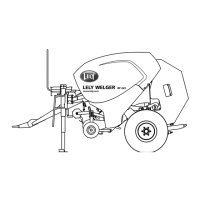


 To Next Page