EasyManua.ls Logo

Lennox LGA036 - User Manual

Lennox LGA036
8 pages
Print Icon
To Next Page IconTo Next Page
Loading...
10/08
*2P1008*
504,875M
*P504875M*
LGA/LGC036, 042, 048, 060, 072
LGA/LGC090, 102, 120, 150,
LGA/LGC156, 180, 210, 240, 300S
LGA/LGC248, 300H, 360
©2006
Litho U.S.A.
504,875M
10/2008
Supersedes 1/2006
WHAT TO DO IF YOU SMELL GAS:
FIRE OR EXPLOSION HAZARD
Failure to follow safety warnings ex-
actly could result in serious injury
death or property damage.
WARNING
Do not store or use gasoline or other
flammable vapors and liquids in the
vicinity of this or any other appliance.
Installation and service must be per-
formed by a qualified installer, ser-
vice agency or the gas supplier.
D Do not try to light any appliance.
D Do not touch any electrical switch; do not
use any phone in your building.
D Immediately call your gas supplier from a
neighbor’s phone. Follow the gas suppli-
er’s instructions.
D If you cannot reach your gas supplier, call
the fire department.
D Extinguish any open flames.
ROOFTOP
UNITS
READ ALL INSTRUCTIONS IN THIS MANUAL
AND RETAIN FOR FUTURE REFERENCE
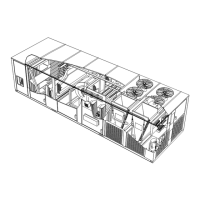
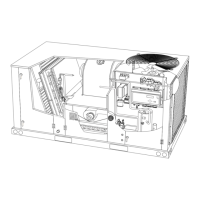
LGA240 SHOWN
See unit nameplate for manufacturer
and address.
FBR113270
(3, 3−1/2, 4, 5, and 6 TONS)
(7−1/2, 8-1/2, 10, and 12-1/2 TONS)
(13, 15, 17-1/2, 20, and 25 TONS)
(20, 25, and 30 TONS)
D Leave the building immediately.
Question and Answer IconNeed help?

Do you have a question about the Lennox LGA036 and is the answer not in the manual?

Summary

Safety Information

General Safety Warnings

Collects various warnings regarding fire, explosion, electrical shock, and hazardous materials exposure.

Unit Operation

Placing Unit Into Operation

Step-by-step guide for safely starting up the furnace, including gas valve operation and ignition sequence.

Burner Flame Inspection

Flue Passage and Vent Inspection

General Service Requirements

Servicing Air Filters

Burner Maintenance

Lubrication Guidelines

Manifold Pressure Specifications

Combustion Air Inducer Maintenance

Flue Passageway and Flue Box Cleaning

Service Reminder Checklist

Repair Parts Listing

Overview

This document serves as a user's information manual for a range of rooftop units, specifically the LGA/LGC series, covering models from 036 to 360, which correspond to various tonnage capacities (3 to 30 tons). The manual provides essential information for the safe operation, maintenance, and servicing of these commercial heating and cooling systems.

Function Description

The LGA/LGC rooftop units are integrated heating and cooling systems designed for commercial applications. They are equipped with components for both gas-fired heating and refrigerant-based cooling. The heating function involves a combustion air inducer, heat exchanger, and burners to generate warmth, while the cooling function utilizes compressors, evaporator coils, and condenser coils to remove heat from the indoor environment. An economizer, which is an optional feature, allows the unit to use outside air for cooling when conditions are favorable, reducing the need for mechanical refrigeration and improving energy efficiency. Air filters are integral to the system, ensuring that the air circulated throughout the building is clean. The units also include a blower system to distribute conditioned air and a condensate drain to manage moisture removed during the cooling process. Electrical controls manage the operation of all these components, including ignition, fan speeds, and temperature regulation. Safety features, such as flame roll-out switches and limit controls, are incorporated to prevent hazardous conditions.

Usage Features

The manual emphasizes safe and proper usage of the rooftop units. Before operation, users are instructed to ensure the unit area is clear of combustible materials and that there is an unobstructed flow of combustion and ventilating air. The units are equipped with an automatic spark ignition system, eliminating the need for manual lighting. In case of a safety shutdown, the thermostat switch should be moved to OFF and then returned to HEAT to reset the ignition control. For logic units and those with electronic temperature controls, resetting involves turning off and then on the main disconnect.

The process for placing the unit into operation involves setting the thermostat to the lowest setting, turning off all electrical power to the furnace, and then accessing the heat section to manipulate the gas valve knob. Depending on the gas valve model (White Rodgers 36E or Honeywell VR8205/VR8305), specific instructions are provided for turning the knob to "OFF" and then back to "ON" after a five-minute waiting period to clear any residual gas. After the gas valve is set to "ON" and the access panel is closed, electrical power is restored, and the thermostat is set to the desired temperature. The unit will then initiate its ignition sequence. If the furnace does not light on the first attempt, it will try up to two more times before locking out, requiring a repeat of the startup steps. The manual also details the procedure for turning off gas to the furnace, which involves setting the thermostat to the lowest setting and turning off all electrical power before any service is performed.

Maintenance Features

Regular maintenance is crucial for the efficiency and longevity of the rooftop units. The manual strongly recommends annual servicing by a qualified service technician, stating that failure to provide proof of service can void the warranty.

Key maintenance tasks include:

  • Filter Servicing: Filters should be checked monthly and replaced as necessary with filters of the same kind and size. The manual highlights the importance of noting the airflow direction marking on the filter frame during reinstallation. A table provides the number and size of filters for different unit models.
  • Burner Cleaning: Before the heating season, burners should be cleaned. This involves turning off electrical power and gas supply, removing the burner compartment access panel, unscrewing and lifting the burners from their orifices, cleaning them, and then reassembling the components. Proper spark gap setting on the ignition electrode is also mentioned as part of this process.
  • Lubrication: All motors are factory-lubricated and do not require further lubrication. However, blower shaft bearings should be relubricated at least once every two years with a specified lithium-base grease. The instruction is to add enough grease to purge through the bearings until a bead of grease appears at the seal lip contacts.
  • Combustion Air Inducer Inspection and Cleaning: The combustion air inducer, which ensures proper airflow for combustion, should be checked and cleaned annually before the heating season, or periodically during the season to establish an ideal cleaning schedule. The cleaning process involves disconnecting pressure switch air tubing, removing screws securing the inducer to the flue box, cleaning the inducer wheel blades and housing with a small brush, and then reassembling, ideally replacing the inducer gasket. The combustion air inlet louvers on the heat access panel should also be cleaned.
  • Flue Passageway and Vent Inspection: Annually, before the heating season, the combustion air louvers, vent cap, heat exchanger, burners, and combustion air inducer should be inspected for corrosion, deterioration, or debris. Any obstructions or blockages must be removed. This involves removing the combustion air inducer assembly and the flue box cover, cleaning the flue box and tubes with a wire brush, and then reassembling, replacing the flue box cover gasket and combustion air inducer gasket.
  • Gas Valve Operation Check: The manual provides instructions for checking manifold pressures, referring to figures that illustrate the location of pressure ports on different gas valve models.
  • General Service Reminder: Before calling a service technician for an inoperative unit, users are advised to check that electrical disconnect switches are ON, the room thermostat is set correctly, blown fuses are replaced or circuit breakers reset, the gas valve is ON, air filters are not plugged, and all access panels are in place.

The manual also includes a "Repair Parts Listing" section, which is essential for identifying and ordering correct replacement parts, emphasizing the need to include the complete model and serial number when ordering. This comprehensive approach to maintenance ensures the safe and efficient operation of the rooftop units throughout their lifespan.

Lennox LGA036 Specifications

General IconGeneral
BrandLennox
ModelLGA036
CategoryAir Conditioner
LanguageEnglish

Related product manuals