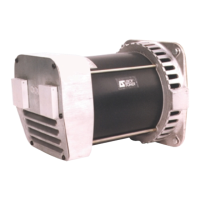
This document provides installation and maintenance instructions for Leroy-Somer LSAP 40 / 42.3 / 44.3 / 45 / 46.2-4 pole Low Voltage AC Generators. These are 4-pole alternators designed for electric power generation.
Function Description
The Leroy-Somer LSAP series AC generators are designed to convert mechanical energy into electrical energy, primarily for electric power generation applications. These alternators are equipped with either a shunt system (R201/R203 AVR) or an Automatic Voltage Regulator (AVR) such as the R-120, R-121, or D-120, which ensures stable voltage output. The generators feature a robust design with a main field, exciter, and armature, allowing for reliable power production. They are available in various configurations, including single-bearing and double-bearing designs, to suit different mechanical coupling requirements. The alternators are designed to operate in various environmental conditions, with provisions for space heaters and air filters to maintain optimal performance.
Important Technical Specifications
The LSAP 40 / 42.3 / 44.3 / 45 / 46.2-4 pole generators are 4-pole machines.
Electrical Characteristics:
- Voltage Regulation: Typically ±1%.
- Supply Range/Voltage Detection: 230V (50Hz).
- Response Time: 1 second for a transient voltage variation amplitude of ±20%.
- Voltage Setting: V.
- Stability Setting: Sealed.
- Insulation Class: H.
- Protection: IP 23.
- AVR Types: R-120, R-121, D-120, R201/R203 (shunt system).
- R201/R203 AVR (Shunt System):
- Sensing Input Voltage: 170-260 VAC or 370-460 VAC, 1-phase or 2-wire jumper selectable.
- Frequency: 50/60 Hz, jumper selectable.
- Power Input: 80-260 VAC, 1-phase 2-wire.
- Voltage Output: Max. 90 VDC @ 240 VAC input.
- Current: Continuous 5A, Intermittent 10A for 10 seconds.
- Resistance: Min. 9 ohm.
- Thermal Drift: 0.03% per °C change in AVR ambient.
- External Voltage Adjustment: ±8% with 1K ohm 1-watt trimmer.
- Unit Power Dissipation: Max. 10 watt.
- Under Frequency Protection (Factory Setting): 60 Hz system presets knee point at 57 Hz, 50 Hz system presets knee point at 47 Hz.
- Soft Start Ramp Time: 2 seconds.
- Dimensions: 138mm L x 103mm W x 53mm H.
- Connection Types: 3-phase and single-phase configurations are supported, with specific terminal connections (L1, L2, L3, N) for different voltage outputs (e.g., 380-415V, 220-240V).
- Anti-condensation heaters (Space Heaters): Recommended for areas of high humidity to prevent condensation on windings.
- Air Filters: Recommended for dusty or sandy environments to prevent fine dust from entering the machine.
Mechanical Characteristics:
- Bearings: The document specifies various bearing types for different frame sizes, including NDE (Non-Drive End) and DE (Drive End) bearings. For example, LSAP 40 uses 6305 2RS C3 (NDE) and 6309 2Z C3 (DE), while LSAP 46.2 uses 6315 2RS C3 (NDE) and 6316 2RS C3 (DE).
- Mounting: Single bearing with standard feet and SAE flanges/coupling discs, or double bearing with standard feet and SAE flanges/coupling discs.
- Cooling: Self-cooled.
- Shaft Extension: Standard SAE flange and cylindrical shaft extension.
- End Shields: Cast iron.
- Greased Ball Bearings: Used for smooth operation.
- Rotor: Wound exciter rotor.
- Stator: Wound exciter stator.
Usage Features
- Installation: The manual provides detailed instructions for assembly, including coupling the generator to the prime mover, checking the alignment, and securing the generator. Lifting rings are provided for safe handling.
- Electrical Connections: Clear diagrams are provided for terminal connections for both 3-phase and single-phase configurations, as well as for the AVR and shunt systems.
- Pre-commissioning Checks: Before starting the machine, checks include verifying the fixing bolts, ensuring the cooling air is free to flow, confirming correct wiring, and checking the winding connection.
- Start-up: The machine should be started at rated speeds.
- Adjustments: Procedures for adjusting voltage, stability, and frequency roll-off are detailed for the AVRs.
- Safety Measures: The manual emphasizes reading the safety instructions before installation and maintenance. It highlights warnings for electrical danger, general danger, and potential risks of accidents. Proper personal protective equipment (PPE) and qualified personnel are required for all operations.
- Environment: Recommendations for anti-condensation heaters in humid environments and air filters in dusty environments are provided to ensure optimal performance and longevity.
Maintenance Features
- First Maintenance Parts: Emergency repair kits are available, including voltage regulators, diode bridge assemblies, and surge suppressors.
- Bearing Maintenance: Detailed information on bearing types for different models and positions (NDE and DE) is provided, facilitating correct replacement.
- Dismantling and Reassembly: Comprehensive instructions are given for dismantling and reassembling various components, including the terminal box, AVR, exciter, and bearings. Specific tools required for these operations are listed (e.g., ratchet spanner, torque wrench, flat spanners, sockets, Allen key).
- Troubleshooting: A fault table is included to help diagnose common issues such as no voltage at start-up, low voltage, high voltage, voltage oscillations, and voltage disappearance during operation. Each fault has a corresponding action and effect, along with a check/cause to guide the maintenance process.
- Winding and Diode Checks: Procedures for checking the winding insulation and the diode bridge are outlined.
- Regular Checks: Regular checks include inspecting the generator for any damage, ensuring proper ventilation, and verifying electrical connections.
- Service Support: Leroy-Somer offers a comprehensive service support network, including tips & specifications, maintenance contracts, refurbishment, upgrades, optimization, surveillance, system audits, exploitation, original spare parts, repairs, and services.
- Warranty: The AC Generator is warranted against inherent manufacturing defects for a period of 12 calendar months from the date of commissioning or 18 calendar months from the date of dispatch, whichever is earlier. The warranty is subject to conditions that the AC Generator is returned to authorized service centers.
- Recyclable Materials: The alternators are designed with recyclable materials (cast iron, steel, copper, etc.), and instructions for disassembling products on request are provided to facilitate material recovery and reduce environmental impact.

 Need help?
 General

 To Next Page