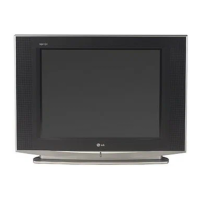
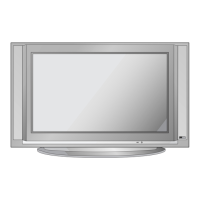
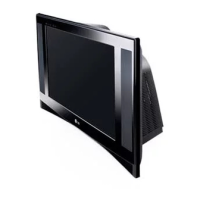
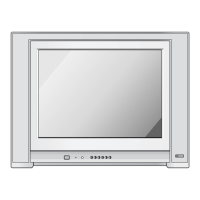
This document is a service manual for the LG COLOR TV, specifically models 29FS4RL/RLX and 29FS4RL/RLX-ZG, which utilize the CW62A chassis. It provides comprehensive information for servicing, adjustment, and troubleshooting of these television sets.
Function Description
The LG COLOR TV is a television receiver designed to display video and audio content from various sources. It supports multiple receiving systems, including PAL, SECAM, and NTSC, making it compatible with different broadcast standards across various regions. The TV features a flat 29-inch screen and a 100-program tuning system (FVS 100Program), with a 200-program capacity for models without Teletext. It includes standard TV/AV input selection, volume and program control, and a menu system for adjusting various settings. Optional features such as Teletext and Picture-in-Picture (PIP) are also supported, depending on the specific model configuration. The TV can be controlled via a remote handset or through front panel buttons.
Important Technical Specifications
The television operates within an input voltage range of AC 110-240V, 50/60Hz (Non EU) or AC 230V, 50/60Hz (EU). It supports a wide range of available channels, including VHF (E2-E12, 02-13), UHF (E21-E69, 14-69), and CATV (S1-S20, S21-S41, 02-13). The operating environment for the TV is specified at temperatures between 0°C and 45°C with relative humidity below 85%. For storage, the temperature range is -20°C to 60°C, also with humidity below 85%.
Key picture settings include:
- AGC (ACG take over): 25
- Red/Green/Blue Gain: 32 for each
- Black level offset: 32 for Red, Green, and Blue
- Cathode Drive Level (CDL): 5
- Luminance delay time (L-DLY): 13
- Peak white limiting (PEAK): 1
- Pre overshoot ratio (SHOOT): 1
Audio specifications include options for RF stereo/AV stereo/Mono, high/low volume curves, Nicam check & FM stereo/Dual, and dual sound setting save. The TV also supports various OSD languages and text languages, which can be configured through service adjustments.
Usage Features
The TV offers a user-friendly interface with both remote control and front panel buttons.
- Remote Control Handset: Features include POWER (on/off/standby), NUMBER BUTTONS (direct channel selection), MENU (accessing settings), PROGRAMME UP/DOWN (channel navigation), VOLUME UP/DOWN (audio adjustment), and OK (confirming selections).
- Teletext (optional): Dedicated buttons for Teletext functions, including TEXT/MIX, TIME, REVEAL, UPDATE, HOLD, SIZE, INDEX, and various colored buttons for specific Teletext operations.
- Picture-in-Picture (PIP) (optional): Buttons for PIP on/off, PR +/- (sub picture program selection), SWAP (alternating main and sub pictures), INPUT (sub picture input mode), SIZE (sub picture size adjustment), STILL (freezing sub picture motion), POSITION (relocating sub picture), and 9/4 PIP (switching between 9 or 4 sub pictures).
- Front Panel Controls: Includes MAIN POWER (on/off), POWER/STANDBY INDICATOR, MENU, OK, and combined Volume/Programme Up/Down controls.
- Connectivity: Features AUDIO/VIDEO IN SOCKETS (AV IN3) for connecting external equipment.
- EYE Function (optional): Automatically adjusts picture settings based on ambient light conditions.
- Sleep Timer: Allows users to set a timer for the TV to automatically switch off.
- Q.VIEW (Quick View): Returns to the previously viewed program.
- LIST: Displays the program table.
Maintenance Features
The manual emphasizes safety precautions for servicing, including the use of an isolation transformer and proper handling of high voltage components.
- Safety Precautions: Important warnings regarding high voltage, X-RAY radiation, and the need to read safety precautions before servicing.
- Leakage Current Check: Detailed instructions for checking leakage current between AC plug prongs, exposed metallic parts, and other accessible connections to ensure electrical safety.
- Adjustment Instructions:
- Focus Adjustment: Involves using a Cross-Hatch Pattern and adjusting the Focus volume of the FBT for optimal clarity.
- Purity & Convergence Adjustment: A multi-step process that includes demagnetization, adjusting the DY (Deflection Yoke) for equal red on the screen, and fine-tuning convergence using a cross-hatch pattern and 4-pole magnets.
- White Balance Adjustment: Involves setting the screen to standard condition, operating for at least 15 minutes, and adjusting various parameters (Vcd Slave, B/R/G/B Amp, Sub Adj, Start Bit, Step Adj, Polarity, EP_Rom_S, Speed/Plus) in the service menu.
- Deflection Setting Data Adjustment: Detailed instructions for adjusting H-SHIFT, H PARALLEL, H BOW, H LINEAR, V SCROLL, EW WIDTH, EW TRAPEZOID, EW UPCOR, EW LOCOR, V LINEAR, V SLOPE, V AMPLITUD, H CORRECTION, V SHIFT, V ZOOM, OVRVOLIN, and VOUARD parameters to ensure proper picture geometry.
- Troubleshooting: Provides flowcharts for diagnosing common issues such as no picture/no sound, no raster/sound, and problems with RF stereo/mono models. These flowcharts guide technicians through checking waveforms, voltages, and components like TU101, IC501, IC601, FBT T402, and various diodes and fuses.
- Printed Circuit Board Layout: Includes diagrams of the main PCB, power board, side-A/V board, LED + pre-amp board, deflection board, and harmonics board, aiding in component identification and location.
- Block Diagram: A high-level overview of the TV's internal architecture, showing the interconnections between major components like the tuner, sound amplifier, UOC III (IC501), RGB amplifier, vertical amp, H-OUT TR, FBT, SMPS, and PIP board.
- Exploded View and Parts Lists: Provides detailed diagrams of the TV's mechanical assembly and comprehensive lists of replacement parts, including ICs, transistors, diodes, resistors, capacitors, coils, inductors, and connectors, with their respective part numbers and descriptions. This is crucial for identifying and ordering correct replacement components.

 Need help?

 To Next Page
 General