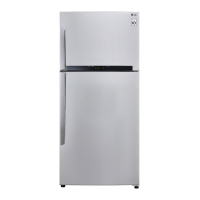
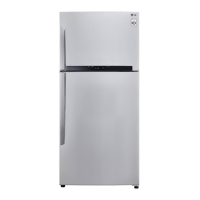
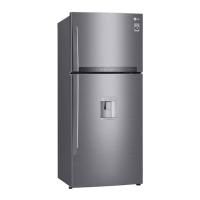
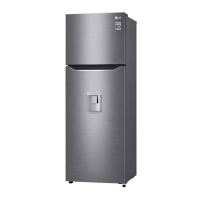
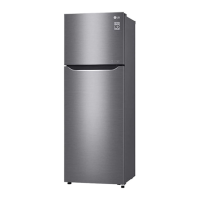
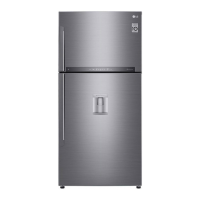
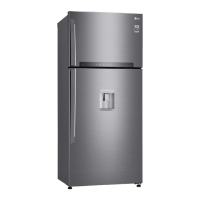
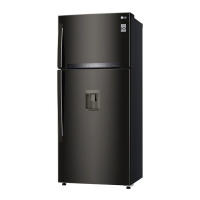
This document is an owner's manual for an LG Refrigerator-Freezer, providing instructions for installation, operation, and maintenance.
Function Description:
The LG Refrigerator-Freezer is a domestic appliance designed for food storage, featuring separate compartments for refrigeration and freezing. It utilizes isobutane refrigerant (R600a) and insulation blowing gas, requiring special disposal procedures. The appliance includes a temperature control system for both the refrigerator and freezer compartments, an ice-making function (Twisting Ice Serve Type or General Type), and a vegetable drawer with humidity and temperature control. Some models are equipped with a deodorizer to manage food odors and a door alarm to alert users when a door is left open. The refrigerator also incorporates a Smart Diagnosis™ function for troubleshooting.
Important Technical Specifications:
- Refrigerant: Isobutane (R600a). The amount of refrigerant is specified on the identification plate inside the appliance.
- Room Size for Installation: The room must be at least 1 m² in size for every 8g of R600a refrigerant.
- Temperature Control:
- Refrigerator Compartment: Controlled by a button with 7 steps, from Cold to Coldest cooling. The default setting is "NORMAL" (middle LED).
- Freezer Compartment: Controlled by a dial (Type A: 4, 3, 2; Type B & C: 6, 5, 4). The default setting is '3' for Type A and '5' for Type B & C. Higher numbers indicate lower temperatures. Setting to '7' (Type B & C) enables quick freezing.
- Lighting: Uses an LED Lamp, which is not user-replaceable and requires an authorized LG Service provider for replacement.
- Power Supply: Requires connection to a dedicated electrical outlet to prevent overloads.
- Ventilation: Requires at least 10 inches (25 cm) clearance above and 2 inches (5 cm) or more from the wall if placed in a recessed area.
- Leveling: Adjustable leveling screws are provided to ensure the unit is level and the front is slightly higher than the rear for proper door closing.
Usage Features:
- Starting: After installation, allow 3-4 hours for stabilization before filling with food. Wait 5 minutes before restarting if operation is interrupted.
- Temperature Setting: The refrigerator temperature control button adjusts the target temperature, with "NORMAL" as the default. The freezer temperature control dial adjusts the air flow balance and temperature.
- Door Alarm (Some Models): Sounds an alarm if the refrigerator or freezer door is open for 1 minute, repeating every 30 seconds if it remains open.
- Ice Making:
- Twisting Ice Serve Type: Fill the ice tray with water, insert it, and twist the knob clockwise to release ice cubes into the bin. The ice maker can be removed for extra freezer space.
- General Type: Fill the ice tray with water and insert it. Hold the tray at its ends and twist gently to remove ice cubes.
- Vegetable Drawer: Features a slider control to adjust humidity and temperature for optimal vegetable storage.
- Deodorizer (Some Models): A passive component located in the refrigerator compartment that deodorizes unpleasant food odors.
- Smart Diagnosis™ (Applied Models): Allows for remote diagnosis of malfunctions by transmitting data to an LG service center via a telephone call. Users open the lower door, press the temperature control button for 3 seconds, then open the upper door and place the phone near the speaker hole.
- Food Storage Suggestions:
- Store fresh food in the refrigerator compartment, avoiding easily perishable items at low temperatures.
- Allow hot food to cool before storing to prevent spoilage and high electricity bills.
- Cover food with vinyl wrap or store in lidded containers to retain moisture and nutrients.
- Do not block air vents to ensure even chilled air circulation.
- Minimize door openings to prevent temperature rise.
- Do not store bottles in the freezer to prevent breakage/explosion.
- Do not refreeze thawed food.
- Place frozen food like ice cream on freezer shelves, not door baskets.
- Load newly introduced foods in specific freezer locations for optimal freezing.
- Avoid placing moist food directly against the refrigerator shelf to prevent freezing; use covered containers or the vegetable storage compartment.
- Clean food before refrigeration.
- Store fresh eggs upright in their rack.
Maintenance Features:
- Cleaning:
- Regular cleaning is recommended to prevent odors.
- Wipe up spilled food immediately.
- Do not use metallic scouring pads, brushes, coarse abrasive cleaners, or strong alkaline solutions.
- Exterior: Clean with a lukewarm solution of mild soap or dish washable solution, then wipe with a clean, damp cloth and dry.
- Interior & Interior Parts: Clean with a lukewarm solution of mild soap or dish washable solution, then wipe with a clean, damp cloth and dry. This includes shelves, door racks, storage trays, and magnetic door seals.
- Deodorizer (Some Models): Clean periodically by gently pushing forward on the front clips, lowering the body, soaking in warm phosphate-based soapy water, and rinsing.
- Safety during Cleaning: Always remove the power cord from the wall outlet when cleaning near electrical parts. Wipe excess moisture to prevent electric shock. Do not use flammable or toxic cleaning liquids, surface active agents, car wax, anticorrosives, oil, gasoline, acids, or wax, as these can damage the finish or cause fire/electric shock. Harsh cleaning chemicals can change the external finish color.
- Defrosting: Takes place automatically. Defrosted water flows to an evaporating tray at the lower back of the refrigerator and evaporates naturally.
- Vacation Time: For average length vacations, leave the refrigerator operating. For extended periods, remove all food, disconnect power, clean the interior, and leave doors open to prevent odor.
- Power Failure: Most failures are short. Minimize door openings. For longer failures, place dry ice on frozen packages.
- Moving: Remove or secure all loose items. Turn leveling screws all the way into the base to prevent damage.
- Anti-Condensation Pipe: The outer cabinet wall may warm up after installation due to the anti-condensation pipe, which prevents "sweating." Do not attach fixtures by drilling, gluing, or screwing.
Safety Precautions:
- Keep ventilation openings clear.
- Do not damage the refrigerant circuit.
- Do not use electrical appliances inside the food storage compartment unless recommended by the manufacturer.
- Ensure proper disposal of refrigerant and insulation blowing gas.
- Avoid naked flames or ignition sources if a refrigerant leak is detected; ventilate the room.
- Do not use multiple power outlets or allow the power plug to face upward or be compressed.
- Prevent the power cord from being squeezed or imprinted.
- Do not bend, kink, or crush the power cord.
- Do not remove the power plug with wet hands or by pulling the cord.
- Remove water or dust from the power plug.
- Wait 5 minutes after disconnecting power before reconnecting.
- Ensure proper grounding; do not use if the earth pin is missing or damaged.
- Do not use damaged power cords or plugs, or damaged/worn outlets.
- Do not place heavy or fluid-containing objects on top of the refrigerator.
- Do not swing on doors or step on door shelves.
- Prevent children from entering the refrigerator.
- Do not place flower vases, cups, cosmetics, medicine, or water containers on the refrigerator.
- Do not install outdoors, in direct sunlight, or in wet areas.
- Do not use or store inflammable materials (ether, benzene, alcohol, medicine, LP gas, spray, cosmetics) near or in the refrigerator.
- Do not store medicine, scientific material, paint, or living compounds inside.
- Do not use a hair dryer or light a candle to dry the inside or remove odor.
- Avoid direct heat sources.
- Do not use combustible spray near the refrigerator.
- Do not use the refrigerator if submerged in water without professional inspection.
- If refrigerant gas leaks, do not touch the refrigerator or air outlet; ventilate the room.
- During electrical storms, remove the power cord and avoid opening doors.
- This appliance is not intended for use by persons with reduced physical, sensory, or mental capabilities, or lack of experience and knowledge, unless supervised or instructed. Children should be supervised.
- Do not spray water directly inside or outside, or clean with abrasive/caustic liquids or pads, or solvents.
- Only qualified engineers should disassemble, repair, or alter the refrigerator.
- If strange smells or smoke are detected, disconnect power and contact service.
- When disposing, remove door seals or doors completely to prevent child suffocation.
- Do not use for commercial purposes or mobile applications.
- Install on a solid, level floor.
- Do not obstruct cold air outlets or the rear lower ventilation grill.
- Do not remove the back cover.
- Place all internal shelving and parts correctly before connecting power.
- Do not use an adapter.
- Never use lit candles or incense in the fridge.
- Do not touch food or containers in the freezer with wet hands.
- Do not overstack food or block air outlets.
- Do not store sealed or full bottles in the freezer.
- Do not insert hands into the bottom of the refrigerator.
- Carry the refrigerator using the built-in recessed handles at the top rear and front bottom.
- Use caution when opening/closing doors to protect children or pets.
- Do not put living matter, animals, pets, or children in or on the refrigerator.
- Do not use abrasive sponges, brushes, pads, solvents, chlorine, stainless steel cleaners, or other chemicals for cleaning surfaces.
- Avoid contact of fats and oils with plastic parts.
- Do not apply oil or lubricants to door hinges.
- If the power cord is damaged, call a licensed electrician or authorized service provider.
- Do not use an extension cord.
- Ensure proper grounding (earthing) via the mains plug.
- Do not modify or extend the power cord length.
- Remove gaskets, latches, lids, or the entire door from unused appliances to make them harmless to children.
- Do not store flammable materials, explosives, or chemicals.
- This appliance is not designed for storage of temperature-official medicines or living plants.
- Do not use a dishwasher to clean lower drawers.

 Need help?
 General

 To Next Page