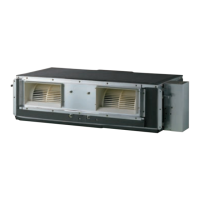
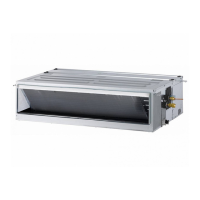
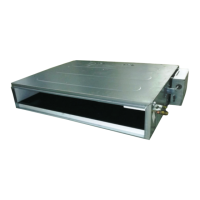
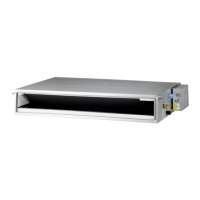
This document is the owner's manual for an LG Multi V Ceiling Concealed Duct - Low Static Type Indoor Unit Air Conditioner. It provides essential information for the safe and proper operation, maintenance, and troubleshooting of the device.
Function Description:
The LG Multi V Ceiling Concealed Duct - Low Static Type Indoor Unit is an air conditioner designed for residential or commercial use. Its primary function is to cool and dehumidify indoor spaces, providing a comfortable environment. The "Ceiling Concealed Duct" design indicates that the unit is installed out of sight within the ceiling, with air distributed through ducts to various rooms or areas. The "Low Static Type" suggests it is suitable for applications with shorter duct runs and lower external static pressure requirements, making it versatile for different installation scenarios. The manual emphasizes that this is a consumer air conditioner and not intended for special purposes such as preserving foods, works of art, or precision refrigeration, as such usage could damage the items.
Important Technical Specifications (from model numbers):
The manual lists several specific model numbers, which indicate different capacities and possibly slight variations in features or power requirements. These models are:
- ARNU05GL4G4
- ARNU07GL4G4
- ARNU09GL4G4
- ARNU12GL5G4
- ARNU15GL5G4
- ARNU18GL5G4
- ARNU24GL6G4
While the exact capacity in BTUs or tons is not explicitly stated for each model number within this excerpt, the numerical prefixes (05, 07, 09, 12, 15, 18, 24) typically correspond to the unit's cooling capacity, often in thousands of BTUs per hour (e.g., 5,000 BTU/h, 7,000 BTU/h, up to 24,000 BTU/h). The "GL4G4," "GL5G4," and "GL6G4" suffixes likely denote specific series, generations, or minor feature sets within the LG Multi V product line.
Usage Features:
The manual provides several guidelines for effective and safe usage:
- Installation: Installation must be performed by a qualified specialist using a dedicated circuit. The product should always be grounded to prevent electric shock. It warns against installing the unit in potentially explosive atmospheres or where it will be exposed to sea wind (salt spray) directly, as this can cause corrosion and malfunction.
- Operation: Users are advised not to expose themselves or pets/plants to direct airflow for extended periods due to health risks. Ventilation is recommended when the air conditioner is used with stoves or other heating devices to prevent oxygen deficiency. The unit should not be operated with wet hands. In case of strange sounds, smells, or smoke, the breaker should be turned off immediately. The manual also cautions against operating the unit with the front panel, cabinet, top cover, or control box cover removed or opened, as this poses risks of fire, electric shock, explosion, or death.
- Remote Control: When using the remote control, users should refer to its specific manual. Batteries should be replaced with new ones of the same type, avoiding mixing old and new or different types of batteries, to prevent fire or explosion.
- Energy Efficiency Tips: To optimize performance and save electricity, users are advised not to overcool the room, keep blinds or curtains closed to prevent direct sunlight, ensure doors and windows are shut tight, and clean the air filter regularly (at least every two weeks). Ventilating the room occasionally is also suggested since windows are kept closed during operation.
Maintenance Features:
Regular maintenance is crucial for the longevity and efficient operation of the air conditioner.
- Safety First: Before performing any maintenance, the main power to the system must be turned off, and the circuit breaker disconnected, to prevent electric shock.
- Cleaning the Grille and Case: The grille and case should be wiped with a soft, dry cloth. Harsh detergents, solvents, bleach, or abrasives should not be used, as they can cause deformation, discoloration, or damage to the surfaces. Water hotter than 40°C should also be avoided for cleaning.
- Air Filter Maintenance: The air filters, located behind the indoor unit on the suction side, should be checked and cleaned every two weeks or more often if necessary.
- Cleaning Method: Filters can be cleaned with a vacuum cleaner or washed with warm, soapy water. For very dirty filters, a solution of detergent in lukewarm water can be used. Hot water (50°C or more) should be avoided as it may deform the filter.
- Drying and Re-installation: After washing, the filters should be dried thoroughly in the shade before re-installing them.
- Importance: A dirty filter reduces the air conditioner's efficiency and can cause product malfunction or damage.
- Long-Term Storage: If the air conditioner will not be used for a long time, it is recommended to operate it in "Air circulation mode" for 2 to 3 hours to dry out internal parts. Afterward, the circuit breaker should be turned off. This prevents dirt accumulation that could cause a fire.
- Pre-Use After Storage: Before using the air conditioner again after a long period, ensure that the air inlet and outlet of the indoor/outdoor unit are not blocked.
- Professional Service: For repairs and maintenance beyond basic cleaning, users should contact an authorized service dealer or technician. The manual explicitly states that installation, removal, or re-installation should not be attempted by the customer.
- Drain Hose: The drain hose must be installed correctly to ensure proper water drainage, preventing water leakage.
- Refrigerant Leakage: Gas (refrigerant) leakage should always be checked after installation or repair, as low refrigerant levels can cause product failure.
- Sharp Edges: Users are warned to be cautious of sharp metal edges when removing the air filter or unpacking and installing the product, especially the fins on the condenser and evaporator.
- Water Ingress: Water should not be allowed to run into electrical parts, as this can destroy insulation and lead to electric shock. The product should not be installed where water could enter it. If the product is soaked (flooded or submerged), an Authorized Service Center must be contacted.
- Flammable Refrigerants: Maintenance and repair involving flammable refrigerants must be carried out under the supervision of personnel competent in their use. Leakage tests or air purging should only use a vacuum pump or inert (nitrogen) gas, never compressed air, oxygen, or flammable gases, to avoid fire or explosion.

 Need help?
 General



 To Next Page
