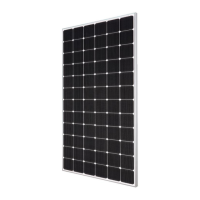
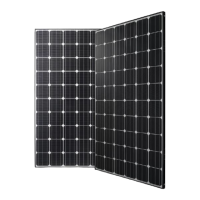
This document is an installation manual for LG N-Type PV Solar Modules, specifically the LGXXXN2T-J5 series. It provides comprehensive guidelines for the safe and proper installation, operation, and maintenance of these solar modules.
Function Description
The LG N-Type PV Solar Module is designed to convert sunlight into electrical energy. These modules are intended for use in solar power systems to generate electricity. They are suitable for various applications, including residential, commercial, and industrial installations, where they can be mounted on roofs or ground structures. The modules are designed to operate effectively in a range of environmental conditions, contributing to sustainable energy solutions.
Important Technical Specifications
Module Series: LGXXXN2T-J5 (N-Type Models)
Electrical Properties (at Standard Test Conditions - STC):
- Irradiance: 1000W/m²
- Cell Temperature: 25°C
- Air Mass: 1.5AM
- Power Tolerance: 0~3% (within -0/+3 percent of rated power)
- Voltage Tolerance: within 5 percent of measured
- Model Range (Pmax at STC): 385W to 410W
- LG385N2T-J5: 385W
- LG390N2T-J5: 390W
- LG395N2T-J5: 395W
- LG400N2T-J5: 400W
- LG405N2T-J5: 405W
- LG410N2T-J5: 410W
- Open Circuit Voltage (Voc at STC): Ranges from 49.4V to 49.9V
- Short Circuit Current (Isc at STC): Ranges from 10.10A to 10.30A
- Maximum Power Voltage (Vmpp at STC): Ranges from 40.3V to 42.3V
- Maximum Power Current (Impp at STC): Ranges from 9.56A to 9.71A
- Max. No. of modules in series: 16 (considering 125% of Voc; actual number depends on site conditions and local codes)
- Max. Series Fuse Rating: 20A
- Max. System Voltage: 1000V
- Connector Type: MC4 (PV-KST4/6II-UR, PV-KBT4/6II-UR)
- Male Connector: PV-KST4/6II-UR
- Female Connector: PV-KBT4/6II-UR
- Cable Cross Section: 4mm² (12AWG)
- Cable Outer Diameter (ØA): 5.5~9mm
- Rated Current (Connectors): 30A
Electrical Properties (at Nominal Module Operating Temperature - NMOT*):
- Irradiance: 800W/m²
- Ambient Temperature: 20°C
- Wind Speed: 1m/s
- NMOT: 42±3 °C
- Pmax Temperature Coefficient: -0.36 %/°C
- Voc Temperature Coefficient: -0.26 %/°C
- Isc Temperature Coefficient: 0.03 %/°C
- Model Range (Pmax at NMOT): 289W to 308W
- Vmpp at NMOT: 37.9V to 39.8V
- Impp at NMOT: 7.62A to 7.74A
- Voc at NMOT: 46.6V to 47.1V
- Isc at NMOT: 8.12A to 8.28A
Bypass Diodes:
- IF (AV): 25A
- VF (max): 0.6V
- VRRM: 50V
- Tj (max): 200°C
- RTH: 2.0°C/W
Mechanical Properties:
- Dimensions: 2024mm (Length) x 1024mm (Width) x 40mm (Height)
- Weight: 20.3 kg
- Frame Material: Corrosion resistant material (e.g., stainless steel for mounting devices)
- Mounting Holes:
- 8-4.3mm diameter grounding holes
- 4-8.5x12.0mm mounting holes
- 4-7.0x10.0mm mounting holes
- Cable Length (with connector): 1200mm
- Module Strength (Basic Load) ; IEC61215-2:2016:
- Design Load A (Front Side): 3600 Pascal
- Design Load A (Rear Side): 2000 Pascal
- Test Load B (Front Side): 5400 Pascal (A x Ym, where Ym = 1.5)
- Test Load B (Rear Side): 3000 Pascal (A x Ym, where Ym = 1.5)
- Mounting Distance (from module long side): 300mm (for 72Cell modules using frame bolt holes)
- Altitude Qualification: Up to 4000m
- Fire Resistance: Class C after ANSI/UL790 Edition 2004 (when installed on a roof over a fire-resistant roof covering)
Usage Features
Installation:
- Qualified Personnel: Installation and maintenance must be performed by qualified and authorized installers.
- Safety Precautions: Emphasizes avoiding contact with electrically active parts, not using broken modules, and ensuring dry conditions and dry tools during installation.
- Mounting Methods: Supports mounting using frame bolt holes and clamps.
- Frame Bolt Holes: Requires four M8 stainless steel bolts, nuts, spring washers, and eight flat washers per module. Modules must be fastened at a minimum of 4 points on two opposite sides. Torque for bolts: 8~12 N·m.
- Clamps: Modules can be fastened to a support using clamps on both long and short edges. Specific clamping locations are provided in the 'Mechanical Installation Scene' (Appendix). Clamps should not touch the module's glass.
- Mounting Rails: Recommended to use corrosion-resistant aluminum or stainless steel mounting rails, preferably more than 40x40mm. Rails should run perpendicularly to the module's long side.
- Site Consideration: Modules should be mounted in a location that maximizes sunlight exposure and avoids shadowing from buildings, trees, or other modules.
- Operating Temperature Range: -40°C to +90°C.
- Clearance: A minimum standoff height of 100mm between module frames and structures is recommended for wiring and air circulation.
- Series Connection: Modules can be wired in series to achieve desired voltage output, ensuring current is the same for each module. The maximum number of series-connected modules is limited by system voltage and Voc.
- Parallel Connection: Modules can be combined in parallel for desired current output. Total current equals the sum of individual module currents. Each series string or module must be fused prior to combining with other strings.
- General Wiring: LG Electronics recommends double-insulated, flexible copper (Cu) conductors with a minimum rating of 90°C (194°F) and a minimum size of 4mm².
- Earth Grounding: Grounding is mandatory and must conform to federal, state, and local codes. Recommended hardware includes one M4 stainless steel bolt, nut, spring washer, two flat washers, one cup washer, one star washer, and 12 AWG Cu wires per mounting hole. All hardware should be corrosion-resistant. Torque for screws and nuts: 4~5 N·m.
- Shadowing: Partial shadowing must be avoided as it can severely reduce output and damage the module.
- Curved Surfaces: Modules should not be forcefully modified for installation on curved surfaces; structures must be properly set up to avoid deformation.
Safety Warnings:
- Danger: Non-compliance can cause serious injury or death (e.g., electrical shock from active parts, using broken modules, bending junction box cables).
- Warning: Non-compliance can cause death or serious injury (e.g., working in wet conditions, handling wet panels, improper equipment use, installation during adverse weather).
- Caution: Non-compliance can cause injury or property damage (e.g., scratching frame coating, concentrating sunlight, applying shock to junction box, creating additional mounting holes).
- Heavy Objects: Do not place heavy objects on, stand on, or drop the module.
- Junction Box: Do not open the junction box, as this will void the warranty.
Maintenance Features
After Installation:
- Connection Check: Ensure connectors are tightly plugged and wiring functions properly.
- Periodic Inspection: Regularly inspect modules for damage to front glass, back sheet, frame, junction box, or external electrical connections.
- Corrosion Check: Check electrical connections for loose connections and corrosion.
- Cleaning:
- PV panels can operate effectively without washing, but cleaning can increase output.
- Use water, ethanol, or a conventional glass cleanser with a micro-fiber cloth.
- Do not use ground water containing calcium carbonate.
- Avoid aggressive, abrasive, or alkali chemicals (including ammonia-based solutions).
- Clean frame surfaces with a wet sponge or cloth, then dry with a clean chamois.
- Back Surface: Keep the back surface free from foreign objects or structural elements that could contact the panel under mechanical load.
- Lubricants: Do not use any oil or lubricant on any module parts, as it can cause defects.
- Replacement: If modules or parts are replaced, ensure the new components have the same model name and specifications as the previously installed ones.
Transporting and Storage:
- Banding: Do not loosen banding during transport to prevent shaking and damage.
- Stacking: Do not stack more than two pallets high to avoid stress and product damage.
- Handling: Do not transport the module by only one side to prevent damage to the frame or cable.
- Storage: Keep modules packed in the carton until installation.
Disposal:
- WEEE Symbol: Indicates that waste electrical and electronic products (WEEE) should be disposed of separately from municipal waste.
- Hazardous Substances: Old electrical products may contain hazardous substances, so correct disposal is crucial for environmental and human health.
- Recycling: Old appliances may contain reusable parts or valuable materials that can be recycled. Contact local government waste offices or visit www.lg.com/global/recycling for details on authorized WEEE collection points.

 Need help?
 General

 To Next Page