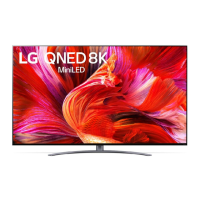
Need help?
Do you have a question about the LG QNED75 Series and is the answer not in the manual?
Guidance on preparing to read the owner's manual for optimal understanding and reference.
Information about additional accessories that may enhance TV functionality and compatibility.
Instructions on proper placement and airflow to prevent overheating and ensure safe operation of the TV.
Guidelines for safely lifting, moving, and transporting the television to prevent damage.
Steps for securely placing the TV on a table, including proper ventilation space.
Instructions for attaching the TV to a wall mount, including VESA compatibility and installation considerations.
Basic operations for powering the TV on and off using the physical buttons on the unit.
Guidelines for connecting HDMI devices, supported audio formats, and cable recommendations.
Instructions and information for setting up external devices using the RS-232C communication protocol.
Specifies the operating and storage conditions for the television, including temperature and humidity.
Details the requirements for wall mounting, specifically the tilt angle for optimal viewing.
Technical details of wireless modules, including frequency ranges and output power for LAN and Bluetooth.
Solutions for issues where the TV is unresponsive to remote control commands.
Steps to diagnose and resolve problems with no image or sound output from the TV.
Explains potential causes and solutions for the TV shutting off unexpectedly, including auto-off functions.
Addresses common display anomalies like pixel variations, brightness differences, and image sticking.
Explains normal operational sounds like cracking noise or humming, and their causes.
Compliance information and regulations for the USA regarding digital device interference and RF exposure.
Compliance information and regulations for Canada regarding wireless functions and RF exposure.
This document serves as the owner's manual for an LG LED TV, providing essential information for its safe and effective operation, maintenance, and external control. The TV utilizes an LCD screen with LED backlights.
The LG LED TV is designed for viewing television broadcasts and connecting to various external devices. It supports a range of input sources including antenna, cable, and HDMI, allowing users to watch DTV, NTSC-M, and QAM broadcasts, as well as content from Blu-ray players, HD receivers, DVD players, VCRs, audio systems, USB storage devices, PCs, and gaming consoles. The TV offers basic functions such as power on/off, volume control, channel selection, and screen mute. Advanced features include aspect ratio adjustment, screen contrast and brightness control, color/colour temperature settings, and sound balance. For models supporting 3D, there are options to change 3D modes, adjust 3D effects, and correct 3D picture. The TV also includes an auto-configure function for optimizing picture position and minimizing image shaking in RGB (PC) mode.
The TV can be operated using a single button for power on/off, menu control, and menu selection. For more comprehensive control, a remote control is provided, offering access to various functions like channel up/down, volume up/down, mute, input selection, sleep timer, teletext, favorite channels, return, AV mode, caption/subtitle, arrow keys for navigation, recent apps, play/stop/pause, soccer mode, record, 3D, auto-config, smart/home, SIMPLINK, info, program guide, and user guide. The TV supports a "User Guide" embedded within the product, accessible through the support menu, which provides detailed information on installation, usage, troubleshooting, and specifications.
For external control, the TV can be connected to a computer or A/V control system via a USB to Serial (RS-232C) converter or an RS-232C (Serial) cable. This allows for remote control of various TV functions using specific commands. The manual provides a comprehensive list of commands for power, aspect ratio, screen mute, volume mute, volume control, contrast, brightness, color/colour, tint, sharpness, OSD select, remote control lock mode, treble, bass, balance, color/colour temperature, ISM method (for Plasma TVs), equalizer, energy saving, tune command for channel selection, channel add/delete/skip, key code transmission, control backlight, control panel light, input select, and 3D mode adjustments. The TV's Set ID can be configured to control individual or multiple connected sets.
The TV also features optional extras such as a Magic Remote Control, which may require checking Bluetooth compatibility in the Wireless Module Specification. A cable to connect antennas and external devices must be purchased separately.
The manual emphasizes several safety and maintenance instructions to ensure the longevity and proper functioning of the TV. Users are advised to read and retain the manual, heed all warnings, and follow all instructions.
The manual also includes information about open-source software, licenses (HDMI, HEVC Advance, Quick Set), and LG's take-back and recycling policy, emphasizing the company's commitment to environmental protection and resource conservation.
 General
| Resolution | 4K (3840 x 2160) |
|---|---|
| Processor | α7 Gen5 AI Processor 4K |
| Smart TV Platform | webOS |
| HDMI Ports | 4 |
| USB Ports | 2 |
| Refresh Rate | 120Hz |
| Bluetooth | Yes (V5.0) |
| Sound Output | 20W |
| Screen Sizes | 75 inches |
| HDR | HDR10, HLG |
| Voice Assistant | Google Assistant, Alexa |
| Wi-Fi | Yes |
| Speaker Channels | 2.0 |
| Display Type | QNED (Quantum NanoCell LED) |

 To Next Page