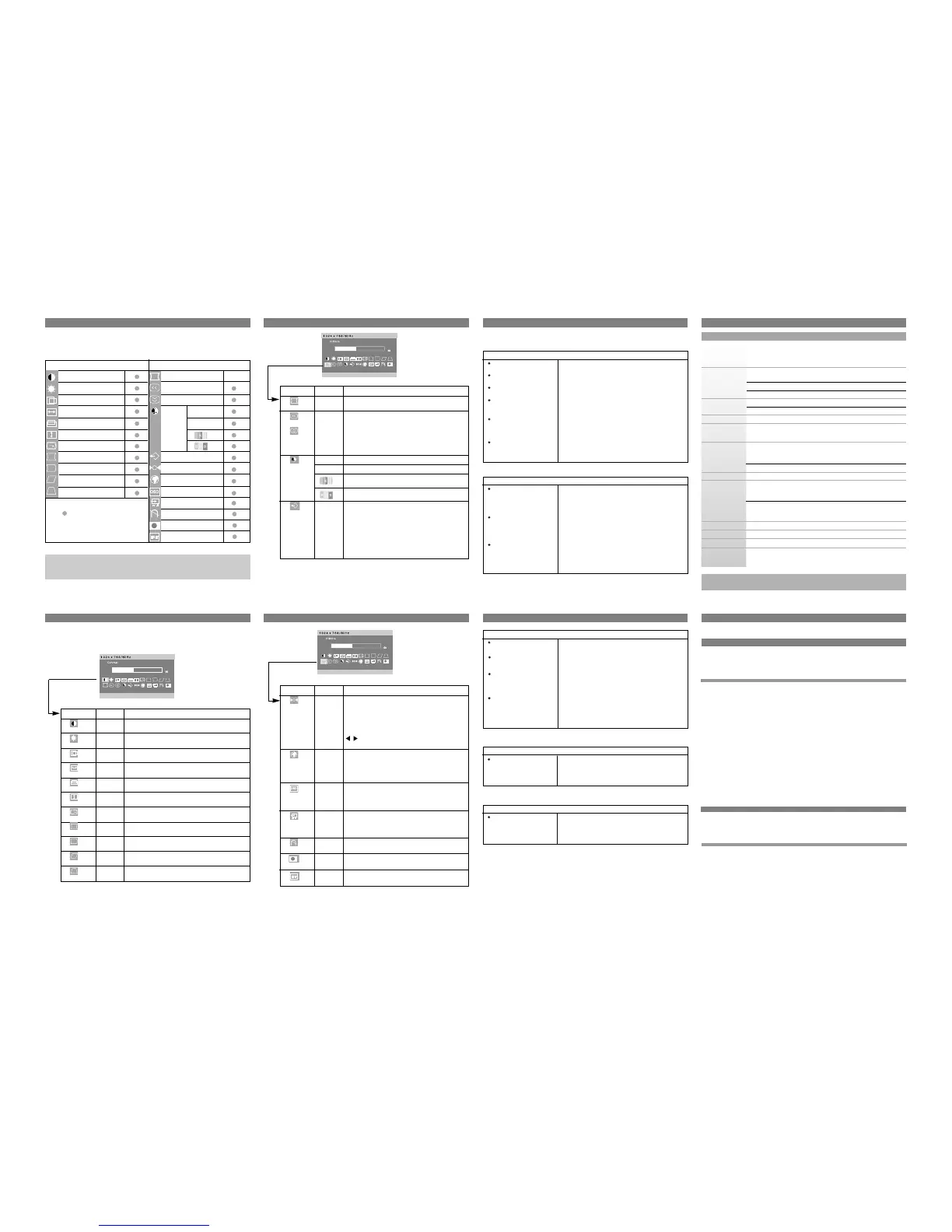
The following table indicates all the On Screen Display controls,adjustments,and
setting menus.
7
You were introduced to the procedure of selecting and adjusting an item using the
OSD system.Listed below are the icons,icon names,and icon descriptions of all
items shown on the menu.
8
9
Check the following before calling for service.
11
12
13
Preset Modes(Resolution)
1 VESA 640 X 480 37.50 75
2 VESA 800 X 600 31.47 60
3 VESA 800 x 600 53.68 85
4 VESA 1024 x 768 48.16 60
DDC(Display Data Channel)
DDC is a communication channel over which the monitor automatically inform the
host system(PC)about its capability.
DDC protocol
1 DDC1/DDC2B
An uni-directional communication channel.
2 DDC 2AB/DDC2B+/DDC2Bi
A bi-directional communication channel.
Note
• PC must support DDC functions to do this.
Energy Saving Design
This monitor complies with the EPA's Energy Star program,which is a program
designed to have manufacturers of computer equipment build circuitry into their
products to reduce power consumption during time of non-use.
When this monitor is used with a Green or EPA Energy Star PC,or a PC with a
screen blanking software following the VESA Display Power Management
Signalling (DPMS) protocol,this monitor can conserve significant energy by
reducing power consumption during periods of non-use.
There are 2 signal lines,4 modes of operation:Normal,Standby,Suspend and off.
Normal On On Green
Standby Off On Amber
Suspend On Off Amber
Off Off Off Amber
When you awaken your PC by hitting a key or moving the mouse,the monitor will
also awaken to its normal operating mode,indicated by the green Power LED light.
Note
The energy saving Design for monitor only work when connected to computers
that have energy saving features.
14
On Screen Display(OSD) Selection and Adjustment
Icon Main menu
Icon Main menu
Contrast
Brightness
H Position
H Size
V Position
V Size
Tilt*
Pincushion
Pin Balance
Parallelogram
Trapezoid
:Adjustable
H Corner*
H Moire
V Moire
COLOR
Recall
Reset
Language
OSD Time
Video Level
Degauss
Information
Exit*
9300
6500
NOTE
• The order of icons may differ depending on the model(A7~A10).
• *The function is available for designated models only.
On Screen Display(OSD) Selection and Adjustment
Icon Sub menu Description
TRAPZOID
To adjust the contrast of the screen.
To adjust the brightness of the screen.
To move image left and right.
To adjust image width.
To move image up and down.
To adjust image height.
To correct image rotation.
To correct a concave or convex bowing of the
image.
To correct the balance of both sides bowing.
To corresctly adjust the skew of the image.
To correct geometric distortion.
On Screen Display(OSD) Selection and Adjustment
Icon Sub menu Description
RECALL
To correct an irregular distortion of the displayed
image.
This item allows you to reduce the degree of
moire.(Moire is caused by interference Horizontal
Scan Line with the periodical dot screen).It is
normally OFF(H:0/V:0)
Moire adjustments may shake slightly while the
moire reduction function is on.
Slightly bluish white.
Slightly reddish white.
Select the screen temperature which you refer
among reddish or bluish or any color in between.
Set your own color levels.
You can use this function to reload the modified
parameters for screen display operation,as
specified by the user after purchase:
9300
6500
On Screen Display(OSD) Selection and Adjustment
Icon Sub menu Description
RESET
LANGUAGE
OSD TIME
VIDEO LEVEL
DEGAUSS
Return to all factory default settings except
"LANGUAGE":Brightness,Contrast,Tilt,Color9300,
Video Level,OSD Time,Moire(These reset options
may differ depending on the mode
selected;Preset,User,or New).
If you don't want to reset the monitor,use the
button to select CANCEL and then
press the SELECT button.
To choose the language in which the control
names are displayed.
OSD Menus are available in 11 language :English,
German,French,Spannish,Italian,Swedish,Finnish,
Portuguese,Korean,Chinese and Russian.
Set the OSD time,i.e the length of time a menu will
remain on-screen before it shuts off
automatically.Adjust the time to 5,10,20,30,0r 60
seconds.
This item is used to select the monitor's input signal
level.The normal level used for most PCs is 0.7V.If
the screen becomes suddenly washed-out or
blurred,please select 1.0V and try again.
To manually demagnetize the screen to avoid
showing incorrect images or colors.
To inform user of preset and user mode data.
To exit from current OSD menu.
• OK
• CANCEL
•PRESET MODE
•USER MODE
Troubleshooting
No image appears
Is the power cord of the
monitor connected?
Is the power indicator light
on?
Is the power on and the
power indicator green?
Is the power indicator
amber?
Do you see an "OUT OF
FREQUENCY"
message on the screen?
Do you see a"SELF
DIAGNOSTICS" message
on the screen?
• Check and see if the power cord is connected
properly to the power outlet.
• Press the power button.
• Adjust the brightness and the contrast.
• If the monitor is in power saving mode,trying moving the
mouse or pressing any key on the keyboard to bring up
the screen.
• This message appears when the signal from the PC
(video card) is out of horizontal or vertical frequency
range of the monitor.See the'Specification' section of
this manual and configure your monitor again.
• This message appears when the signal cable between
your PC and your monitor is not connected.Check the
signal cable and try again.
The screen is flickering
Is the vertical frequency
less than 70Hz or is your
monitor set to the interlaced
mode?
Do you have any magnetic
material such as adapter,or
high-voltage line near to
your minitor?
Do you hear a "~ding"
sound while the monitor is
flickering?
• Set the vertical frequency to 72Hz or higher,and consult
the video card user manual for instruction on converting
to a non-interlaced mode.
(You can se t this option under the Display icon of the
Control Panel.)
• Remove magnetic sources,such as power
adapetors,speakers,or high-voltage lines,away from the
monitor.
• Use the normal degaussing function.The function clears
the screen and reduces any screen blur that may occur
due to the surrouding magnetic field.The screen may
flicker for about 5 sconds,accompanied by a "~ding"
sound.
Troubleshooting
The screen color is not normal.
Do you see basic
discoloration(16 colors)?
Is the screen color unstable
or monochrome?
Do you hear a "~ding"
sound while the monitor is
flickering?
Do you see a partial blurring
on the screen?
• Set color depth to 256 colors or higher.Use ' Control
Panel'→'Display'→'Settings'→'Color Palette'.
• Check the connection of the signal cable.Or put out the
video card of the PC and insert it again.
• This is due to a small amount of foreign or abnormally
forescent material that became fastend on the mask
during manufacturing.It will not affect product
performance.
• This happens due to interference from surrounding
magnetic fields,as created when speakers,steel
structures,or high-voltage lines are placed near the
monitor.Remove any such materials from the immediate
vicinity and use the DEGAUSS icon on tthe screen
adjustment menu to fix the screen.
I see an after-image on the screen
Do you see the after-image
even when you turn off the
monitor?
• A premature aging of the monitor pixels may cause the
prolonged display of a single image on the screen.Be
sure to use a screen saver to maximize the service life of
the monitor.
I see waves on the screen
Do you see the wave
directly on the screen?
• This occurs in inverse proportion to the screen focus,
which can be caused by a particular frequency or video
card.Brighten the screen and use the 'MOIRE' icon on
the screen adjustment menu to adjust the screen.
Specification
Picture Tube
Sync Input
Video Input
Plug&Play
Power
Consumption
Dimensions
&Weight(with
tilt/swivel stand)
Power Input
Environmental
Conditions
Tilt/Swivel Stand
Signal cable
Power cord
Regulations
15 inches(14.0 inches viewable)
90 degree deflection
0.28mm dot pitch
AGAS(Anti-Glare Anti-Statics) coating
Horizontal Freq. 30-54kHz(Automatic)
Vertical Freq. 50-120Hz(Automatic)
Input Form Separate TTL,Positive/Negative
Signal Input 15 pin D-Sub Connector
Input Form
Separate,RGB Analog,0.7Vp-p/75ohm,Positive
Resolution(max) 1024 x 768@60Hz
DDC 2B
Normal <63W
Stand-by/Suspend <15W
Power off <5W
Width 35.6cm/14.0 inches
Height 37.1cm/14.6inches
Depth 39.5cm/15.5inches
Net 11.7kg(25.79lbs)
AC 100-240V 50/60Hz 1.5A
Operating Conditions
Temperature 0˚C to 40˚C
Humidity 10% to 90% non-Condensing
Storage Conditions
Temperature -20˚C to 60˚C
Humidity 5% to 90% non-Condensing
Detached
Attached
Detached
Non MPRII(500G)
MPRII(500E)
NOTE
• Information in this document is subject to change without notice.
Specification
Display Modes(Resolution) Horizontal Freq.(kHz) Vertical Freq.(Hz)
Mode Horizontal Sync. Verical Sync. LED Color
10 12


 To Previous Page
 Loading...