Page Number - 2
Form 404401
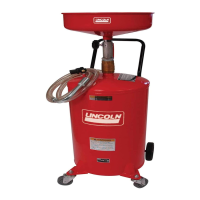
MODEL 3601
USED OIL RECEIVER
NOTICE
This device dispenses uid using pressurized air, and complies
with the specications of the Uniform Fire Code, Standard Fire
Prevention Code and the National Fire Protection Association,
(NFiPA-30). It does not comply with current provisions of
BOCA section F.5.3. You should consult your local re marshall
concerning code compliance of this device.
GENERAL SAFETY STANDARDS
The standards listed below must be observed for prevent injury
to operators and damage to the Waste oil receiver.
• Read all labels on the Waste oil receiver carefully, do not
cover them and replace them immediately if damaged.
• The Waste oil receiver must only be used by authorized
personnel trained in its use.
• NEVER leave unit unattended when operating or
evacuating.
• NEVER use near open ame or heat source.
• ALWAYS disconnect air supply after emptying.
• NEVER use unit for handling highly volatile fuels and
uids.
• Use only the nozzle assembly provided.
• Pay attention to other people in the vicinity while the
Waste oil receiver is operating, especially children.
• Do not use the Waste oil receiver in an environment
Subject to explosion hazard.
• Do not use the Waste oil receiver as a means of transport.
• Do not use acid solutions which could damage the Waste
oil receiver and/or injure persons.
• The Waste oil receiver will remain in place up to a
maximum gradient of 0.5%, before beginning to slide.
• If the Waste oil receiver malfunctions, contact the dealer or
send it to the nearest service center.
• When replacing parts, always demand ORIGINAL
replacement parts from an authorized Lincoln dealer or
retailer
• IMPORTANT! The Waste oil receiver must not be used at
more than 10.0 PSI (0,69 bar).
INSPECTION
Prior to operation or maintenance, a visual inspection shall
be made. Check for worn parts, air leaks, damaged, loose or
missing parts.
Check tank operation by connecting air to air nipple and
closing ball valve. Verify that there is sufcient air ow coming
from nozzle/hose assembly.
If the unit is damaged, badly worn or operates abnormally, it
should be removed from service. Contact a factory authorized
service center for repair.
An annual tank/component inspection is recommended to be
performed by a factory authorized service center.
CLEANING AND MAINTENANCE
The Waste oil receiver does not require any special
maintenance, other than normal cleaning, which should be
done with a damp cloth (water and alcohol or normal detergent
for household appliances).
IMPORTANT!
The Waste oil receiver must not be cleaned with nitrocellulose-
based solvents
DRAIN OIL INTO TANK
1. Air line must be disconnected from tank. Do not overll
tank. Check sight gauge tube frequently. Do not ll above
hose strap.
2. Raise drain bowl/tube to desired height and lock in place
by turning knob clockwise.
3. Main valve must be fully open, with valve handle in vertical
position.
REMOVING OIL FROM TANK
1. The tank should be wheeled to the main oil collection
reservoir.
2. Place drain nozzle securely into reservoir opening.
3. With drain bowl raised, main valve must be fully closed,
with valve handle in horizontal position.
4. Connect air supply to tank (maximum supply pressure of
150 PSI [10.3 BAR] ).
5. Oil will drain from tank into reservoir. Disconnect air supply
when nished.


 To Next Page
 Loading...