EasyManua.ls Logo

Lionel 151 SEMAPHORE - Page 4

Lionel 151 SEMAPHORE
6 pages
Print Icon
To Next Page IconTo Next Page
To Previous Page IconTo Previous Page
Loading...
|
GREEN
LAMP
i
NO.
153
ae
NO.
167
WHISTLE
CONTROLLER
ae
Pe
oF
=S.
RED
LAMP
|
NN
AG
|
5
ao
ace
ges
eI
o>
aie
©
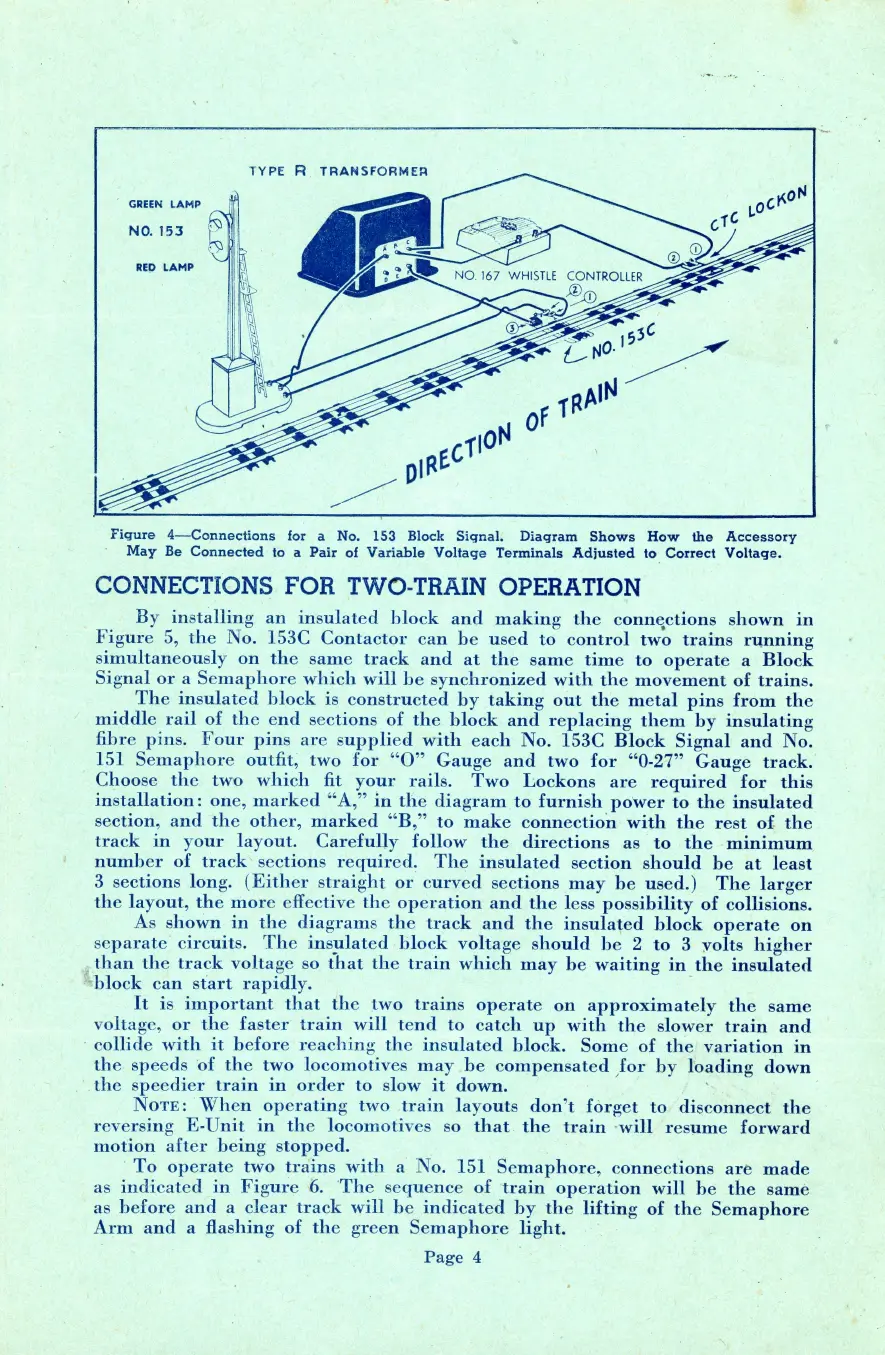
Figure
4—Connections
for
a
No.
153
Block
Signal.
Diagram
Shows
How
the
Accessory
May
Be
Connected
to
a
Pair
of
Variable
Voltage
Terminals
Adjusted
to
Correct
Voltage.
CONNECTIONS
FOR
TWO-TRAIN
OPERATION
By
installing
an
insulated
block
and
making
the
connections
shown
in
Figure
5,
the
No.
153C
Contactor
can
be
used
to
control
two
trains
running
simultaneously
on
the
same
track
and
at
the
same
time
to
operate
a
Block
Signal
or
a
Semaphore
which
will
be
synchronized
with
the
movement
of
trains.
The
insulated
block
is
constructed
by
taking
out
the
metal
pins
from
the
middle
rail
of
the
end
sections
of
the
block
and
replacing
them
by
insulating
fibre
pins.
Four
pins
are
supplied
with
each
No.
153C
Block
Signal
and
No.
151
Semaphore
outfit,
two
for
“O”
Gauge
and
two
for
“0-27”
Gauge
track.
Choose
the
two
which
fit
your
rails.
Two
Lockons
are
required
for
this
installation:
one,
marked
“A,”
in
the
diagram
to
furnish
power
to
the
insulated
section,
and
the
other,
neked
“B,”
to
make
connection
with
the
rest
of
the
track
in
your
layout.
Carefully
follow
the
directions
as
to
the
minimum
number
of
track
sections
required.
The
insulated
section
should
be
at
least
3
sections
long.
(Either
straight
or
curved
sections
may
be
used.)
The
larger
the
layout,
the
more
effective
the
operation
and
the
less
possibility
of
collisions.
As
shown
in
the
diagrams
the
track
and
the
insulated
block
operate
on
separate
circuits.
The
insulated
block
voltage
should
be
2
to
3
volts
higher
,_
than
the
track
voltage
so
that
the
train
which
may
be
waiting
in
the
insulated
“block
can
start
rapidly.
It
is
important
that
the
two
trains
operate
on
approximately
the
same
voltage,
or
the
faster
train
will
tend
to
catch
up
with
the
slower
train
and
collide
with
it
before
reaching
the
insulated
block.
Some
of
the
variation
in
the
speeds
of
the
two
locomotives
may
»
be
por
pensated
|
for
by
loading
down
the
speedier
train
in
order
to
slow
it
down.
;
Note:
When
operating
two
train
layouts
don’t
forget
to
dissiniacee
the
reversing
E-Unit
in
the
locomotives
so
that
the
train
-will
resume
forward
>
motion
after
being
stopped.
|
To
operate
two
trains
with
a
No.
151)
Boucle
connections
are
dinds
as
indicated
in
Figure
6.
The
sequence
of
train
operation
will
be
the
same
as
before
and
a
clear
track
will
be
indicated
by
the
Somes
of
the
Semaphore
|
Arm
and
a
flashing
of
the
green
Semaphore
light.
3
Page
4

Related product manuals