The LISSMAC Mini Crane LMK, specifically the LMK 400 TFE and LMK 400 TFE/DK models, is a mobile lifting aid designed for efficient and safe handling of building bricks on construction sites. Developed in cooperation with users and approved by TÜV, it emphasizes professional processing, simple handling, and operator safety.
Function Description:
The mini crane is primarily used for moving building bricks in conjunction with a tested LISSMAC brick gripper. It is operated by a single person using a hand-guided controller, which must be fixed to the brick gripper. The crane's compact design allows for precise handling and adaptability to various brick formats.
Key functional components include:
- Telescoping (T): The jib height can be extended, allowing for greater reach.
- Traction Drive Unit (F): Available on the LMK 400 TFE/DK, this electric motor-driven unit enables the mini crane to be moved. It can also be disengaged for manual adjustment.
- Electrohydraulic Assembly and Dismantling (E): This feature allows for effortless assembly and dismantling of the jib. A safety valve ensures controlled lowering even without a power source.
- Rotary Drive (D) (Optional): For the LMK 400 TFE/DK, this electrically controlled drive enables the swivel frame to rotate.
- Trolley Running Gear (K) (Optional): For the LMK 400 TFE/DK, this electrically controlled system allows the chain hoist to travel along the jib.
- Chain Hoist: Equipped with a mechanical clutch, it securely holds the attached load. Its load-bearing capacity is safety-adjusted to the maximum permissible limit.
- Ballast Support: Essential for stability during assembly and dismantling, it must be lowered and tightened.
- Swivel Lock: Secures the jib to prevent unintentional swiveling, especially during transport.
- Parking Brake: Used to secure the mini crane against unintentional rolling.
Important Technical Specifications:
| Specification |
LMK 400 TFE |
LMK 400 TFE/DK |
| Dimensions (LxWxH) |
6100 x 2100 x 5210 mm (Telescoped 6710 mm) |
6100 x 2100 x 5210 mm (Telescoped 6710 mm) |
| Transport dimensions LxWxH |
6100 x 2100 x 2000 mm |
6100 x 2100 x 2000 mm |
| Lifting capacity |
400 kg |
400 kg |
| Hook height |
5000 mm |
4500/6000 mm |
| Weight without ballast |
991 kg |
1107 kg |
| Ballast |
1070 kg |
1070 kg |
| Total weight |
2061 kg |
2177 kg |
| Lifting speed |
2.0/8.0 m/min. |
2.0/8.0 m/min. |
| Power |
2.1 kW |
3.4 kW |
| Power consumption |
3.1 A |
5 A |
| Operating voltage |
400 V-16 A |
400 V-16 A |
| Turning radius |
1.5 m |
1.5 m |
| Wheel pressure max. |
14 kN |
14 kN |
| Wheelbase max. |
2000/2000 mm |
2000/2000 mm |
| Telescopic tower (T) |
yes |
yes |
| Traction drive unit (F) |
yes |
yes |
| Assembly and dismantling (E) |
electro-hydraulic |
electro-hydraulic |
| Slewing drive (D) |
no |
yes |
| Trolley drive (K) |
no |
yes |
The sound power level (LWA) is 87 dB(A), and the emission sound pressure at the workplace (LPA) is 75 dB(A). Ear protection is mandatory if the sound power level exceeds 85 dB(A).
Usage Features:
- Robust Construction: The base frame, tower, and jibs are hot-dip galvanized for corrosion resistance, ensuring durability in demanding environments.
- Smooth Operation: A generously sized ball slewing ring provides smooth rotation.
- Integrated Cable Towing Device: Power supply to the jib and chain hoist is managed by an integrated cable towing device, enhancing safety and preventing cable entanglement.
- Low-Backlash Tower Fixing: Ensures stability and precision during operation.
- Transport Optimization: The jib's inclined position allows two mini cranes to be placed on one load area for efficient transport. The weight relief of the ball slewing ring during transport extends its service life.
- Horizontal Adjustment: The crane can be horizontally adjusted using a forklift or crane.
- Radio Remote Control (Optional): Available for all versions, offering flexible operation.
- Soft Start and Stop: The electrical slewing drive features soft start and soft stop functions for smooth movements.
- Protective Hood: A special hood protects the chain hoist from moisture.
- Quick Disassembly: The chain hoist can be quickly disassembled via a plug connection.
- Flexible Control Cable: A highly flexible coiled cable connects to the hand-held or pendant control panel.
- Safety Interlocks: The ballast support, parking brake, and swivel lock must be engaged for safe operation and stability.
- EHS Controller: For intended use, the controller must be mounted on the brick gripper, and the cable must not wrap around the chain.
Maintenance Features:
- Regular Inspections: The mini crane must undergo regular inspections by a qualified inspector, with the first inspection within one year of commissioning, and then annually. A check measurement of the slewing ring is required every 12 months, with replacement if the tilting clearance exceeds +1.4 mm from the baseline.
- Lubrication: Moving parts must be lubricated at regular intervals at designated lube points using approved, heat-resistant multi-purpose grease. This includes the slewing ring, trolley, chassis wheels, and connections between the inner tower, jib, and swivel frame. Gear wheels on the traction drive unit also require grease.
- Hydraulic System: The hydraulic unit is filled with hydraulic oil by the manufacturer. The hydraulic oil level must be checked regularly, and the oil must be disposed of properly. The operating pressure is controlled by a pressure relief valve.
- Electrical System: Electrical equipment must be inspected and tested at regular intervals. Maintenance or repair work on electrical components must only be carried out by qualified electricians after disconnecting the power supply and securing the machine.
- Screw Connections: All screw connections must be re-tightened after maintenance and repair work, following specified torque values.
- Cleaning: The mini crane should be cleaned thoroughly before inspections. Sharp cleaning equipment should be avoided to prevent paint damage. Electrical motors, switches, and plug connectors must be protected from detergent penetration during cleaning.
- Troubleshooting Guide: The manual provides a troubleshooting section for common issues such as the jib not setting up vertically, jerky lifting, tower not moving, difficulty in slewing, traction drive unit not propelling, and suspended loads running to one side.
- Spare Parts: Detailed lists of spare parts are provided for both LMK 400 TFE and LMK 400 TFE/DK models, including specifications and recommendations.
- Maintenance Schedule: A dedicated section is provided to record completed maintenance and service work, ensuring a comprehensive service history.

 Need help?
 General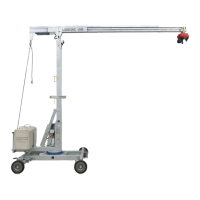

 To Next Page