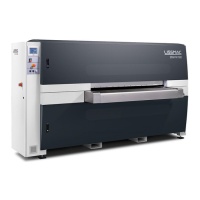
Need help?
Do you have a question about the Lissmac SBM-L 1000 G1S2 and is the answer not in the manual?
Manual is intended for machine operators and maintenance personnel for safe and economic operation.
Lists supplementary documentation for individual machine components like dust extraction systems.
Explains warning symbols (Danger, Warning, Caution, Note) and their associated meanings and consequences.
Explains symbols for important information, requests, results, and position numbers used in the manual.
Machine must be used for intended purpose, in faultless condition, and with observance of safety instructions.
Personnel must read manual, use PPE, follow safety instructions, use original parts, and maintain legible warnings.
Only authorized, trained, and supervised personnel may operate or maintain the machine.
Safe lifting, securing, and vehicle transport procedures for the machine, using proper gear and attachment points.
Safe operating practices, checks for damage, and malfunction handling during normal use.
Procedures for authorized personnel, power disconnection, and safety checks during maintenance and repair.
Electrical system work by electricians, power interruption, and fuse replacement precautions.
Regulations for dust control, carcinogenic substances, and exhaust system requirements for safe operation.
Precautions regarding flammable materials, workpieces, and machine cleaning to prevent fire risk.
Measures to prevent explosion hazards from dust, proper media processing, and ensuring extraction system function.
Explanation of various safety and operational symbols found on the machine for user awareness.
Machine intended for deburring/rounding edges; requires approved extraction system and specific operating conditions.
Specifications for machine dimensions, weight, and electrical data for SBM-L 1000/1500 G1S2 models.
Technical data for machining units, feed, hydraulic unit, environment, noise, and workpieces.
Details the information presented on the machine's type plate, including model, serial, and specifications.
Identifies components on the machine's input (front) side with a labeled diagram.
Identifies output side components and control elements with diagrams.
Details the top and bottom machining units and their key components.
Lists and illustrates the main control and display elements on the front panel.
Explains machine function, machining units, feed, and automatic tool wear compensation.
Details the machine's safety features like emergency stop buttons, shutdown bars, and interlocks.
Instructions and warnings for safely transporting the machine via crane or forklift.
Guidelines for proper machine storage, including cleaning, greasing, and protection.
Procedures and warnings for installing the machine, including lifting, leveling, and setup.
Steps and safety precautions for electrical connection, including high voltage warnings.
Requirements for extractor system, flow rates, piping, grounding, and electrical connection.
Overview of control elements and display on the front of the grinding machine.
How to operate the machine using function switches and enter setup mode.
Steps to enter setup mode using the key switch for setting and checking operations.
Using the display for various machine operations and settings.
Describes the main screen layout and available menu items for operation.
Details icons, functions, error messages, and unit activation on the start screen.
Instructions for setting sheet thickness via jog mode or direct input on the display.
Procedures for setting the grinding unit G, including belt retraction and adjustments.
Procedures for setting the grinding unit S, including belt retraction and adjustments.
Displays operating hours and offset values for individual machine assemblies.
Shows cleaning interval display and how to select material for processing.
Displays tool wear compensation values and their graphical representation.
Instructions for selecting language and units (mm/inch) via the HMI.
Instructions for setting sheet thickness via buttons or direct input, reiterating earlier info.
Prerequisites and steps for starting the machine and activating grinding assemblies.
Explains user levels, functions, and color codes managed by the ID key switch.
Describes external USB/RJ45 ports for HMI access and service technicians.
Details barcode scanner function, connection, and requirements for Material Data Memory.
Explains internal storage of machine parameters and recipes on the HMI.
Discusses external storage options and customer responsibilities for data management.
Explains data acquisition interface, digital signals, and LED indicators for operating states.
Instructions and warnings for placing workpieces, including minimum dimensions and fire hazard.
Procedures for replacing grinding belts on the G unit.
Steps to move units and remove grinding belts from the G unit.
Instructions for installing new grinding belts and checking running direction.
How to align grinding belts using adjustment screws on the G unit.
Procedures for checking and replacing sliding blocks on the G unit.
Steps to remove the sliding block belt from the G unit.
Instructions for installing and tensioning the sliding block belt.
Procedures for replacing abrasive belts on the S unit.
Notes on belt differences and the need to record wear before replacement.
How to read and record wear display for upper and lower S unit belts.
Instructions on how to access the S unit, noting G unit closure requirement.
Steps to release belt tension via control unit and physical tensioning unit.
Instructions for placing new abrasive belts and mounting the belt guide on the S unit.
How to tension the abrasive belt using the hydraulic belt tensioner on the S unit.
How to reset wear values to zero or measure according to instructions for S unit belts.
Detailed steps for measuring wear on upper and lower S unit abrasive belts.
Procedure to set S unit wear display to zero for rough orientation.
Maintenance of grinding belt and sliding block belt drives on the G unit.
Overview of belt drives, inspection, and retightening/replacement intervals for G unit.
Steps to remove the poly-V belt from the G unit drive.
Instructions for installing a new poly-V belt on the G unit drive.
Steps for correctly tensioning the poly-V belts on the G unit drive.
Procedure for replacing the toothed belt for the sliding block drive on the G unit.
Procedures for replacing V-belts on the S unit.
Steps to remove the support bar to access S unit drive belts.
Steps to remove V-belts from the S unit drive motor pulley.
Instructions for installing V-belts on the S unit, emphasizing replacement in pairs.
Steps for correctly tensioning the V-belts on the S unit.
Steps to reinstall the support bar on the S unit after belt replacement.
Instructions for replacing V-belts on the rear of the S unit.
Steps for tensioning V-belts on the rear of the S unit.
Procedures for lubricating various machine parts and checking hydraulic oil.
Identifies and instructs on lubricating left guide shafts.
Identifies and instructs on lubricating right guide shafts.
Identifies lubrication points and plugs on the G unit's upper operator side.
Instructions for lubricating the flanged bearing on the S unit belt.
Instructions for checking and maintaining the hydraulic oil level.
Procedures and warnings related to cleaning the machine and its components.
Details automatic cleaning stops and daily cleaning tasks based on material processed.
Lists regular service tasks and their recommended intervals for machine maintenance.
Lists required consumables like grease and hydraulic oil for maintenance.
Table of tightening torques for standard metric threads and screw classes.
A table listing common errors, causes, and solutions for machine malfunctions.
Contact information for LISSMAC customer service for support.
Guidelines for dismantling and disposing of the machine and its environmentally hazardous parts.
Details the machine's warranty period and exclusions for wear parts.
Warning about carcinogenic substances and requirements for exhaust systems during operation.
Formal declaration of conformity with directives and machine specifications.
 General
| Brand | Lissmac |
|---|---|
| Model | SBM-L 1000 G1S2 |
| Category | Industrial Equipment |
| Language | English |

 To Next Page