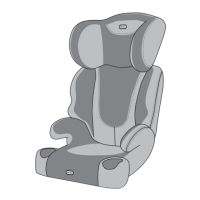
This document describes the Little Tikes Highway Group 2,3 car seat, designed for children weighing 15-36kg (33-79lb), approximately 4 to 12 years old. It is a "Universal" child restraint approved to ECE Regulation 44.04 for general use in vehicles, though it may not fit all vehicle seats. A correct fit is likely if the vehicle manufacturer has declared in the Vehicle handbook that the vehicle is capable of accepting a "Universal" child restraint for this group. This child restraint has been declared "Universal" under more stringent conditions than those applied to earlier designs which do not carry this notice. If in doubt, consult either the child restraint manufacturer or the retailer.
Function Description
The Little Tikes Highway Group 2,3 car seat serves as a child restraint system for older children, utilizing the vehicle's 3-point seat belt to secure the child. It is designed to be installed forward-facing only. The car seat consists of a backrest and a base that connect to form the complete seat. For children in Mass Group II (15kg-25kg), the full car seat with backrest is used. For children in Mass Group III (22kg-36kg), the seat cushion alone can be used, with the harness system removed. The headrest is adjustable to ensure optimal fit and comfort for the child as they grow.
Important Technical Specifications
- Weight Categories: Group II and III
- Child Weight Range: 15kg - 36kg (33lb - 79lb)
- Approximate Age Range: 4 years - 12 years
- Mass Group II: 15kg - 25kg (uses full car seat with backrest)
- Mass Group III: 22kg - 36kg (can use seat cushion alone, harness removed)
- Installation: Forward-facing only
- Vehicle Belt System: Only suitable with approved vehicles fitted with a 3-point/with retractor safety-belt, approved to UN/ECE Regulation No.16 or other equivalent standards.
- Approval: ECE Regulation 44.04
Usage Features
Assembly:
- Place the backrest and base on a flat surface.
- Align the connector piece on the backrest with the opening on the base, ensuring the space is free of padding.
- Connect the backrest and base.
- Lift up the backrest.
- Ensure the backrest has locked into the base before use.
Height Adjustment of Headrest:
The headrest height should be regularly checked to ensure it fits optimally to your child, with their head resting comfortably in the middle of the headrest.
To adjust the height:
- Turn the seat to the back.
- Press down the height adjuster of the headrest.
- Push the headrest upwards or downwards to the desired height position.
- Lock it into position and check it is secure.
Securing the Child Car Seat with Vehicle's Seat Belt (for 15kg-36kg):
The vehicle's 3-point belt system is used to buckle up children in age groups II and III. The harness system must be removed from the seat when used for these age groups (refer to section 5.1 for removal instructions).
Step 1: Place the child safety seat on the vehicle's seat, ensuring it is firmly pressed against the car seat backrest.
Step 2: Seat your child in the child car seat.
Step 3: Pull out the 3-point vehicle seat belt. Place the lap belt on the opposite side of the buckle under the armrest. Ensure that both the diagonal belts and the lap belt on the buckle side are under the armrest. The lap strap should be worn low down so that the pelvis is firmly engaged, and the straps are not twisted. Buckle the belt in place; you should hear a "click."
Step 4: Place the diagonal seat belt through the head belt guide on the side of the headrest, ensuring the belt is not twisted. Tighten the adult belts in the direction shown in the figures, and tighten the diagonal shoulder belt in the direction of the automatic roll-up as much as possible. The satisfactory position of the adult safety-belt buckle relative to the child car seat is important; contact the manufacturer if in doubt.
When using 22-36kg Group III mode (Seat Cushion Only):
To separate the backrest from the base for seat cushion use:
- Lay the backrest flat.
- Lift it up at the connection point and pull to separate the base and the backrest. This is the reverse order of installation.
For 22-36kg children, only use the seat cushion with 3-point seat belts.
- Place the child seat firmly onto the car seat.
- Let the child sit on the seat with their hips and back against the vehicle's seat.
- Pull the vehicle's 3-point seat belt. Put the waist belt under the armrests of the child car seat (ensuring the diagonal belt buckle end is also under the armrest). Tighten up the belt, ensuring the waist belt is as low as possible to make the child seat fit firmly in the car seat. The seat belt must not be twisted.
- Place the buckle end into the buckle to hear a "click."
- With your knee against the child seat, tighten the belt to reduce any relaxation and make the child seat fit firmly.
- Ensure the seat belt is not loose or twisted.
- To release the child, release the car seat belt buckle.
Safety Instructions:
- Read instructions carefully before first use to avoid endangering the child's life through incorrect use.
- Retain these instructions with the child seat for its lifespan.
- The child seat can only be installed forward-facing using a three-point vehicle belt.
- Do not use this child seat at home; it is designed for car use only.
- Before each journey, check that the child car seat is installed firmly.
- Do not modify the child car seat in any way.
- Do not leave your child unattended in the seat at any time.
- In an emergency, the child must be released quickly. The buckle is not fully tamper-proof, and children must be taught not to play with it.
- Keep the child restraint system out of direct sunlight to prevent high temperatures from hurting the child.
- Ensure all parts are locked in place correctly and not trapped by adjustable seats or doors.
- Secure luggage or other objects liable to cause injuries in a collision.
- The child car seat must not be used without the cover.
- Only use the seat cover recommended by the manufacturer.
- Periodically inspect the harness (if applicable), paying attention to attachment points, stitching, and adjusting devices.
- Do not continue to use the child car seat if parts are damaged or loosened after an accident.
- The backrest of the child car seat system must rest flat against the back of the vehicle seat. Adjust the vehicle's headrest if necessary.
- When driving without a child, always secure the child restraint system with the adult belt.
- Do not use any load-bearing contact points other than those described and marked in the instructions.
- Using the child car seat in the back seat of cars is recommended.
- Rigid items and plastic parts of the child restraint must be located and installed so they are not liable to become trapped by a movable seat or a door during everyday use.
- Any straps holding the restraint to the vehicle should be tight, adjusted to the child's body, and not twisted.
- The child restraint system must be changed if it has been subject to violent stresses in an accident, according to the manufacturer's instructions.
- The buckle of the car seat belt cannot be too close to the underside of the armrest.
Maintenance Features
Removing / Replacing the Cover:
- Press the backrest so far back that it rests flat on the floor.
- Remove the backrest.
- Release the elastic on the headrest to remove the cover.
- Loosen the elastic on the backrest to remove the cover.
- Pull the seat cushion cover forward and remove it.
To replace the cover, reverse these steps.
Cleaning the Cover:
Refer to the care label on the covers for specific cleaning instructions.
Procedure After an Accident:
- The child car seat must be replaced if it has been subject to violent stresses in an accident.
- It is dangerous to make any alterations or additions to the device without the approval of the Type Approval Authority.
- It is dangerous not to follow the installation instructions carefully.
- Ensure children are not left unattended in their child restraint system.
- Ensure any luggage or other objects liable to cause injuries in the event of a collision are properly secured.
- The child restraint shall not be used without the cover; the seat cover should not be replaced with any other than the one recommended by the manufacturer.
- It is extremely dangerous to use any load-bearing contact points other than those described in the instructions and marked on the child restraint.

 Need help?
 General

 To Next Page