
 Need help?
Do you have a question about the Livoo DOC111 and is the answer not in the manual?
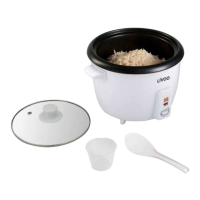
This document provides an instruction manual for a Livoo rice cooker, designed for domestic use. The manual emphasizes safety, proper operation, and maintenance to ensure user satisfaction and product longevity.
The primary function of this appliance is to cook rice, but it can also be used for preparing soups and stews. Its design aims for ease of use and consistent results.
The rice cooker is straightforward to operate, with a clear process outlined for cooking rice. Users begin by measuring rice using the provided measuring cup and adding it to the inner pot. Water can be added either by using the measuring cup according to a specific chart or by filling to the appropriate waterline marked inside the inner pot. For softer rice, a pre-soaking period of 10-20 minutes is recommended.
Once the rice and water are in place, the lid is secured, and the power cord is plugged in. It's important to only plug in the appliance when ready to cook to prevent spoilage. The cooker features a power switch (On "I" / Off "O") and a "COOK" switch. Pressing the "COOK" switch initiates the cooking process, indicated by an illuminating light.
A key feature of the rice cooker is its automatic operation. Once the rice is done, the "COOK" switch will automatically pop up, signaling the completion of the cooking cycle. After cooking, it is crucial to leave the lid on for at least 15 minutes to allow the rice to steam thoroughly, ensuring it is fully cooked. The "KEEP WARM" function activates automatically when the cord is plugged in and the power switch is "On," maintaining the rice at an optimal serving temperature.
For brown rice, an additional 3/4-cup of water is suggested to accommodate its longer cooking time. The manual also notes that rice/water measurements might vary slightly depending on the type of rice, encouraging users to adjust as needed for the best results.
Beyond rice, the appliance can be used for soups and stews. The manual suggests allowing extra simmering time for these dishes to enhance flavors and tenderize meat. Helpful hints for soup and stew preparation include thickening with flour paste, adding fresh herbs late in the cooking process, and saving leftovers for improved flavor.
Maintaining the rice cooker's cleanliness is essential, especially since it comes into direct contact with food. Before any cleaning, the appliance must be unplugged and allowed to cool completely.
The inner pot and lid are removable and should be washed in hot, sudsy water, then rinsed thoroughly and dried with a soft cloth. The exterior of the cooker can be cleaned with a damp cloth and a mild dish detergent. Abrasive cleaners, metal tools, or steel wool should never be used on the exterior finish or the cooking pot, as they can cause damage. Crucially, the main body of the rice cooker must never be immersed in water.
The heating plate and thermo-control plate require specific attention. These can be polished or cleaned to remove residue using steel wool, then wiped with a damp cloth and allowed to dry completely before reuse. It's vital to keep these components free from foreign objects to ensure proper operation. Any residue from vinegar or salt should be completely cleaned after each use to prevent corrosion of the inner pot.
For a quick cleaning tip, users can add 1/2 cup of water and a small amount of liquid dish or dishwasher detergent to the inner pot, press the "COOK" switch, and allow it to heat for 10 minutes. Afterward, the pot should be rinsed well and dried completely before re-using.
The manual also emphasizes that any servicing beyond basic cleaning should be performed by an authorized service representative. This ensures that the appliance remains safe and functional.
The manual includes comprehensive general safety instructions to prevent damage to the appliance or injury to the user. It stresses the importance of reading the instructions thoroughly before first use. Users are advised to check that the mains voltage matches the appliance's specifications and to regularly inspect the power cord for damage. The appliance should never be used if the cord or the appliance itself shows any signs of damage.
The steam vent becomes very hot during cooking, so users must keep their face and hands away from it and the outer lid. The appliance is intended for domestic purposes only and should not be used near hot surfaces or outdoors. It must always be placed in a dry environment.
To prevent hazards, only accessories recommended by the producer should be used. The appliance should never be moved by pulling the cord, and the cord should not be wound around the appliance or bent. It must be placed on a stable, flat surface. Unplugging the appliance when not in use is also a key safety measure.
Special attention is given to children and individuals with reduced capabilities. Children aged 8 years and above can use the appliance under supervision and after receiving instructions on safe use and understanding the hazards. Children should not play with the appliance, and cleaning or user maintenance should not be performed by children unless they are over 8 and supervised. The appliance and its cord must be kept out of reach of children under 8 years.
The manual also warns against potential injury from misuse and notes that the heating element surface retains residual heat after use. It explicitly states that the appliance must not be immersed in water.
A critical safety caution highlights that the appliance must not be supplied through an external switching device, such as a timer, or connected to a circuit that is regularly switched on and off by the utility. This is to prevent hazards due to inadvertent resetting of the thermal cut-out. The manual also clarifies that the appliance is not for professional use and that failure to follow instructions carefully may result in device damage.
 General
| Keep Warm Function | Yes |
|---|---|
| Non-stick coating | Yes |
| Non-stick inner pot | Yes |
| Automatic shut-off | Yes |
| Indicator lights | Yes |
| Voltage | 220-240 V |
| Material | Plastic and metal |
| Frequency | 50 Hz |

 To Next Page