
 Need help?
Do you have a question about the Livoo DOC269 and is the answer not in the manual?
Caution: This barbecue will become very hot. Do not move it during use.
Caution: Do not leave the barbecue within the reach of children and pets.
Warning: Do not use the barbecue in confined or habitable spaces.
Position the barbecue on a stable surface and add a single layer of charcoal, not exceeding 50% capacity.
Use solid fire starters, light, wear protective gloves, and open vents for combustion.
Heat the barbecue until fuel glows for at least 30 minutes before the first cooking.
Light aromatic wood, add gradually, keep vents open initially, then close for low temperature smoking.
Manage temperature by adjusting lid and air supply holes. Use soaked wood chips or hot water if needed.
Add flavored wood chips for aroma, liquid for moisture, and avoid lifting the lid frequently.
Allow barbecue to cool completely after use. Empty pan and clean all parts to prevent grease buildup.
Do not use abrasive cleaners or sharp objects. Avoid standing water to prevent rust.
List of all components with item numbers, descriptions, and quantities for assembly.
Illustrated step-by-step guide for assembling the portable barbecue smoker.
This document describes the "LIVOO Portable Barbecue Smoker," an outdoor cooking appliance designed for both grilling and smoking food. It emphasizes safety, proper usage, and maintenance to ensure user satisfaction and product longevity.
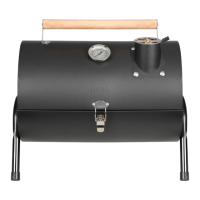
The LIVOO Portable Barbecue Smoker serves as a versatile outdoor cooking tool, allowing users to either grill food directly over charcoal or smoke it at lower temperatures using aromatic wood chips. Its primary function is to provide a convenient and effective way to prepare barbecued and smoked dishes in an outdoor setting. The appliance is designed for private use and is not intended for events or public places. It features a main body, a cooking grid, and a charcoal holder (fire grate) for fuel. A thermometer on the lid allows for temperature monitoring, which is particularly useful for smoking. Ventilation openings and a chimney damper help control airflow and temperature during operation.
The barbecue smoker is designed for ease of use, but adherence to safety instructions is paramount. Before use, it must be assembled correctly on a flat, level, stable, and heat-resistant surface. The appliance should never be moved while hot. For grilling, only charcoal or charcoal briquettes compliant with EN1860-2 standard should be used as fuel, placed in the provided charcoal holder, not directly on the tank bottom. The amount of charcoal should not exceed 50% of the tank's maximum capacity, which is specified as 0.8 kg. Before the first cooking, the barbecue must be heated up, and the fuel kept glowing for at least 30 minutes, waiting for a layer of ash to cover the fuel. For subsequent uses, sufficient embers should be present, and the charcoal spread evenly.
For smoking, aromatic wood, such as apple or cherry, or even sawdust from juniper, can be used. The process involves lighting the wood or charcoal, then placing food on the grill, closing the vents and chimney damper to reduce airflow, and maintaining a low cooking temperature, ideally around 70°C. The lid's thermometer helps monitor this temperature. If the temperature is too high, the lid should be placed on, air supply holes closed, and soaked wood chips added. If too low, fanning the fire by opening air supply holes is recommended. Useful tips for smoking include adding flavored wood chips for extra flavor, using a metal clip to prevent burns, and placing liquid (water, broth, wine) in a broth pan to keep food moist. It's advised to avoid lifting the lid frequently during smoking to prevent heat and smoke loss. The appliance can also function as a regular grill, following the lighting instructions and placing food on the cooking grill.
Users are cautioned against using alcohol, gasoline, or similar liquids to start or rekindle a fire, emphasizing the use of fire starters compliant with EN 1860-3. Loose clothing should not be worn when lighting or using the barbecue. It should not be used in strong winds or covered during use. The appliance is strictly for outdoor use and must not be used in confined or habitable spaces like houses, sheds, caravans, tents, or boats due to the risk of fire, suffocation, and carbon monoxide poisoning. It should also be kept away from flammable materials, at least 1.5 meters from combustible material. Protective gloves and heat-resistant barbecue utensils are necessary to handle hot parts and food, as accessible parts can become very hot. The cooking grate should not be covered with foil, dishes, or containers to prevent heat build-up.
Proper maintenance is crucial for the appliance's safety and longevity. After each cooking session, the barbecue, ashes, and accessories must be allowed to cool completely before cleaning and storing. It is recommended to empty the ashes 24 hours after use. The appliance and its accessories should be cleaned after each use to prevent the accumulation of grease, which poses a fire risk. Sharp objects or abrasive cleaners should not be used on the cooking grate or pan; a strong degreaser is preferable. Standing water should not be left in the pan, as it can cause rust and rapid material deterioration. For storage, the appliance should be kept in a dry and sheltered place. If left outdoors in fine weather, it should be protected with a cover. Protection from rain and moisture is essential when not in use for long periods. The manufacturer reserves the right to make modifications to the product without advance notice, indicating a commitment to continuous quality improvement.
 General
| Brand | Livoo |
|---|---|
| Model | DOC269 |
| Category | Smokers |
| Material | Steel |
| Fuel Type | Charcoal |
| Number of Shelves | 2 |
| Adjustable Air Vents | Yes |
| Thermometer | Yes |

 To Next Page