TRAVELING
You have done your walk-around inspection, the diesel
is running, and you and your work partners are seated
and buckled up.
Ride
only in the cab
during travel to and from the
area where you will collect garbage house-to-
house.
THE RIDING STEP SHALL NOT BE USED WHEN:
SPEEDS EXCEED 10 MPH
DISTANCE OF TRAVEL IS MORE THAN 2 TENTHS OF A
MILE
VEHICLE IS MOVING BACKWARDS (IN REVERSE)
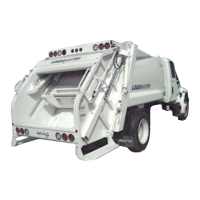
When driving on the street in the chassis/packer,
always be aware that you are driving a
heavy
truck
. The way a heavy truck handles and brakes
is different from your personal passenger car or
light truck (pickup truck). The packer requires more
distance to stop in a “panic” situation. Always allow
extra spacing in traffic. The packer is not as agile
or responsive as a typical passenger car. You will
not always be able to maneuver your way out of
difficult situations. This means you must drive extra
defensively when traveling in the chassis/packer.
Always be alert and anticipate possible traffic
hazards. Account for the size and weight of your
chassis/packer.
The center of gravity of the chassis/packer is much
higher than a passenger car. This fact must be
accounted for to avoid rolling over. Turn through
corners at slower speeds and account for the larger
turn radius the chassis/packer will require.
Also, be aware that the full chassis/packer will
behave (brake and handle) somewhat differently
from the empty chassis/packer.
ALWAYS DRIVE CAREFULLY AND DEFENSIVELY! ALWAYS BE
AWARE THE CHASSIS/PACKER IS A
HEAVY
VEHICLE AND NOT
A PASSENGER CAR. THE CHASSIS/PACKER WILL REQUIRE
SLOWER CORNERING SPEEDS AND LONGER STOPPING
DISTANCES. THE CHASSIS/PACKER WILL HAVE A HIGHER
CENTER OF GRAVITY WHICH PRESENTS A “ROLL-OVER”
HAZARD IF DRIVING HABITS ARE NOT ADJUSTED. BE AWARE
THE CHASSIS/PACKER’S HANDLING AND BRAKING
CHARACTERSITICS WILL
CHANGE
AS YOU BUILD A PAYLOAD.
FAILURE TO ACCOUNT FOR THESE FACTORS COULD LEAD TO
ROLL-OVER OR LOSS OF CONTROL RESULTING IN SERIOUS
INJURY OR DEATH.
You must know the height of your chassis/packer
before going under any overpasses. Be sure to
allow sufficient clearance to avoid slamming into
anything overhead.
As mentioned in the “walk-around” pre-travel
inspections, be sure the tailgate is fully down and
fully latched closed. Do this by visually checking it
to be fully down in addition to monitoring the “gate
ajar” warning light periodically during road travel.
Pull over immediately should you notice the “gate
ajar” light has illuminated during travel. When you
unload (tailgate raised up), confirm that the “gate
ajar” light does indeed illuminate (proper and
normal). If not, have the “gate ajar” warning light
system repaired immediately. (Note that the “gate
ajar” light will illuminate when vehicle transmission
shifts to reverse, even with gate fully down…this is
how it is wired.)
ALWAYS KEEP THE IN-CAB “GATE AJAR” PILOT LIGHT IN
GOOD WORKING CONDITION. ALWAYS BE SURE THE BACK-
UP ALARM SOUNDS WHENEVER THE TAILGATE IS RAISED-UP
A FOOT OR SO. REPLACE LAMP BULB OR REPAIR ELECTRICAL
WIRE SYSTEM IMMEDIATELY. FAILURE TO DO SO COULD
LEAD TO SERIOUS SITUATIONS.
Never allow any person to ride in the hopper
or to ride sitting on the loading sill at any
time.
When traveling to or from your on-the–route
collection geographic area, always have the rocker
switch labeled THRTL in the OFF position (no red
color band showing). This rocker switch is a
master
kill switch which precludes any malfunction or
unintentional throttle advancing during travel
whenever it is at the OFF position.
THE IN-CAB MASTER ROCKER SWITCH LABELED “THRTL”
(THROTTLE) MUST BE IN THE “OFF” POSITION WHEN THE
TRUCK IS BEING DRIVEN ABOVE 10MPH!
SHOULD THE THROTTLE ENGAGE DURING TRAVEL, LOSS OF
VEHICLE CONTROL COULD OCCUR RESULTING IN SERIOUS
INJURY OR DEATH.
Sec02-pg14


 To Next Page
 Loading...