Need help?
Do you have a question about the Logik LFC55W12 and is the answer not in the manual?
Details on selecting a suitable position for the fridge freezer, considering ventilation, temperature, and proximity to heat sources.
Step-by-step guide and tools required for reversing the door swing of the fridge freezer.
Instructions on how to adjust the levelling feet to ensure the unit is stable and doors seal correctly.
Guide on cleaning the interior and exterior of the unit before initial use, including important precautions.
Steps to take before placing food in the unit, including running time and temperature checks.
Information on the placement and use of various shelves and drawers within the unit.
Instructions on connecting the unit to power, setting the thermostat, and initial run-in period.
Guidance on how to adjust the thermostat for optimal temperature control based on environment.
Explanation of normal operating noises and their causes, assuring users they are not faults.
Tips for selecting, transporting, and storing chilled food to maintain quality and safety.
Advice on proper food placement, covering, and door usage for optimal freshness and efficiency.
Guidelines for purchasing frozen food, checking packaging, and transport to maintain frozen state.
Best practices for preparing and packaging food for freezing to ensure quality and safety.
Steps for safely defrosting frozen food, including handling, cooking, and avoiding bacteria.
Procedure for manual defrosting when frost builds up, including tools and methods.
Detailed instructions for cleaning all parts of the fridge freezer, including shelves and exterior surfaces.
Advice on managing condensation and when to seek professional assistance for cleaning issues.
Step-by-step guide for safely replacing the interior light bulb of the unit.
Important instructions on how to safely lift and move the appliance to prevent damage.
Guidance on when and how to get the unit serviced, emphasizing authorised personnel.
Procedure for safely shutting down the unit for extended periods, including cleaning and door management.
Information on environmentally friendly disposal methods for the unit and its components.
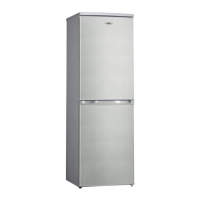
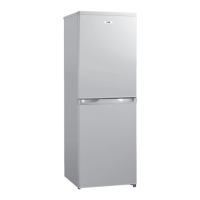
This document is an instruction manual for the Logik Frost Free Fridge Freezer, model LFC55W12. It provides comprehensive guidance on the installation, operation, maintenance, and disposal of the appliance, along with important safety warnings.
The Logik Frost Free Fridge Freezer is a dual-compartment appliance designed for the storage of both fresh and frozen foods. The "Frost Free" feature in the freezer compartment means that it is designed to prevent the accumulation of frost, eliminating the need for manual defrosting under normal usage conditions. The unit operates by circulating refrigerant liquid within a cooling system, driven by a compressor motor, to maintain desired temperatures in both the fridge and freezer sections. The internal temperature is controlled by a thermostat, allowing users to adjust the cooling level according to their needs and ambient conditions.
Installation and Setup: The manual emphasizes proper installation for optimal performance and safety. The unit should be placed on a flat, firm, and well-ventilated floor, away from heat sources and direct sunlight, with specific clearance requirements (200 mm at sides, 200 mm at rear, 300 mm at top) to ensure adequate air circulation. The door swing can be reversed, a process that is recommended to be performed by a qualified technician due to the complexity and risk of damaging the coolant system if not done correctly. Before initial use, the unit must be levelled using its adjustable feet to ensure proper door and magnetic seal alignment. It is crucial to wait two hours after moving the unit before turning it on to allow the coolant fluid to settle. The interior should be cleaned with a weak bicarbonate soda solution and warm water, then dried thoroughly before placing food inside.
Operation and Temperature Control: The unit is switched on by connecting it to the mains socket. The internal temperature is regulated by a thermostat with seven settings, where position 6 is the coldest and "OFF" turns the unit off. Position 3 is recommended for normal room temperatures (16°C to 38°C). The manual advises waiting 24 hours after turning on the unit before filling it with food to ensure it reaches the correct temperature. For colder environments (e.g., winter), settings 1 to 4 are suggested, while 5 to 6 are for hotter environments. A fridge/freezer thermometer can be used to verify that the fridge compartment is 5°C or lower and the freezer compartment is -18°C or lower. The manual also addresses normal operating noises, explaining that sounds from the refrigerant circulation and compressor motor are typical.
Food Storage Guidelines:
Interior Accessories: The unit includes various glass or plastic storage shelves. One full-size glass shelf should always be placed on the lowest set of guides, above the fruit and vegetable containers. Shelves can be adjusted by pulling them forward, swivelling them, and re-inserting at a different height. Users can remove shelves and/or drawers to maximize storage volume in both compartments according to their daily needs.
Cleaning: The freezer compartment is frost-free, so frost accumulation should be minimal with proper use. However, if frost builds up due to improper use, it should be scraped away with a plastic scraper (not included). Metal or sharp instruments and electrical appliances should not be used for defrosting. Defrosting is recommended when the frost layer reaches 10mm. This involves removing food, turning off the unit, and leaving the door open. Frozen food should be transferred to another freezer or wrapped in newspaper/towels and a thick blanket to keep it cool. A shallow bowl or pan should be placed below the freezer compartment to collect water. Placing a bowl of hot water inside the freezer cabinet with the door closed can speed up defrosting. Once defrosted, the interior and exterior of the unit should be cleaned. For general cleaning, all shelves, drawers, and the salad bin should be removed. The interior should be wiped with a weak bicarbonate soda solution, rinsed with warm water, and dried completely. The exterior can be cleaned with a damp cloth and furniture polish, ensuring polish does not get on magnetic door seals. The condenser grille at the back should be vacuumed with a soft brush attachment. Condensation on the outside of the unit, if persistent, may indicate a problem requiring a technician.
Changing the Internal Light: To replace the internal light bulb (10W SES), the thermostat control dial must first be set to "OFF," and the unit disconnected from the mains supply. The light bulb cover is then gently prised off with a flat-bladed screwdriver. The old bulb is unscrewed anti-clockwise, replaced with a new one, and the cover refitted. Finally, the unit is reconnected to the mains and switched on by adjusting the thermostat.
Handling and Moving: When moving the unit, it should be held by its sides or base, never by the edges of the top surface. A minimum of two people are required for safe handling.
Servicing: Any servicing or repairs should only be carried out by an authorised engineer using genuine spare parts. Users are strongly advised not to attempt repairs themselves to avoid injury or malfunction.
Switching Off for Long Periods: If the unit will not be used for an extended period, it should be disconnected from the mains supply, emptied of all food, and cleaned. The door should be left ajar to prevent the build-up of unpleasant smells.
Disposal: The manual emphasizes environmentally friendly disposal methods to recover valuable raw materials. The refrigerant and insulation materials require special disposal procedures, and care should be taken not to damage the pipes on the back of the unit. Information on disposal options can be obtained from local council offices. For old units, any locks or latches should be broken off, and doors removed as a safety measure, especially to prevent children from becoming trapped.
 General
| Type | Fridge freezer |
|---|---|
| Energy Rating | A+ |
| Dimensions (H x W x D) | 85 x 45.6 x 54.7 cm |
| Weight | 44 kg |
| Color | White |
| Energy efficiency class | A+ |
| Number of Shelves | 3 |
| Freezer Compartment | Yes |
| Noise level | 42 dB |
| Fridge features | 3 shelves |
| Freezer features | Ice tray |

 To Next Page