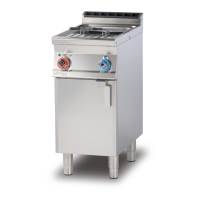
This document provides installation and operating instructions for the LOTUS ELECTRIC PASTA COOKER FOR PROFESSIONAL USE, specifically models CP-94ET, CPA-94ET, CP-98ET, CPA-98ET, and CPB-98ET. The manual, identified as LIBR.ISTR.CP90E CON SIC. with code 563007803, was last revised on March 22, 2019.
The primary function of this appliance is for professional cooking or heating of food, specifically pasta. It is designed for industrial use and must only be operated by trained personnel who are aware of the risks associated with high temperatures. The manufacturer emphasizes that any other use is considered improper.
Technical Specifications:
The technical data table provides detailed electrical specifications for various models:
- CP-94ET / CPA-94ET:
- Dimensions: 40x90x90h
- Power Supply: 400V~3N 50/60 Hz
- Maximum Power: 13.5 kW
- Maximum Absorption: 19.57 A
- Power Supply Cable (silicon type): 5 x 2.5 mm²
- CP-98ET / CPA-98ET / CPB-98ET:
- Dimensions: 80x90x90h
- Power Supply: 400V~3N 50/60 Hz
- Maximum Power: 27 kW
- Maximum Absorption: 39.13 A
- Power Supply Cable (silicon type): 5 x 6 mm²
The appliance complies with GAR 2016/426 for gas parts and directives 2014/30/EU, 2014/35/EU for electrical parts. Installation must adhere to current regulations, especially concerning ventilation and exhaust gas evacuation. The connection cable must be silicone type, capable of withstanding temperatures up to 180°C, and have an appropriate cross-section for the appliance's power.
Usage Features:
The pasta cooker is equipped with several components for operation:
- Knob (1): Used to select the desired heating level (1 to 3) or turn off the appliance (position "0").
- White indicator light (2): Illuminates when the heating element is powered.
- Green indicator light (3): Indicates normal operation.
- Water discharge (4): For emptying the tank.
- Safety thermostat accessibility (5) and Threaded closing cap (6): For accessing and resetting the safety thermostat.
For models with automatic loading (CPA-94ET, CPA-98ET), additional features include:
- Water level control unit (1): Manages water levels.
- Water solenoid (4): Controls water flow.
- Level probe (9): Detects water levels.
- Red indicator light (11): Flashes to signal an alarm (e.g., no water in the tank, filling timeout).
- Slow refilling button: Activates slow tank filling to prevent foaming.
- Level button: Defines the water level in the tank (high for cooking pasta, low for steaming).
Turning on the appliance:
- When powered up, the red indicator light flashes briefly.
- If there is no water, the red light continues flashing.
- Open the water tap to fill the tank between the minimum and maximum level marks. For automatic models, filling starts automatically.
- Turn the control knob to the desired heating level (1-3). The white indicator light will turn on.
- The appliance must not be operated without water in the tank.
Safety features:
- Safety thermostat: Cuts off power if the heating element temperature exceeds 180°C (e.g., in case of dry operation). It can be reset by pressing a red button behind a threaded cap on the front panel.
- Water level control (automatic models): If the probe doesn't detect water for 15 seconds, the heating element is disabled, and the red indicator light flashes. If filling takes more than 350 seconds, an alarm is signaled by a steady red light, blocking operation.
Water connection requirements:
- The inlet must be supplied with drinkable water.
- Total hardness: 0.5 to 5 French degrees.
- Pressure: 50 to 250 kPa (0.5-2.5 bar).
- pH: above 7.
- Electrical conductivity: 50 to 2000 µS/cm (20 °C).
- Chloride ion concentration (Cl-): not too high (acceptable reference value: 10ppm).
- Connecting to a hot water pipe (max. 60 °C) is advisable to reduce heating times. A shut-off valve up-line is recommended.
- The discharge pipe must be connected to a suitable drain without bends to avoid bottlenecks or siphon effects. Water drains by gravity, so the drain must be below the exit point of the pipe.
Maintenance Features:
Regular maintenance is crucial for safe operation, and a service contract is recommended. Maintenance must only be performed by specialist personnel in compliance with current regulations.
Before maintenance or cleaning:
- Disconnect the appliance from the mains power supply and/or close the gas.
- Allow the appliance to cool down sufficiently.
- Do not wash with direct or high-pressure water jets to prevent water infiltration into electrical components.
Routine checks (at least once a year):
- Status of connections (terminal board, power supply cable, gas connections).
- Operating condition of components (functional test).
- For appliances with rotary resistances, remove the hub, grease it, and replace the three O-ring seals to prevent leaks. It is recommended to replace O-rings annually due to wear.
Cleaning:
- External cleaning should be performed regularly to ensure hygiene and durability, avoiding damage to cables and electrical connections.
- Disconnect from power supply before cleaning.
- Steel parts can be washed with warm water and neutral detergent, then rinsed and dried.
- Do not use abrasive or corrosive detergents.
- Enamelled parts should be washed with soapy water.
- Do not wash the appliance with water jets under pressure.
- Stainless steel surfaces must always be kept clean and in contact with air to prevent corrosion.
- Avoid products containing salt or sulfuric acid for descaling; use commercially available products or a diluted acetic acid solution.
- For "minor cleaning," a mild washing-up liquid solution can be used.
- During inactivity, lockable stainless steel appliances should be left uncovered.
- Avoid prolonged contact of stainless steel with concentrated acids, aromatized concentrates, salt solutions, mustard, or spice mixtures, as these can damage the passive layer. Rinse and dry contact surfaces immediately.
- It is inadvisable to use stainless steel pots exclusively for cooking in salt water; periodically use them for cooking fats or vegetables to prevent corrosion.
- After cooking in salt water, rinse tanks with fresh water to prevent spotting corrosion from salt residues.
- Avoid prolonged contact of stainless steel with ferritic steels to prevent secondary corrosion.
- Eliminate any secondary corrosion spots immediately.
- Do not use sharp objects that may scratch stainless steel parts.
- The use of flammable fluids for cleaning is forbidden.
Spare parts:
- Parts like valves, piezoelectrics, ignition control units, or gas pipes can be replaced easily.
- Switch replacement: Remove the knob, open the panel, unscrew fastening screws, disconnect electrical connections, and replace.
- Level control unit replacement: Disconnect electrical connections to the sensor, unscrew fastening screws from the bottom of the appliance, and replace.
- Rotary heating element replacement: Remove the panel, disconnect wires, unscrew fastening screws from the bracket, pull out the bracket, then remove the heating element from inside the bowl. Replace the three O-rings and apply grease.
In case of faults, close the gas connection cock and/or switch off the power using the up-line device, then notify customer service. If the appliance is not to be used for a long time, close the gas cock and/or disconnect the power supply and clean the system.

 Need help?
 General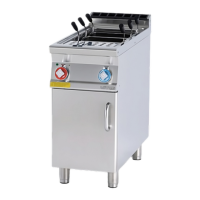

 To Next Page