15
The correct height of shafts and lams is easy to
understand and therefore easy to keep in mind:
In their neutral position the shafts have to be
fixed at the height that the warp on the loom
passes through the middle of the heddle eyes.
The distance between the shaft bars should be
far enough to keep the heddles stretched, but
remain moveable along the bars.
The lams should be at such a height, that their
tie-ups to the treadles keep the treadles in an
angle whereby the row of screw heads is
horizontal.
The difference in height of the upper and lower
lam has to correspond to the difference in
length of the tie-up cords to the treadles.
Adding or removing heddles
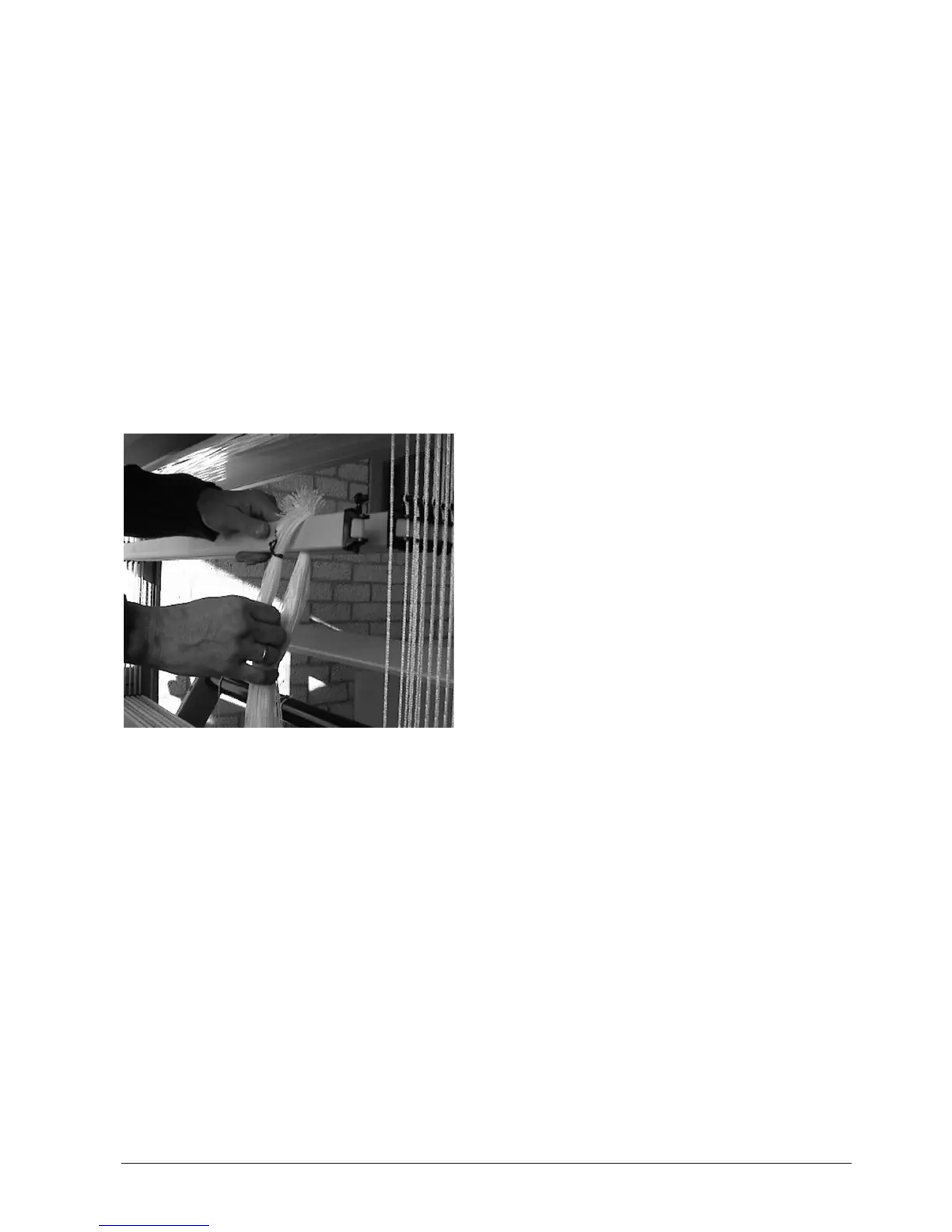
If you need to add heddles to a shaft, pull the
hook that connects the upper shaft bar to the
cord, out of its cord loop. Slip over a bundle of
heddles and push the hook back into the same
loop again. Repeat this with the lower shaft bar,
but untie the bundle before you attach the lower
bar into the cord again.
Naturally, reverse the steps to remove heddles
and don’t forget to tie them together at four
places, right after you release the tension by
unhooking the lower shaft bar.
If your warp doesn't need the whole weaving
width of the loom, you can leave the heddles
that you don't use on the shafts at the sides.
Clicking the hook out or into the cord is easier
after you release its tension by taking the cord
out of one or two rollers at the castle top. By
releasing the tension this way, the whole cord
changes place a bit and you have to pay
attention to use the same loop, pushing in the
hook again. The potential error shows up when
you replace the cord onto the rollers: The shaft
bar differs in level. To avoid errors you could
mark the loop with a felt pen.
The cross sticks
If you are used to leaving the cross sticks in
your warp while weaving, the cross sticks
should be tied to the screw eyes at the back of
the warp beam supports. By doing this, you will
avoid the lease sticks following the warp toward
the shafts, when you advance the fabric.
Cross sticks in between the back beam and
shafts reduce the usable depth of your loom.
The raddle
The plastic raddle strip on top of the castle has
2 dents to 1 cm (5 dents to the inch).
Because the raddle is built up from 10 cm strips
with half an opening at each end, you will lack
one opening for a loom wide warp. In that
situation you have to add some more warp
ends into the openings at the outside.
The middle of the raddle is marked as a guide
for starting to thread the warp.
Threading through
The warp always should be threaded through
the heddles of at least four shafts. Using only
two shafts for a tabby, you will overload the
shaft bars and lams. Lock the shafts, not in use,
in their neutral position.
Tying the warp to the beams
The apron rods are marked at the spots where
the cords have to be attached. The diagram
shows the usual loop to do this.
After the warp is threaded through the heddles
and the reed, the warp ends have to be tied to
the apron rod of the cloth beam. For this job the
breast beam should be blocked, otherwise it is
impossible to get an even tension on all warp
ends: Every time you tighten a bundle of
threads, the breast will move and release all the
other warp ends. When you take the spring
cords off the floating arms, the short cords you
installed to connect the arms to the loom will
block the breast beam.



 To Next Page
 Loading...