1
The parallel countermarch system
In a countermarch loom, every shaft is actively
involved in each shed: Each shaft is either lifted
or pulled down by each treadle.
Uneven sheds, for example a satin weave
shed, where four shafts are lifted and one is
pulled down, open cleanly every time. The warp
ends on the fifth shaft do not tend to ride up as
they often do with jack looms.
When the shed is made, the same tension is
applied to the raised ends as to the lowered
ones, resulting in the best shed in relation to the
increase of the warp tension.
Traditional countermarch system
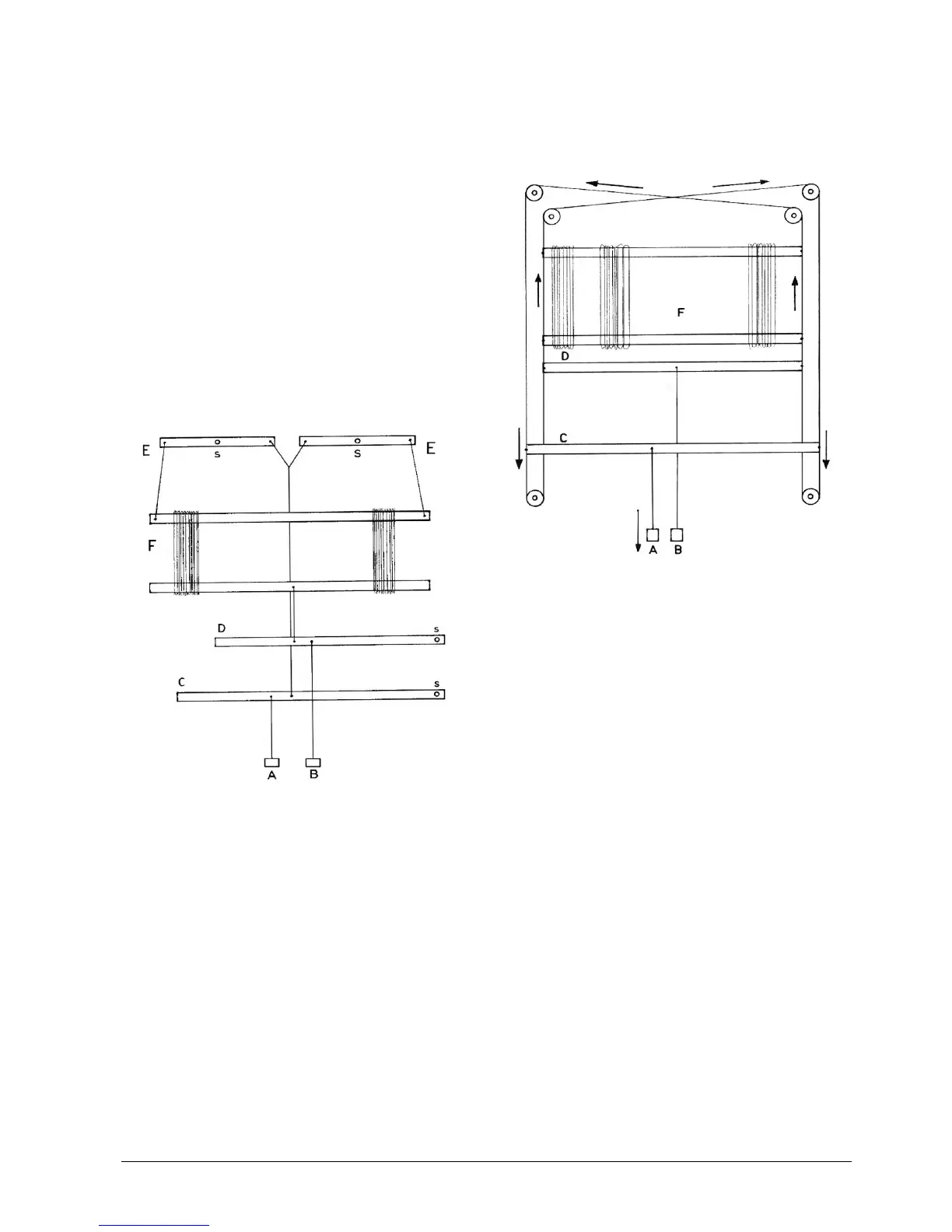
Look at the diagram to help you understand
how a countermarch loom works. The points
marked S are the pivoting points for the lams C
and D and the jacks E.
You will see that beneath each shaft, there are
two lams associated with it. One of those lams
is directly connected to the shaft and moves in
the same direction as it does: when this lam is
pulled down, the shaft moves down. When the
other lam is pulled down, the shaft rises.
Parallel countermarch
Each shaft is attached to a cord, which goes
over all six rollers. The ends of the cord are
joined, so the cord forms a continuous loop.
When treadle A is pressed down, the lower lam
C, attached to the outside part of the cord,
moves downward, pulling the shaft F up. When
treadle B is pressed down, the upper lam D
attached to the inside part of the cord, goes
down, pulling the shaft with it.
Compared to the traditional countermarch, the
parallel countermarch has five nice features:
1. In contrast to the traditional countermarch,
the lams of the parallel countermarch stay
horizontal, while moving the same distance
as the shafts. This means that the action of
all treadles is the same, not depending on
their location in the width of the loom.
2. The parallel countermarch system is more
compactly constructed, because the action
space the lams need is less than pivoting
lams and the rollers at the top take less
space than jacks.
3. Shaft bars and lams cannot slant. Their
ends are fixed to the cord and when the
cord moves, all parts of the cord have to
move the same distance.
4. There is no tie-up to the middle of the lower
shaft bars, so the heddles can be moved
freely over the shafts.
5. There are no cords, connecting the lams to
jacks, running through the middle of the
warp
Because each treadle is tied to one of the lams
of each shaft, twice as many tie-ups per treadle
must be made, on the average, compared to
looms with another system.
Before the advent of Texsolv cord, the time
required to tie up a countermarch loom was



 To Next Page
 Loading...