Page 4 For technical questions, please call 1-888-866-5797. Item 62565
Grounding
TO PREVENT ELECTRIC SHOCK AND DEATH FROM INCORRECT GROUNDING WIRE CONNECTION:
Check with a qualified electrician if you are in doubt as to whether the outlet is properly grounded.
Do not modify the power cord plug provided with the Light. Never remove the grounding prong from
the plug. Do not use the Light if the power cord or plug is damaged. If damaged, have it repaired by a service
facility before use. If the plug will not fit the outlet, have a proper outlet installed by a qualified electrician.
Grounded Lights: Lights with Three-Prong Plugs
1. Lights marked with “Grounding Required” have
a three-wire cord and three-prong grounding
plug. The plug must be connected to a properly
grounded outlet. If the Light should electrically
malfunction or break down, grounding provides a
low resistance path to carry electricity away from
the user, reducing the risk of electric shock.
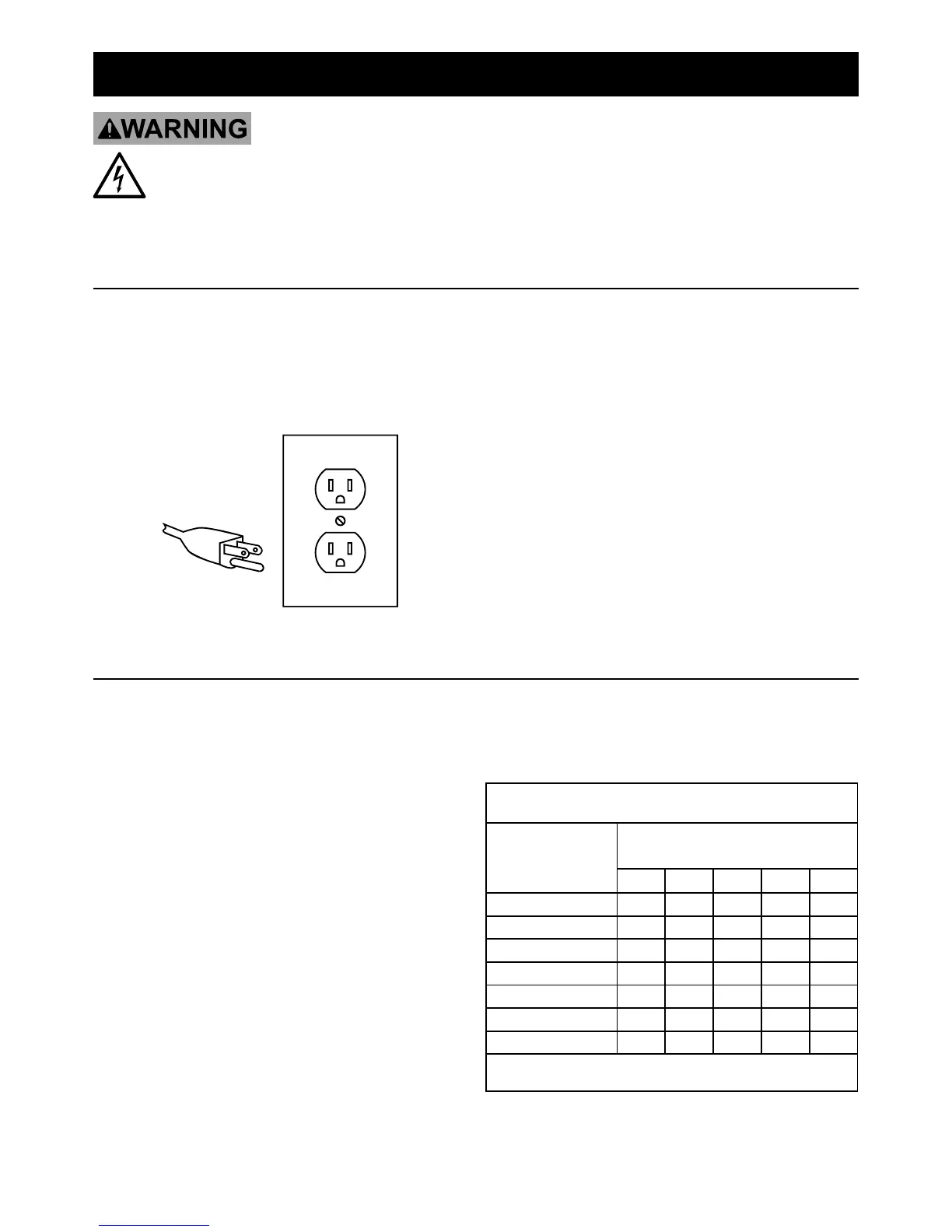
3-Prong Plug and Outlet
2. The grounding prong in the plug is connected
through the green wire inside the cord to the
grounding system in the Light. The green wire
in the cord must be the only wire connected to
the Light’s grounding system and must never
be attached to an electrically “live” terminal.
3. The Light must be plugged into an appropriate
outlet, properly installed and grounded in
accordance with all codes and ordinances.
The plug and outlet should look like those in the
preceding illustration. See 3-Prong Plug and Outlet.
Extension Cords
1. Grounded Lights require a three-wire extension cord.
Double Insulated Lights can use either
a two- or three-wire extension cord.
2. As the distance from the supply outlet increases,
you must use a heavier gauge extension cord.
Using extension cords with inadequately sized wire
causes a serious drop in voltage, resulting in loss of
power and possible Light damage. (See Table A.)
3. The smaller the gauge number of the wire,
the greater the capacity of the cord. For
example, a 14-gauge cord can carry a
higher current than a 16-gauge cord.
4. When using more than one extension cord to
make up the total length, make sure each cord
contains at least the minimum wire size required.
5. If you are using one extension cord for more than
one Light, add the nameplate amperes and use the
sum to determine the required minimum cord size.
6. Make sure the extension cord is properly wired
and in good electrical condition. Always replace
a damaged extension cord or have it repaired
by a qualified electrician before using it.
7. Protect the extension cords from sharp objects,
excessive heat, and damp or wet areas.
TABLE A: RECOMMENDED MINIMUM WIRE
GAUGE FOR EXTENSION CORDS* (120 VOLT)
NAMEPLATE
AMPERES
(at full load)
EXTENSION CORD
LENGTH
25´ 50´ 75´ 100´ 150´
0 – 2.0 18 18 18 18 16
2.1 – 3.4 18 18 18 16 14
3.5 – 5.0 18 18 16 14 12
5.1 – 7.0 18 16 14 12 12
7.1 – 12.0 16 14 12 10 -
12.1 – 16.0 14 12 10 - -
16.1 – 20.0 12 10 - - -
* Based on limiting the line voltage drop to five volts at
150% of the rated amperes.


 To Next Page
 Loading...