2
Okay let's get started...
Note:
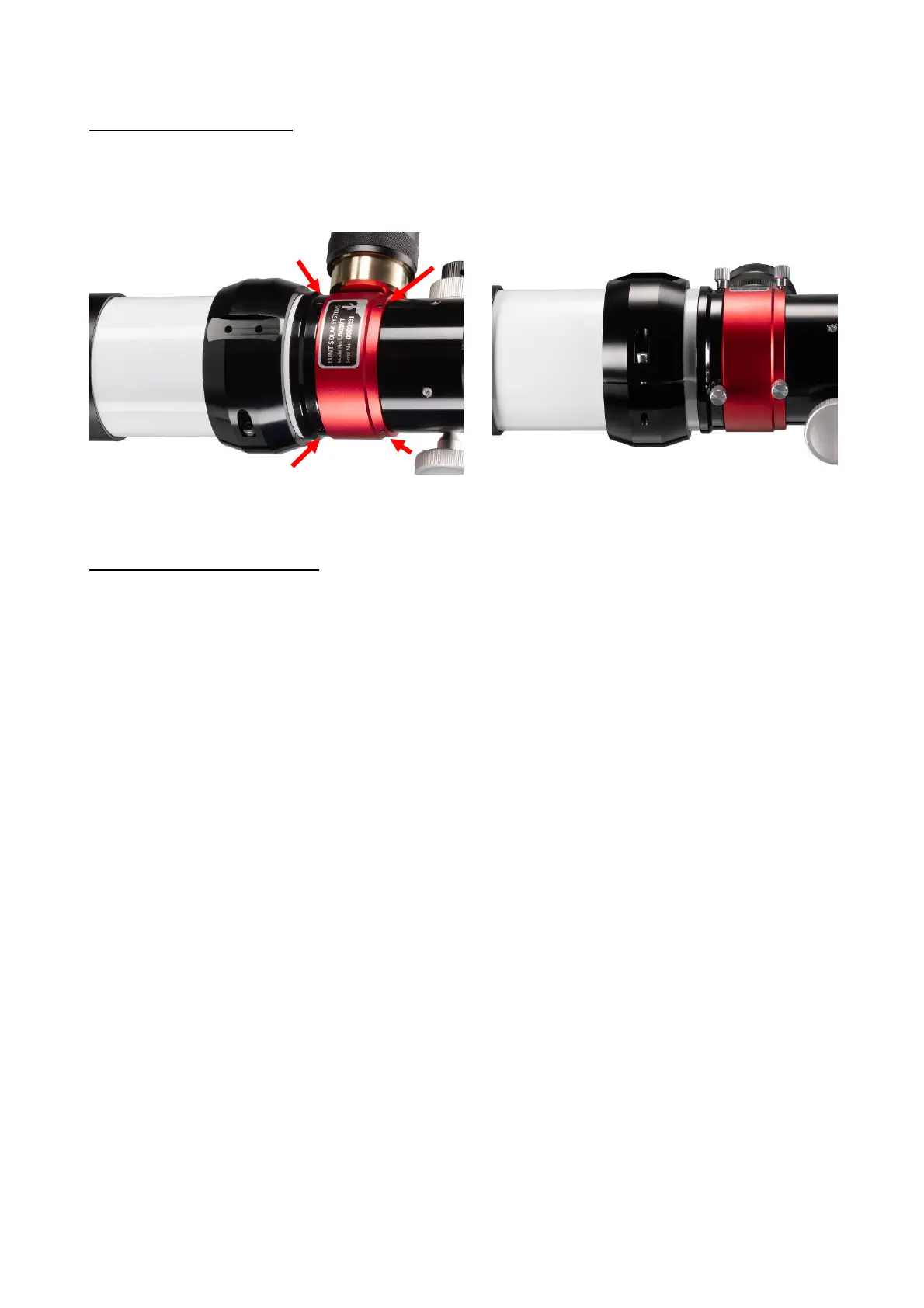
- During shipping some knurled screws at tube or focuser may become loose. Simply tighten the screws.
- Included are 6 knurled screws. The headless screws on the red H-alpha unit can be replaced by these
knurled screws to make it easier to convert the telescope later:
For solar observing in H-alpha:
Safety First!
- Always check any telescope before use for solar observing. Do not use any telescope or filter that
appears to be damaged. Verify that all glass and filters are in place.
- The Blocking Filter diagonal or extension tube must always be used with the Lunt telescope or filter
for solar observing.
For sun observation 60mm of the telescope's aperture is used and the focal length is 420mm. The etalon
with the air pressure tuning provides a bandwidth of <0.7 Angstrom.
Install the LS60MT telescope on a photo tripod or with an additionally available dovetail rail on an
astronomical mount.
Pull the blocking-filter diagonal slide tube out about 50mm. Put the focus tube at about 50% of travel.
Place a ~25mm eyepiece in the focus end so you have the largest field of view to look at. If you do not have
a Sol Searcher you can use the shadow cast by the Sun on the front objective cell against the clamshell.
Center one on the other and you should be close. Look thru the eyepiece. Do you see a fuzzy red ball? If
not, make sure you have removed the dust cap from the front. Try to re-align the Sol Searcher and look
again. After some trial and error the Sun should appear in the eyepiece. Once the Sun is centered now is a
good time to adjust a Sol Searcher.
Focus: It is amazing how many people walk up to a solar telescope and take a quick look thru without ever
focusing. Course focus is achieved by moving the diagonal drawtube in and out (only B1200 or B1800).
Medium focus is achieved using the larger black knobs on either side of the focuser assembly. Fine focus is
achieved with the 10:1 reduction (smaller red knob). The fine focus is often too fine for visual use, but comes
in very handy if you are imaging. Focus so that the edge of the Sun is as sharp as possible.
Tuning: On the side of the scope is a large black cylinder. This cylinder is the tuning system for the H-alpha
filter. Now we will describe how to bring 656.28nm wavelength on band. The black handle of the cylinder
system has a 4 start thread attaching it to the brass cylinder body. Unscrew the black handle completely and
carefully pull the piston from the cylinder. There may be some resistance and a faint pop as the air enters
the cylinder. This is normal. This has reset the system for your altitude. Carefully re-thread the handle onto
the body and engage the threads about one turn. While looking thru the eyepiece gently turn the black
handle onto the cylinder body. There will be little resistance at first, but as the pressure in the cylinder builds
the resistance will increase slightly. As you turn the cylinder you should see features come into view thru the
eyepiece. Continued turning will result in the wavelength shifting thru 656.28nm and detail will begin to
disappear. Fine-tune the cylinder for the best performance.


 To Next Page
 Loading...