GB
43
devices must not be disposed of with house-
hold waste. They may contain substances
that are harmful to the environment and
human health.
Consumers must dispose of waste electrical
devices, spent portable batteries and
rechargeable batteries separately from
household waste at an official collection point
to ensure that these items are processed cor-
rectly. Information on returning these items is
available from the seller. Sellers are required
to accept these items free of charge.
Batteries and rechargeable batteries,
which are not permanently installed in
waste electrical devices, must be
removed prior to disposal and must be
disposed of separately. Lithium batteries and
battery packs in all systems must only be
retuned to a collection point when dis-
charged. Batteries must always be protected
against short circuits by covering the poles
with adhesive tape.
All end users are responsible for deleting any
personal data stored on waste devices prior
to their disposal.
Disposal of the packaging
The packaging consists of cardboard
and correspondingly marked plastics
that can be recycled.
– Make these materials available
for recycling.
Technical data
*) The specified values are emission values and do not necessarily
represent safe workplace values. Although there is a correlation
between emission and immission levels, this cannot be used to
infer whether additional safety measures are necessary or not.
Factors which affect the current immission levels at the work-
place, include the type of room, other sources of noise, e. g. the
number of machines operating and other processes taking place
in the vicinity. Permitted workplace values can differ from coun-
try to country. This information is designed to help the user to
better assess the dangers and risks. Determination of noise
emission values in accordance with EN 60335-2-77.
**) The specified vibration emission value was measured in accord-
ance with a normed test procedure and can be used in order to
compare one tool with another. The specified vibration emission
value can also be used for an introductory evaluation of the
exposure. The vibration emission value may fluctuate from the
specified value during actual use of the power tool. These fluc-
tuations will depend on the way in which the power tool is used.
Try to keep vibrations to a minimum. One method of reducing
the vibration load is, for example, limiting the length of time you
work with the tool. All parts of the operating cycle must be taken
into account for this purpose (for example, also including times
in which the power tool is switched off and times in which it is
switched on, but is running without load). Determination of vibra-
tion emission values in accordance with EN 60335-2-77.
Accessories
Accessories are available from your local
vendor.
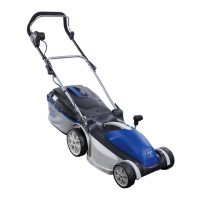
Item number 196062
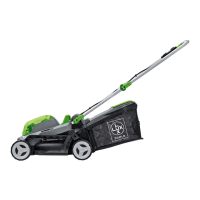
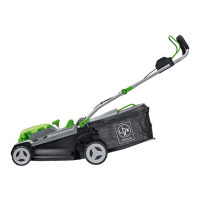
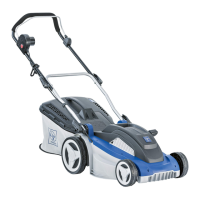
Lawn mower
Idling speed 2800 min
-1
Rated voltage 2× 20 V
Protection class III
Working width 460 mm
Cutting height 25–75 mm
Number of stages 6
Volume of collecting sack 50 l
Sound power level (L
WA
)* 88 dB(A)
(K = 0,94 dB(A))
Sound pressure level
(L
PA
)*
76,6 dB(A)
(K = 3 dB(A))
Vibration** = 2,5 m/s²
(K = 1,5 m/s²)
Weight 23,5 kg
Battery charger
Rated voltage 230 V~, 50 Hz
Rated power 140 W
Charge voltage 20,9 V
Charge current 2,4 A
Protection class II
Rechargeable battery
Battery pack type Li-Ion
Rated voltage
• maximum
• nominal
20 V
18 V
Capacity 4000 mAh
Charging time 120 min
Item
number
Accessory
196052 Battery pack 4 Ah
196054 Battery charger
196055 Battery charger
196053 Battery set with charger
Item number 196062
Rasenmaeher_Akku_196062.book Seite 43 Donnerstag, 5. Dezember 2019 1:26 13


 To Next Page
 Loading...