EasyManua.ls Logo

Lyte LOFT LADDER - User Manual

Lyte LOFT LADDER
2 pages
Print Icon
To Next Page IconTo Next Page
Loading...
GB
INSTRUCTIONS FOR THE INSTALLATION OF ATTIC STAIRS
Please read the instructions carefully to avoid installation problems.
Failure to comply with the installation instructions will render the warranty void.
Point 1. Prepare the opening for the frame installation. IMPORTANT! The ladder should not be attached to dry walls. It is also forbidden
to disassemble the stairs to individual part for the time of installation. In particular, it is forbidden to remove the screws at the tting, which
holds the ladder on the hatch of the stairs. Failure to comply with this provision will render the warranty void and will exclude the
manufacturer's liability for the safety of the product used.
Point 2. Remove the wooden/metal stick from the box. In the Standard model, attach the opening hook to the lock in accordance
with drawing 1 IMPORTANT! Failure to attach the hook poses a threat of the hatch becoming locked during the installation.
Point 3. The frame should be installed using at least 8 screws. Do not press the frame into the opening - the opening should be
slightly larger than the frame. Check the geometry, i.e. the diagonals of the box must be equal. See drawing 4A.
Point 4. Attach two wooden beams to the box (not included) - drawing 3, tie them to the box so that the box protrudes below the ceiling
level. IMPORTANT! Only very strong connections between the beam and the box and beams of appropriate length and strength should be
used to hold the stairs during the installation!
Point 5. Using wedges (not included), face the lower part of the box with the surface of the ceiling, drawing 4B.
Before the installation of the box, check the opening mechanism of the stairs.
Point 6. Before the installation of the stairs, check the diagonals of the frame, drawing 4A. If the frame is not adjacent to the beams,
to which it will be attached, insert wooden strips, which will ensure the rigidity of the frame and insert screws into them - drawung 4C.
Please use at least 8 screws 8x100 mm for permanent installation of the frame (3 on the sides of the frame and at least 1 at the front and at
the back). Spaces between the frame and the opening should be lled with tting foam - drawing 4.
Point 7. When the foam is dry, check the function of the stairs - drawing 5. IMPORTANT! Do not climb the stairs at this stage!
Point 8. To ensure that the ladder functions properly, it should form a straight line when unfolded. The individual elements of the
ladder should be in contact with each other on the whole surface and the lower part of the ladder should be cut so that its weight fully rests
on the oor. To do so, after unfolding the segments of the ladder which do not touch the oor fully and after lowering the hatch, measure
the distances A and B as shown in drawing 6 in a very accurate manner and then mark these distances on the last section of the ladder and
cut along the line joining the designated points.
IMPORTANT! It is forbidden to use the stairs if the ladder has not been cut or has been cut in an improper manner as this causes a risk of
damaging the structure of the stairs and may cause a serious accident during use. The use of stairs with an uncut ladder or a ladder cut in an
inappropriate manner will render the warranty void and will exclude the manufacturer's liability for the safety of the product used.
It is unacceptable to cut the stairs at the height of the step. If such a situation occurs, move the ladder to higher openings tting the ladder
to the hatch and perform subsequent measurements before cutting!
Point 9. If the surface against which the ladder is based is slippery (wooden oors, laminate ooring, ceramic tiles), it is necessary to
glue or nail a rubber strip or another element to reduce the slipperiness to the ladder base. Drawing 8.
Point 10. Checking if the hatch goes down after opening is the last element of assembly verication. The hatch should go down
between 10-40 cm from the ceiling. If it goes down more, please tighten the spring by one link of the chain (once on the right and once on
the left side) and check the descending motion again. The tightening should be performed with particular care with the hatch closed.
Drawing 10. IMPORTANT! In no circumstances may the spring be tightened with the hatch open!
The stairs purchased are covered by a 24-month warranty from the date of purchase. The purchase document constitutes the basis
for making a complaint. Damaged or incomplete stairs may not be installed or used in any event. A complaint should be submitted
immediately if any defects are noticed. Failure to comply with the above will render the warranty void.
IMPORTANT! The Manufacturer reserves the right to introduce design changes and technical innovations without prior notice.
LOFT LADDER
01204 590 232
sales@ladderstore.com

Question and Answer IconNeed help?

Do you have a question about the Lyte LOFT LADDER and is the answer not in the manual?

Summary

Attic Stairs Installation Guide

Prepare Opening and Frame

Prepare the opening for frame installation, ensuring it is slightly larger than the frame and diagonals are equal.

Attach Opening Hook and Beams

Attach the opening hook to the lock for safe operation and secure the box with two wooden beams protruding below ceiling level.

Secure Frame and Rigidity

Install the frame with at least 8 screws. Ensure rigidity by using wooden strips if the frame does not meet attachment beams.

Check and Adjust Ladder Length

Verify ladder functions correctly, forms a straight line, and cut the lower section to rest fully on the floor based on precise measurements.

Improve Ladder Base Grip

Glue or nail a rubber strip to the ladder base if the floor surface is slippery to prevent slippage.

Verify Hatch Descent

Check that the hatch descends 10-40 cm. Tighten the spring by one link if it descends more, with the hatch closed.

Overview

This document provides comprehensive instructions for the installation and maintenance of a loft ladder, designed to facilitate safe and convenient access to attic spaces. The manual emphasizes adherence to specific installation procedures to ensure the product's safety, functionality, and to maintain warranty validity.

Function Description

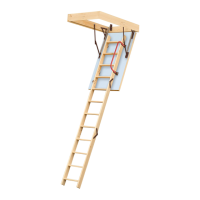
The loft ladder serves as a retractable staircase, allowing users to safely ascend to and descend from an attic or loft area. When not in use, the ladder folds and stores compactly within the ceiling opening, concealed by a hatch. This design maximizes floor space in the living area below while providing ready access to the attic when needed. The system is engineered for stability and ease of operation, with a focus on user safety during both installation and subsequent use.

Usage Features

The loft ladder is designed for practical and safe usage, incorporating several features to enhance its functionality and user experience.

Installation and Setup:

  • Opening Preparation: Before installation, a precise opening must be prepared in the ceiling. The manual explicitly states that the ladder should not be attached to dry walls, highlighting the importance of a structurally sound mounting surface.
  • Frame Installation: The ladder's frame is secured into the prepared opening using a minimum of eight screws (8x100 mm). It's crucial that the opening is slightly larger than the frame to avoid forcing it, and the frame's geometry (diagonals) must be checked to ensure it's square. Wooden beams (not included) are temporarily attached to the box to support it during installation, ensuring it protrudes below the ceiling level. Wedges are used to align the lower part of the box with the ceiling surface.
  • Rigidity and Sealing: If the frame does not sit flush against the supporting beams, wooden strips are inserted to ensure rigidity before securing with screws. Gaps between the frame and the opening are filled with fitting foam to seal the installation, preventing drafts and improving insulation.
  • Hatch Mechanism: The system includes a hatch that conceals the folded ladder. During installation, an opening hook must be attached to the lock to prevent the hatch from becoming inadvertently locked.
  • Ladder Deployment: Once installed and the foam is dry, the ladder's function is checked. It's critical not to climb the stairs at this stage. The ladder should unfold into a straight line, with all segments in full contact with each other.
  • Customization for Fit: A key feature is the ability to customize the ladder's length to perfectly fit the floor height. After unfolding, if the lowest segments do not fully touch the floor, the user must measure distances A and B (as shown in the diagrams) and cut the last section of the ladder along the line connecting these points. This ensures the ladder's weight rests fully on the floor, preventing structural damage and ensuring safety. The manual strictly prohibits cutting the ladder at the height of a step and advises adjusting the ladder to higher openings if this occurs.
  • Anti-Slip Measures: For slippery floor surfaces (e.g., wooden, laminate, ceramic tiles), a rubber strip or similar element should be glued or nailed to the ladder's base to reduce slipperiness, enhancing user safety.
  • Hatch Descent Adjustment: The final step in assembly verification involves checking the hatch's descent after opening. It should descend between 10-40 cm from the ceiling. If it descends more, the spring mechanism needs adjustment by tightening one link of the chain on both sides. This adjustment must be performed with the hatch closed to prevent injury.

Maintenance Features

The loft ladder is designed for durability, but proper maintenance and adherence to usage guidelines are essential for its longevity and safe operation.

  • Structural Integrity Check: Regular checks of the ladder's structural integrity are crucial. The manual explicitly warns against using the stairs if they have not been cut correctly or if any damage is noticed. Improper cutting or damage can compromise the ladder's structure, leading to serious accidents and voiding the warranty.
  • Spring Mechanism Adjustment: The spring mechanism, which controls the hatch's descent, may require occasional adjustment. If the hatch descends too far (more than 40 cm), the springs need to be tightened. This ensures smooth and controlled operation of the hatch.
  • Anti-Slip Element Maintenance: If an anti-slip strip is applied to the ladder's base, it should be regularly inspected for wear and tear. A worn strip should be replaced to maintain effective grip on slippery surfaces.
  • Warranty and Complaint Procedure: The ladder comes with a 24-month warranty from the date of purchase. The purchase document serves as the basis for any complaints. It is imperative not to install or use damaged or incomplete stairs. Any defects must be reported immediately upon discovery. Failure to comply with these provisions will void the warranty.
  • Design Changes: The manufacturer reserves the right to introduce design changes and technical innovations without prior notice. This implies that users should always refer to the latest version of the manual or contact the manufacturer for any updates or specific queries regarding their model.

By following these detailed instructions for installation, usage, and maintenance, users can ensure the safe, efficient, and long-lasting performance of their loft ladder.

Lyte LOFT LADDER Specifications

General IconGeneral
Sections3
HandrailYes
FoldableYes
Max Load330 lbs
Weight Capacity330 lbs
Height8.5 feet
Weight25 kg
TypeAttic ladder