EasyManua.ls Logo

LZR P220 - User Manual

LZR P220
12 pages
Print Icon
To Next Page IconTo Next Page
Loading...
1
LZR
®
-P220
E
R
L
A
U
B
T
Z
E
R
T
I
F
I
Z
I
E
R
U
N
G
N
A
C
H
DIN 18650
E
N
A
B
L
E
S
A
C
C
O
R
D
A
N
C
E
W
I
T
H
EN
SAFETY SENSOR
FOR SECURING THE CLOSING EDGE
ON REVOLVING DOORS
Users Guide
for software version 0300 and more
(refer to tracking label on product)
This user’s guide is an informative document and
can not be seen as a commitment of result.
Question and Answer IconNeed help?

Do you have a question about the LZR P220 and is the answer not in the manual?

Summary

LZR-P220 Safety Sensor Users Guide

DESCRIPTION

Component Identification

Identifies physical parts of the sensor and its mounting bracket.

LED Signal Status

Explains the meaning of different LED colors and flashing patterns for status indication.

Safety and Operational Symbols

Explains common symbols used in the manual for warnings and functions.

SAFETY INFORMATION

Laser Radiation Hazards

Details laser specifications and warnings regarding exposure and safe handling.

Installation and Maintenance Precautions

Lists essential precautions for installation and ongoing maintenance to ensure safety.

MOUNTING INSTRUCTIONS

Mounting Procedure Steps

Step-by-step guide for physically installing the sensor unit and bracket.

WIRING GUIDELINES

New Installation Wiring

Wiring configurations for new installations (NC and NO).

IRIS ON C Retrofit Wiring

Specific wiring instructions for retrofitting the sensor with an IRIS ON C system.

POSITIONING AND TEACH-IN

Sensor Positioning and Beam Adjustment

Instructions for adjusting the sensor's lateral and tilt angles using laser beams.

Teach-In Procedure

Steps to initiate the sensor's learning process for detection and environment adaptation.

REMOTE CONTROL SETTINGS

Field Adjustment Parameters

Details adjustable parameters like field width, height, and uncovered zone.

Mounting Position and Curtain Choice

Options for mounting position and selecting curtain types for optimal detection.

REMOTE CONTROL OPERATION

Basic Remote Control Functions

Explains unlocking, adjusting parameters, and ending sessions via remote control.

Advanced Remote Control Operations

Covers saving, deleting access codes, and restoring factory settings.

TROUBLESHOOTING GUIDE

LED Status Error Indicators

Diagnoses issues based on LED color and flashing patterns.

Sensor Not Responding or Unlocking

Solutions for problems related to remote control response and sensor unlocking.

TECHNICAL SPECIFICATIONS

Device Characteristics

Details technology, detection modes, ranges, and emission characteristics.

Electrical and Physical Properties

Lists supply voltage, power, dimensions, material, and environmental ratings.

Conformity and Standards

Outlines compliance with relevant industry standards and regulations.

Overview

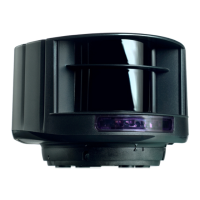
The LZR®-P220 is a safety sensor designed for securing the closing edge on revolving doors. It utilizes laser scanner, time-of-flight measurement technology to detect both motion and presence, ensuring the safe operation of revolving doors. This device is certified according to EN 16005 and DIN 18650, and has been type-tested by TÜV NORD.

Function Description

The sensor emits invisible (IR) and visible laser radiation. The IR laser, with a wavelength of 905 nm and output power less than 0.10 mW, is classified as Class 1 according to IEC 60825-1. The visible laser, with a wavelength of 635 nm and output power less than 1 mW, is classified as Class 2. While the visible laser beams are inactive during normal functioning, they can be activated by the installer for setup and adjustment purposes. It is crucial not to stare into the visible laser beams.

The LZR®-P220 provides a maximum detection range of 5m x 1m (at max. 4m according to EN 16005, DIN 18650). It can detect objects with a remission factor greater than 5% of the IR laser wavelength. The angular resolution is 0.3516°. The minimum detected object size is typically 2.1 cm at 3 m and 3.5 cm at 5 m, which is proportional to the object distance. Test bodies used for conformity include 700 mm x 300 mm x 200 mm (CA according to EN 16005, DIN 18650) and Ø 50 mm at max. 4 m (CB according to DIN 18650).

The sensor's output is a single NO or NC (galvanic isolated - polarity free) output, with a maximum switching voltage of 35 V DC / 24 V AC and a maximum switching current of 80 mA (resistive). The switching time is ton=5 ms; tOFF=5 ms. The input is a 1 optocoupler (galvanic isolated - polarity free) with a maximum contact voltage of 30 V DC (over-voltage protected). The response time for the monitoring input is less than 5 ms.

Important Technical Specifications

  • Technology: Laser scanner, time-of-flight measurement
  • Detection Mode: Motion and presence
  • Max. Detection Range: 5m x 1m (at max. 4m according to EN 16005, DIN 18650)
  • IR Laser: Wavelength 905 nm, output power <0.10 mW (CLASS 1)
  • Visible Laser: Wavelength 635 nm, output power <1 mW (CLASS 2)
  • Supply Voltage: 10-35 V DC @ sensor side
  • Power Consumption: <5 W
  • Response Time: Typ. 80 ms; max. 150 ms
  • Output: 1 output NO or NC (galvanic isolated - polarity free)
  • Protection Degree: IP65
  • Temperature Range: -30 °C to +60 °C if powered; -10 °C to +60 °C unpowered
  • Dimensions: 125 mm (D) x 93 mm (W) x 70 mm (H) (mounting bracket + 14 mm)
  • Material: PC/ASA, black
  • Conformity: EN 12978; EN ISO 13849-1 Pl "d"/ CAT2; IEC/EN 60825-1; IEC/EN 61496-1; IEC/EN 61496-3 ESPE Type 2; IEC/EN 62061 SIL 2; EN 16005; DIN 18650-1

Usage Features

The sensor is designed for easy installation and adjustment. The mounting process involves:

  1. Positioning: The sensor curtain should be positioned alongside the closing edge of the door. An adhesive mounting template helps in correctly positioning the sensor, with a grey area indicating the detection range. The LBA accessory can be used for ceiling mounting.
  2. Drilling: Drill four holes as indicated on the mounting template, and if possible, a hole for the cable. If drilling is not possible, cable conduits on the back of the bracket can be used.
  3. Wiring: The device supports both NC (Normally Closed) and NO (Normally Open) installations. For door control without a test function, red and blue wires can be connected to the power supply without polarity (excluding conformity with DIN 18650 and EN 16005). For IRIS ON C retrofit, a specific cable kit (sold as an accessory) is available.
  4. Mounting: Secure the bracket with four screws to avoid vibrations. Plug the connector, position the cable in the slit, and close the protection cover firmly.
  5. Housing: Position the housing on the bracket and turn the sensor until the two triangles on the housing and bracket are face to face.

LED Signals:

The sensor features multiple LEDs for status indication:

  • Detection LED (bi-colored): Green for no detection, red for detection. It can flash quickly, slowly, or remain solid.
  • Error LED (orange): Indicates an error, can flash or remain solid.
  • Power LED (blue): Indicates power status, can flash or remain solid.

Remote Control Adjustments (Optional):

The sensor can be adjusted using a remote control. To unlock the sensor and activate visible laser beams, press the unlock button on the remote. If the red LED flashes quickly after unlocking, an access code (1 to 4 digits) needs to be entered. To end an adjustment session, always lock the sensor.

Adjustable parameters include:

  • Field Width: Adjustable from 10 cm to 100 cm, with a default of 25 cm. Note that <20 cm does not allow conformity with EN 16005 / DIN 18650.
  • Field Height: Adjustable from 10 cm to 500 cm, with a default of 400 cm. Note that >400 cm does not allow conformity with EN 16005 / DIN 18650.
  • Mounting Position: Can be set for left or right mounting, with or without background.
  • Uncovered Zone: Adjustable from 5 cm to 15 cm, with a default of 7 cm. This setting can be increased in cases of snow, dead leaves, etc.
  • Immunity Filter: Settings for indoor, outdoor low, outdoor med*, and outdoor high. (*at max. 3 m mounting height (EN 16005 / DIN 18650)).
  • Background Tracking: Can be turned off or on.
  • Choice of Curtain: Allows selection of different curtain configurations (A, B, C, D) with varying distances between curtains. The visible laser beams indicate the position of the first curtain.

Teach-in Procedure:

A teach-in procedure is essential after installation, changing sensor position, or when new objects are added or changed in the detection zone. During teach-in, the sensor learns its surroundings and adapts the detection field shape, cutting out objects in the field. The detection field should be free of snow buildups, heavy rain, snowfall, fog, or other moving objects during this process.

Troubleshooting:

The manual provides a comprehensive troubleshooting guide for various issues, including:

  • No blue LED (no power, inverted polarity)
  • Only blue LED on (test input not connected)
  • Detection LED remains green (field too small/deactivated, object size too small)
  • Detection LED remains red (object in field, field touching floor/wall/door)
  • Orange LED flashing and detection LEDs red (no background found, sensor masked)
  • Orange LED on (power supply voltage exceeding limits, sensor exceeding temperature limits, internal error)
  • Sensor not responding to remote control (dead batteries, badly pointed RC, reflective object in proximity)
  • Sensor not unlocking (wrong access code entered)

Maintenance Features

To ensure optimal performance and longevity, the following maintenance practices are recommended:

  • Avoid Extreme Vibrations: Ensure the sensor is securely mounted to prevent vibrations.
  • Keep Front Screens Clear: Do not cover the front screens. Regularly wipe them with a clean and damp cloth. Do not use aggressive cleaning products.
  • Clear Detection Field: Avoid moving objects and light sources in the detection field.
  • Environmental Considerations: Avoid the presence of smoke and fog in the detection field. Prevent condensation.
  • Temperature Management: Avoid exposure to sudden and extreme temperature changes. Keep the sensor permanently powered in environments where the temperature can descend below 0°C.
  • High Pressure Cleaning: Avoid direct exposure to high-pressure cleaning.
  • Warranty: The warranty is void if unauthorized repairs are made or attempted by unauthorized personnel. Only trained and qualified personnel should install and adjust the sensor.

The manufacturer emphasizes that the door system manufacturer is responsible for risk assessment and installation in compliance with applicable regulations and standards. Any other use of the device is outside its permitted purpose and cannot be guaranteed by the manufacturer.

LZR P220 Specifications

General IconGeneral
BrandLZR
ModelP220
CategoryAccessories
LanguageEnglish