
 Need help?
Do you have a question about the M-Audio Code 49 and is the answer not in the manual?
Alerts users to sensitive proprietary data, requiring authorization and non-disclosure agreements.
Introduces the manual's purpose for service technicians and encourages user suggestions.
Specifies conditions for manual transfer, service authorization, liability, and intellectual property rights.
Highlights risks like electric shock/fire and explains hazard warning symbols for voltage and instructions.
States that non-authorized service voids M-Audio warranty and clarifies liability for such repairs.
Specific cautions for safely replacing fuses and internal batteries to prevent fire, explosion, or electrocution.
Detailed guidelines on product usage, environment, cleaning, and when to seek authorized service.
This document serves as a comprehensive service manual for the M-Audio Code 49 [MK43] device, providing essential information for service technicians regarding its operation, maintenance, and repair. It is intended to be used in conjunction with the User Reference Manual to offer a complete understanding of the device's functionality and serviceability.
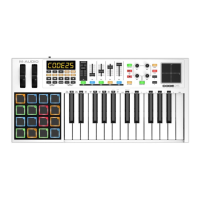
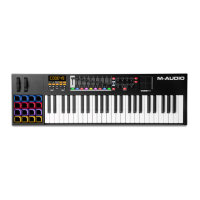
The M-Audio Code 49 is a versatile MIDI controller designed for music production and performance. Its primary function is to provide a tactile interface for controlling various parameters within digital audio workstations (DAWs) and other music software. The device features a 49-key keyboard, which allows for expressive musical input, along with a range of assignable controls that enhance its utility as a performance and production tool.
The Code 49 offers a rich set of usage features that cater to both studio and live applications. The 49-key keyboard is velocity-sensitive, enabling dynamic and nuanced playing. This responsiveness is crucial for capturing the expressiveness of a performance. In addition to the keys, the device incorporates a variety of assignable controls, including knobs, buttons, and faders. These controls can be mapped to different parameters in software, such as volume, pan, filter cutoff, and effects send, providing hands-on control over the sound.
A notable feature is the inclusion of pitch and modulation wheels, which are standard for expressive control over musical parameters. The pitch wheel allows for bending notes up or down, while the modulation wheel can be assigned to control vibrato, tremolo, or other continuous parameters, adding depth and character to performances. The device also includes an XY pad, which offers a unique way to control two parameters simultaneously with a single touch, facilitating intuitive and dynamic manipulation of sound. This is particularly useful for real-time effects control or sound design.
The Code 49 is designed for seamless integration with various software environments. It typically connects to a computer via a USB cable, which also provides power, simplifying setup and reducing cable clutter. The device supports MIDI communication, allowing it to send and receive MIDI data to and from a computer or other MIDI-compatible hardware. This ensures broad compatibility with a wide range of music software and hardware setups.
For enhanced control and feedback, the device incorporates an LCD display, which provides visual information about parameter assignments, values, and other operational details. This display is crucial for navigating menus and configuring the controller without constantly referring to a computer screen. The presence of multiple buttons, including dedicated transport controls (play, stop, record), further streamlines the workflow, allowing users to control their DAW directly from the device.
The assignable nature of its controls means that users can customize the Code 49 to suit their specific needs and preferences. This flexibility makes it a powerful tool for various musical genres and production styles. Whether it's controlling virtual instruments, mixing tracks, or triggering samples, the device provides a comprehensive set of tools for creative expression.
Maintaining the M-Audio Code 49 involves several aspects to ensure its longevity and optimal performance. The manual emphasizes the importance of proper power source connection, advising users to connect the product only to the power supply described in the operating instructions or marked on the product. This prevents electrical damage and ensures safe operation.
Protection of the AC power supply cord is also highlighted, with instructions to place cords such that they are not stepped on or subjected to pressure from other objects. This helps prevent damage to the cord, which could lead to electrical hazards or device malfunction. For periods of non-use, the manual recommends unplugging the AC power supply cord from the outlet, a practice that conserves energy and protects the device from power surges.
Environmental considerations are crucial for maintenance. Users are warned against allowing liquids or foreign objects to fall into the product's openings, as this can cause internal damage or electrical shorts. The device should not be used near water or in moist environments, and it should be kept away from heat sources such as stoves, radiators, or other heat-producing equipment. Adequate ventilation is also essential to prevent overheating, which can damage internal components.
Cleaning the device should be done as recommended by the manufacturer, typically involving a soft, dry cloth to wipe down surfaces. For any service beyond routine cleaning or user-level upkeep, the manual directs users to an authorized service center. This is particularly important for situations involving liquid spills, exposure to excessive moisture, damaged power cords, inappropriate changes in performance, or damage to the enclosure.
The manual also includes specific warnings regarding replaceable components like fuses and internal batteries. For fuses, it cautions against incorrect replacement, emphasizing the use of the same type or an equivalent recommended by the manufacturer to prevent fire or electrocution. Similarly, for internal batteries, it warns of explosion danger if incorrectly replaced and advises using the same or equivalent type, along with proper disposal according to manufacturer instructions.
The document explicitly states that repairs performed by unauthorized personnel will void the M-Audio warranty, underscoring the importance of professional service. It also clarifies that the manual does not authorize recipients to compete with M-Audio distributors or authorized service centers in providing repair services. All unauthorized repairs are performed at the sole risk of the individual or entity, with M-Audio disclaiming any liability for such work. This ensures that complex repairs are handled by qualified technicians, preserving the device's integrity and performance.
 General
| MIDI-keyboard number of keys | 49 keys |
|---|---|
| Product color | White |
| Pitch bend wheel | Yes |
| Interface | USB |
| Power source type | - |



 To Next Page